
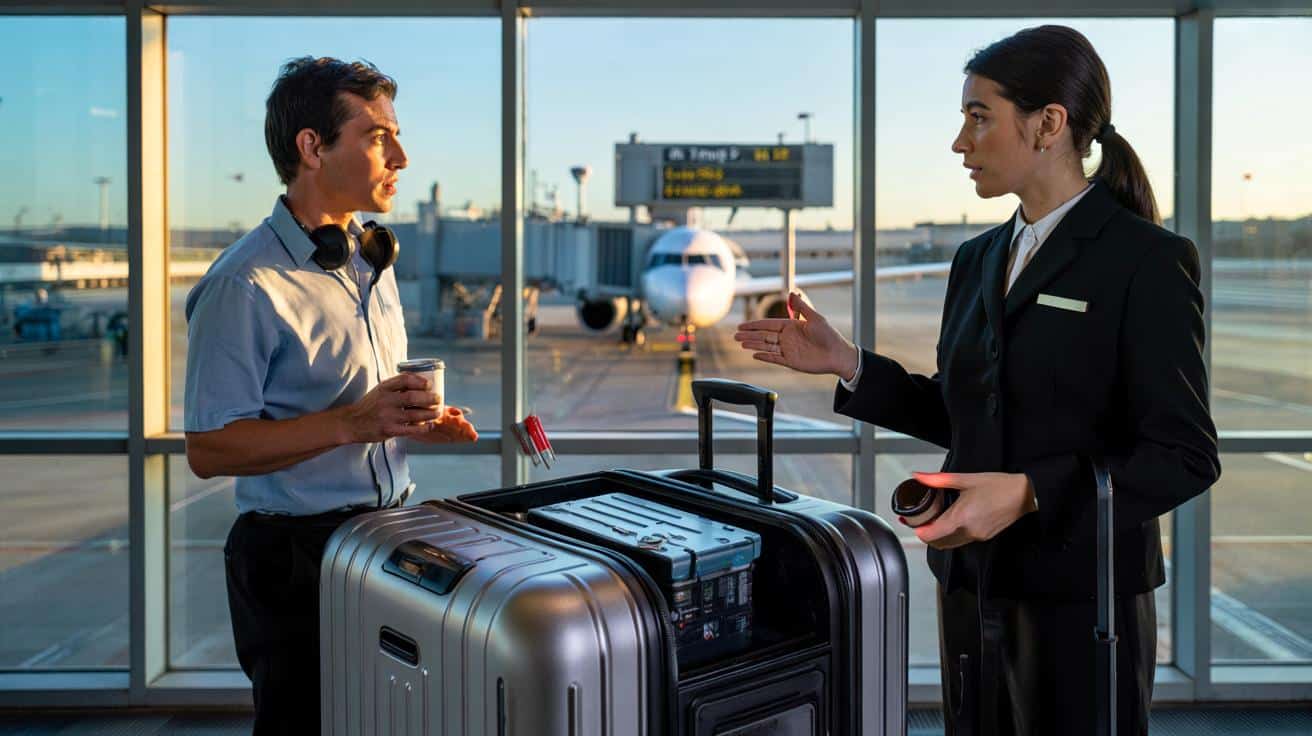
The new trap isn’t a passport issue or liquids at security, it’s your suitcase itself. Not the weight. Not the wheels. The battery. One simple oversight with “smart” luggage can stop your holiday at the gate, and the worst part is many travellers think they’re doing everything right. A sleek case, a charged phone, a quick boarding selfie. Then the gate agent says no. You don’t fly.
She stood by the jet bridge at Heathrow, the kind of traveller we all recognise: headphones on, coffee in hand, a brushed-aluminium suitcase that looked like it came with its own podcast. The queue surged, screens blinked, and the agent’s smile was unwavering until it wasn’t; the case had a fixed power bank, and the airline couldn’t take it into the hold or the cabin without the battery removed. *It felt like watching a tiny drama unfold in slow motion.* Bags were shuffled, zips tugged, calls made. The plane didn’t wait. Then the gate agent shook her head.
The rule nobody reads until it bites
Airlines love order, and lithium batteries do not, which is why the biggest luggage mistake today is turning up with a **smart suitcase with a non‑removable battery** and expecting a shrug and a wink; most carriers follow IATA guidance that says lithium batteries must be removable if the bag goes in the hold, and even in the cabin the power source needs to be switched off and carried safely, so the quiet revolution in luggage has created a quiet minefield for rushed travellers, and the rules aren’t hidden so much as ignored in the pre-flight blur, which is exactly when they can wreck your journey.
Ask Tom from Manchester, who messaged me after missing a city break to Porto because his smart case had a sealed power pack; staff at the gate explained it couldn’t be checked, the cabin was full, and the battery didn’t come out, which left him with a choice that wasn’t a choice at all, so he was rebooked on a later flight at extra cost while his friends posted sardines and sunset shots without him, and he admitted he’d never once checked his case’s battery design, because the brand’s ads made everything look frictionless and fun.
The logic isn’t petty; when lithium cells fail, they can run hot and fast, and flight crews train for it in the cabin where a smoking phone or power bank can be contained, which is impossible in a sealed hold where an unseen fire threatens everyone, and that is why a gate agent doesn’t have wiggle room with a dead-simple policy, and why you may get **denied boarding** if you won’t remove or surrender the battery, as regulators from the CAA to the FAA cite hundreds of lithium incidents over the past decade, with runaway events that start as a puff and turn into a panic.
How to dodge the smart-bag trap
Give yourself five quiet minutes before you pack and do a mini‑audit: find the battery door on your case, check that it opens without drama, and practice removing the pack so you know the angle and the tiny clip that always fights back, then bag the power bank in a small pouch you’ll put in your personal item for the flight, and take a quick photo of the removal step in case a flustered agent asks how it comes out, because proof plus calm hands beat a queue’s energy every time.
Watch the sneaky habits that pile risk onto risk, like throwing spare power banks into your checked suitcase “just this once,” or leaving e‑cigarettes and drones with batteries in the hold where they’re not allowed, and read your airline’s baggage page even if it’s the driest corner of the internet, because brands vary on size, weight, and whether the smart case can ride in the overhead, and We’ve all had that moment where the airport churns our brain to mush and we cut corners to get moving, so breathe, slow down, and keep the electrics where crew can see them.
Let’s be honest: nobody actually does that every day.
“If we can’t remove the battery, we can’t board the bag,” a UK airline safety manager told me, “and if the cabin is full, we can’t take the case at all — the risk doesn’t care how stylish it looks.”
- Open the battery flap and remove the cell before you leave for the airport.
- Put the cell and any spare power banks in your hand luggage, switched off.
- Carry a tiny screwdriver if your case uses one of those awkward panels.
- Check airline rules the night before; screenshot the battery guidance.
- Arrive early enough to swap bags or buy a basic cabin case if needed.
Why this rule won’t change soon
Airlines and regulators see what we don’t: cabin crews dousing a smoking battery with water or halon, pilots turning back because of a smell that won’t fade, and investigations that point to one small cell that ran hot behind a lining, so the smart money is on stricter clarity rather than relaxed rules, and the only way around it is better design with fully removable packs or no batteries at all, which is why many brands now brag about pop‑out power modules and magnetic doors you can flip with one hand, yet the older cases still roll, and they still turn up at gates where rules meet reality.
We don’t need fear, we need habits, because a calm two‑step — remove the battery, keep it in the cabin — is faster than the drama of pleading at a jet bridge, and the culture will catch up as travellers share stories, influencers push better checklists, and brands stop hiding the battery door behind pretty panels, as long as we stop treating safety rules like small print and start treating them like seatbelts, and yes, a backpack and a simple carry‑on with no electrics still wins most days, even if the Instagram shot looks less glossy.
The baggage mistake that bans you isn’t about attitude or outfits, it’s about physics in a pressurised tube where a battery needs a place the crew can reach, and that’s not a hill to argue on with a plane full of people who want to get home, so stash the electrics up top, keep the sparks where we can see them, and fly.
| Key point | Detail | Interest for the reader |
|---|---|---|
| Smart-bag battery rules | Batteries must be removable; cells travel in the cabin, switched off | Prevents a last‑minute gate refusal and trip disruption |
| Lithium risk in the hold | Crew can’t access a burning battery in checked luggage | Explains the “why” behind strict policies |
| Practical prep | Test removal, carry a pouch and tiny screwdriver, screenshot rules | Simple steps that turn stress into control |
FAQ :
- Can a smart suitcase go in the cabin if the battery stays inside?Only if the battery is removable and you take it out when asked; many airlines want the cell removed and carried separately even when the bag rides overhead.
- What if my battery is built in and can’t be removed?That bag may be refused at the gate or check‑in; you’ll be told to leave it, swap luggage, or not board, and you could face fees or a missed flight.
- Are power banks allowed in checked baggage?No. Power banks and spare lithium batteries must go in hand luggage, switched off and protected from short circuits.
- How big a battery is too big for air travel?Most airlines cap power banks at 100 Wh without prior approval; up to 160 Wh often needs airline consent, and anything larger is typically banned for passengers.
- Do all airlines follow the same smart-luggage policy?Broadly yes under IATA guidance, yet the wording and enforcement vary; always check your carrier’s baggage page and keep a screenshot.







Never knew non-removable batteries could get you denied boarding. Thanks for the clear breakdown and the mini-audit tips; screenshotting the airline rules tonite.
Is this realy enforced consistently? I’ve flown twice with a smart case and no one cared. Feels like a gotcha policy that depends on who you meet at the gate.