
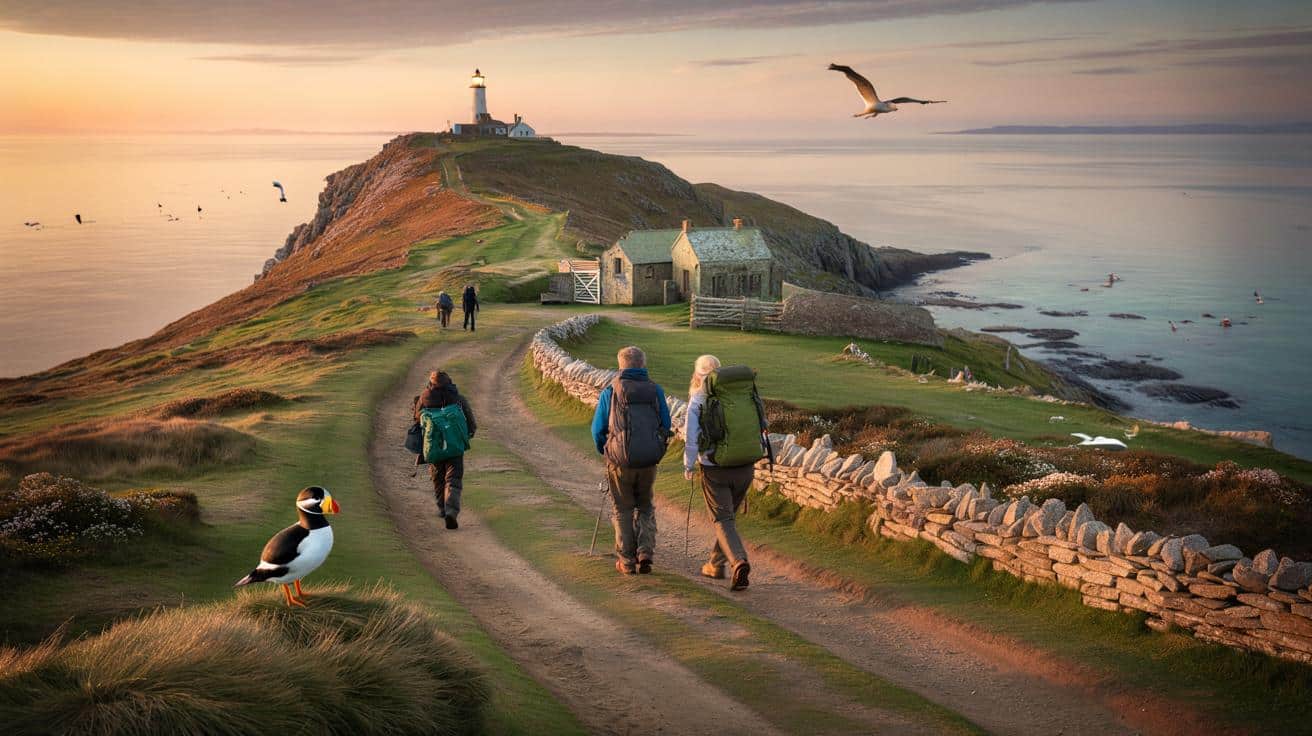
There’s a sliver of British rock where engines don’t growl, streets don’t hurry, and schedules bend to the wind and tide. On this car-free island, three miles long and half a mile wide, the modern world keeps missing its ferry.
No honking, no taxis, just seabirds wheeling and a wind that sounded like a long inhale. Somewhere up the slope, a bell clinked from the tiny church. Boots scuffed the track. A child pointed at a shag on a buoy as if it were a dragon.
On Lundy, the silence isn’t empty. It’s thick with detail—salt on lips, ponies grazing between granite walls, a pub door with paint worn smooth by a thousand palms. You look up and the sky keeps going. Then you notice the stunning absence of cars. And something loosens.
The old lighthouse blinks its steady eye, and you feel time tilt. The island isn’t slow. It’s different.
Where engines fall silent and the days go long
Lundy sits in the Bristol Channel like a sturdy table set for gulls and cloud-watching. The first thing you notice is how sound behaves without traffic. Footsteps seem louder, but conversations go softer. A farmer’s Land Rover putters only for supplies; visitors walk. You sense the old rhythms quickly—shop in the morning, stomp the coastal path by noon, a pint as the sun drops into salmon-coloured water.
There are only a few dozen people who call this island home all year. In summer, the **MS Oldenburg** delivers day-trippers and overnighters in packets: smiles, rucksacks, binoculars. In winter, a helicopter thrum replaces boat chatter. The island’s heartbeat stays even. Puffins stitch the air in spring. Seals loaf on rocks like oversized commas. The **Marine Conservation Zone** here holds the sea in a kind of quiet trust, and visibility underwater sometimes feels like another kind of sky.
Car-free isn’t a quirk; it changes how you move, where you look, what you remember. Without engines, distances shrink and details bloom. You clock the three miles from the jetty to the north cliffs by the stride, not the speedometer. Old milestones still stand, as if they’re in on the joke. You’ll find the village in the middle, with a tiny shop, a phone box, and the **Marisco Tavern**, which becomes a living room for anyone with tired calves and salt in their hair.
How to slip into Lundy time without forcing it
Start with your feet. Good boots make the island feel smaller, and a wool hat is worth its space even in June. The ferry rocks when the Channel flexes, so keep a hand free climbing the steel steps at the jetty. Book accommodation early; lighthouse cottages and the castle rooms get snapped up. Bring a paperback you actually want to finish and a torch for the night walks. The stars here aren’t shy.
Weather writes the rules. Some sailings sway, some don’t sail at all. Build a cushion day around your trip, not because you’re soft, but because the Atlantic doesn’t check your calendar. The shop holds basics and a few lovely surprises, yet pack what you’d miss at 10pm. Card machines usually work, until they don’t. Cash won’t go out of fashion on a rock like this. Let your phone sulk in your pocket.
Pick one simple ritual and repeat it. Same bench at dusk. Same path past the Old Light in the morning. Routine is the secret wick that makes this place glow.
We’ve all had that moment when life shouts; Lundy answers back in a whisper you can finally hear.
- Best months: April–June for puffins and wildflowers; September for glassy calm and warm seas.
- Getting there: seasonal ferry from Ilfracombe or Bideford; winter helicopter from the mainland.
- What to bring: layers, boots, torch, a book, a spare battery, a small first-aid kit.
- Good to know: Wi‑Fi is patchy by design; sunsets are not.
Stories the island tells when you slow down
One afternoon I watched a red postbox swallow a card with a Lundy stamp sporting a puffin. The post leaves when the tide agrees, which feels right. A group of climbers ghosted along the granite like spiders, while a ranger pointed out Soay sheep and a seal pup with a whiskery grin. I counted steps up the Old Light, then sat on the turf and let the wind scrub the week off me.
There’s history under your boots. Pirates, a castle ruin, shipwreck tales, and a century of stubborn islanders who wired up electricity and painted windows green against the salt. The village keeps practical hours: the shop chalks its opening times on a board, the tavern serves hot pies and stories. Let’s be honest: nobody really does that every day. Yet here, you might. You can walk the length of Lundy before lunch and feel like you’ve done something worthy with your breath.
Tiny rules keep the calm intact. Dogs stay home to protect the wildlife. Drones sit in bags. Paths nip around nesting spots because puffins were here first. And yes, cars are out—not as a gimmick, but as a promise. *Time doesn’t run here; it drifts.* People forget their wristwatch and listen for bells, gulls, and the page-turning sound of wind through grass.
What lingers long after the boat pulls away
The mainland arrives with noise and notifications. Your legs remember the climbs, and your pockets smell faintly of damp rope and heather. You might find yourself keeping odd little habits: looking up more, unrolling conversations without glancing at a screen, walking the long way home. Lundy flips something you didn’t know needed flipping.
It’s a place that makes room inside your day. Not dramatic, not staged—just an old rhythm that still fits modern legs. Friends ask what you did there, and you find yourself describing the sound of no cars and the feel of long grass against your knees. Share that. Or better: bring them. There’s an island in the Bristol Channel where time stands still just long enough for you to notice that you can, too.
| Key point | Detail | Interest for the reader |
|---|---|---|
| Car-free reality | No private vehicles; you walk everywhere on tracks and clifftop paths | Peaceful soundscape, slower pace, more detailed memories |
| Getting there | Summer ferries from Ilfracombe/Bideford; winter helicopter service | Plan with weather in mind, build buffer days, pack smart |
| Stay the night | Lighthouse cottages, castle rooms, simple campsite managed by Landmark Trust | Immersive dusk and dark skies you won’t get on a day trip |
FAQ :
- Where exactly is this “forgotten” island?In the Bristol Channel, about 12 miles off the Devon coast, roughly between Ilfracombe and Hartland.
- Are cars banned completely?Visitors can’t bring cars. Staff use a few utility vehicles for essentials, and everyone else walks.
- How long should I stay?A single night changes the feel of the place; two or three nights let you loop the island without rushing.
- Is it suitable for children?Yes, if they like walking and wildlife. Keep a close eye near cliffs and respect marked paths.
- Will my phone work?Patchy at best. Treat any 4G as a bonus and download maps or podcasts before you sail.






No cars, just puffins and pints? Take my boots already 🙂
Calling it “forgotten” feels a bit PR-ish—between the ferry, helicopter and Insta posts, is it really off-grid? Also, how strict is the no-car rule if staff still use Land Rovers?