
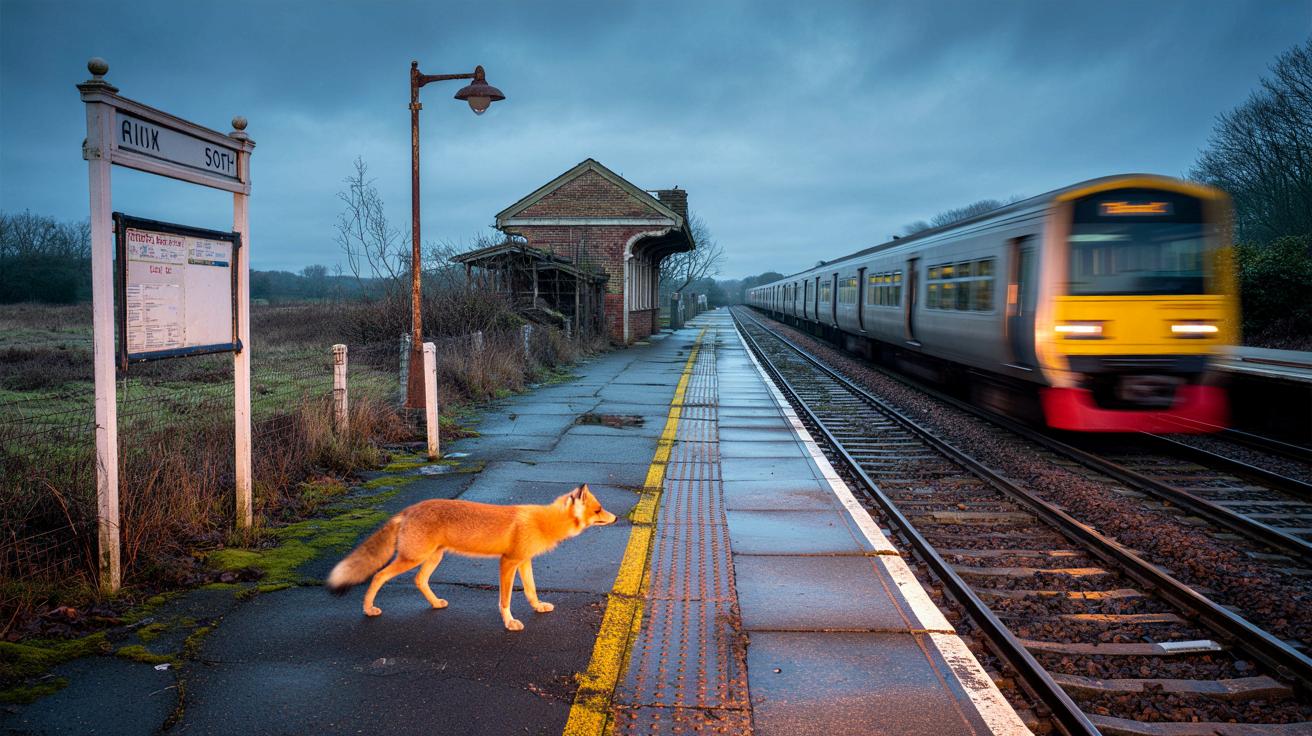
A silent platform, two crumbling shelters, and rails that still hum with passing trains. A place designed for crowds, forgotten by time. The ‘ghost’ station that hasn’t welcomed a single passenger in half a century is still there, hiding in plain sight.
A concrete island in the dusk, bleached by weather and waiting for no one. We slowed on a signal, the driver’s cab light cast a soft cone, and a fox trotted along the edge of the platform as if it owned the lease.
In the quiet, you clock everything: enamel signposts with no names, a rusted lamppost leaning like a tired sentry, the outline of a ticket office that’s now just brick and bramble. My carriage mates were buried in their phones. I pressed my forehead to the glass and held my breath.
We’ve all had that moment when a place tugs at you and you don’t entirely know why. For me, it started there, on a cold Tuesday. A station built for strangers, and nobody left to arrive.
What a ghost station feels like up close
The first thing you notice is the sound. Not silence, exactly, but the low, constant fizz of mains power somewhere, the choral rush of wind on ballast, the hurried bassline of a freight in the distance. Then the rhythms the railway leaves behind: paint lifted by sun, a timetable frame with nothing to say, puddles stippled by last night’s rain.
I came back by day and walked the public footpath that skirts the cutting. A couple in muddy boots ambled past with a collie and didn’t look twice. A kestrel hung in the air over the far embankment. There’s an odd dignity to these places—no drama, no collapse—just a long, stubborn pause. The platform edges are scalloped by frost, the old fencing patched with wire and goodwill.
Why does it stick? Maybe because the station isn’t truly gone. The line is still live, trains skim through without a glance, the mirrors and signal posts still do their jobs. That tension—open rails, closed doors—brings the past within touching distance. You can picture a porter’s cap, a pram, the clack of a clipper on cardboard tickets. And you can see how quickly habit becomes history when no one turns up for the 08:12 anymore.
How to explore—safely, legally, and with care
If you go looking, start with a map and a forum thread. There are heritage groups—quietly brilliant people—who log disused platforms and the paths that run near them. Stick to public rights of way and open viewpoints. Bring curiosity, not bolt cutters. The rails are live, the land is private, and the safest vantage points are often the prettiest anyway.
Let’s be honest: nobody really does that every day. So make it simple. Choose one spot near where you already are. Go on a Sunday morning with a coffee in hand. Notice the detail: a faded warning stencil, a drain cover stamped with a long-vanished company’s name. That’s where these places speak, in the things we usually walk past on the way to somewhere else.
“A closed station is like a paused sentence,” a local rail volunteer told me, “and the line keeps finishing it every ten minutes.”
There are pitfalls. Don’t trespass for a better photo. Don’t share exact access notes if it risks a farmer’s gate being lifted off its hinges next weekend. If you want to get closer, book a guided tour at a recognised ghost site—Down Street or Aldwych in London run occasional visits—and learn from people who genuinely care.
- View from public land only
- Keep dogs on leads near livestock and lines
- Leave nothing, take only photos and time
- Support local heritage groups before you post
Why these empty platforms still matter
We talk about trains as motion, but stations are the real anchors. When one slips out of use, the map you carry in your head shifts a little. Villages tilt towards car parks; habits pivot to the bypass. A ghost station is the outline of a choice made long ago—and a reminder that infrastructure is never neutral.
There’s also the simple pulse of story. A locked waiting room with a tiled floor holds a thousand mornings on wet wool coats. A bricked-up arch tells you someone once expected a crowd. *I stood on the public footpath, breathed out, and felt the present tense soften.* That doesn’t make me nostalgic for soot and semaphore. It makes me curious about what we keep, and why.
Some will reopen. Okehampton did. Lea Bridge did. Others will fade into nettles and live on in drone footage and memory. I don’t think you need to be a train person to care. You just need to have stood somewhere that once held people together, and felt the space noticing you back.
There’s a practical thread here too. These places can unlock future transport with fewer rows than starting from scratch. Platforms exist. Alignments exist. Communities exist. The cost is still real, and so are the politics, yet re-using bones beats pouring new concrete in new fields. All that from a platform with frost-bitten paint and a fox that walks the yellow line like a tightrope.
We say “ghost” because it feels right. Shapes without function. Names that still show up in attic photographs and inherited diaries. The joke is that the living network is right beside them, roaring past every hour. If you ever want to feel history and now, same track, different lanes—stand there a while. It gets under your skin.
| Key point | Detail | Interest for the reader |
|---|---|---|
| Ghost stations are everywhere | Hundreds of closed UK platforms sit beside live rails, from rural halts to bricked-up city stops | There’s likely one within an hour of you—an easy, intriguing micro-adventure |
| Look, don’t trespass | Use public footpaths, heritage tours, and community guides for safe access | Stay legal and still get the best views and stories |
| Past can power the future | Reusing old alignments and platforms can cut costs and controversy | How a ghost station near you might one day come back to life |
FAQ :
- What exactly is a “ghost” station?A closed or mothballed station where trains may still pass, but passenger services no longer stop.
- Can I visit one without trespassing?Yes—many are visible from public roads or footpaths. Some offer guided tours via heritage groups.
- Are any ghost stations reopening?Yes. Recent reopenings like Okehampton and Lea Bridge show there’s appetite when demand and funding align.
- Is it safe to explore near the tracks?From public land, yes. Never enter the railway boundary or ignore signage. Trains are quiet and fast.
- Why do these places feel so powerful?They hold layers: routine turned memory, community habits reshaped, and the eerie duet of motion and pause.






Chilling piece—felt like standing there in the dusk.
Ghost station? More like an introvert platform avoiding crowds for half a century. But how do you verify its been 50 years, not 49? Sources would be gr8.