
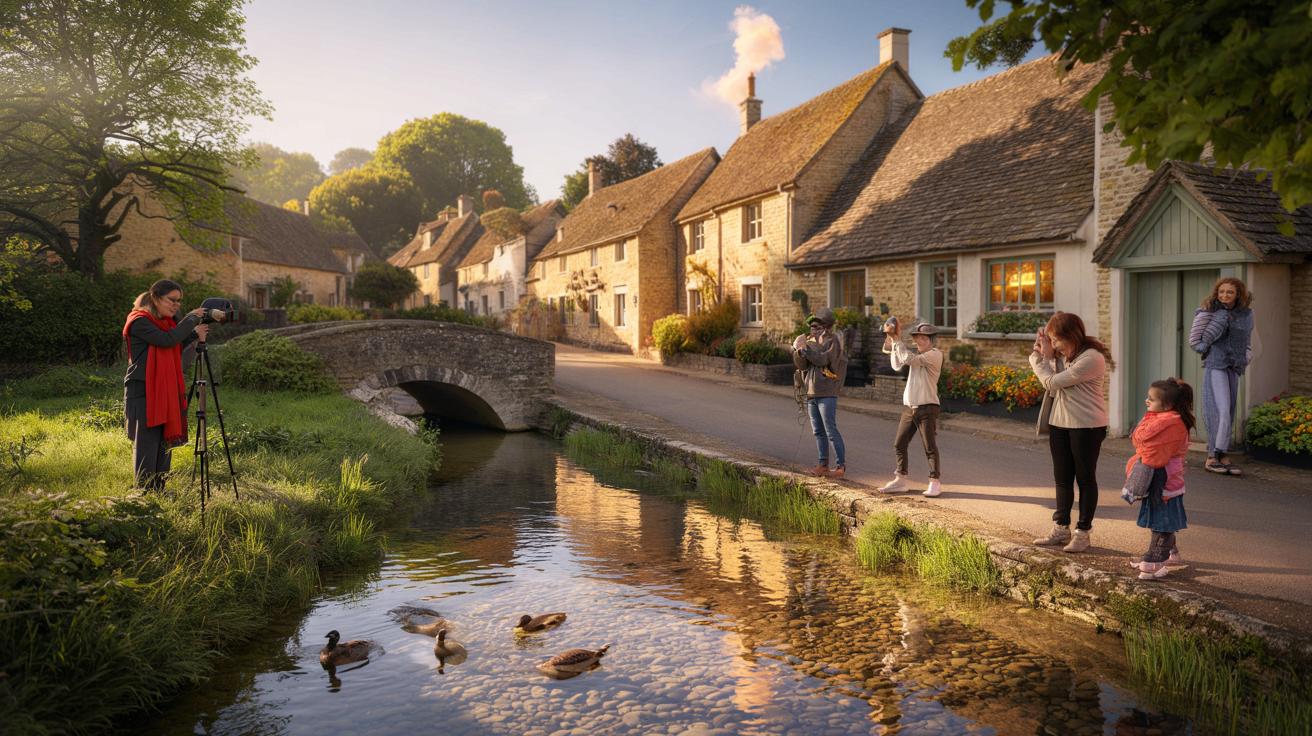
Thousands of day-trippers, influencers and curious families are tramping down one narrow lane in the Cotswolds, as a postcard-perfect hamlet becomes an unlikely global magnet. The locals are proud. They’re also tired. And the question everyone whispers over a takeaway coffee is simple: why here?
A coach door sighs open and the quiet is gone, replaced by the rustle of padded coats and the soft clatter of phone cases. Morning light hits the stone just right, turning those honeyed cottages the colour of toast. You can smell bacon from a pub kitchen and damp meadow from the river.
A woman in a red scarf positions her partner against a lintel, then wrangles a tripod like a fishing rod. A resident waves to a child and ducks back through a painted door. I stand beside the stream and feel the tug of that old English myth: ducks, low bridges, moss on slate, time behaving itself for once.
It’s not just the cottages.
What’s really drawing the crowds
Most people who come here will use the same word first: **Arlington Row**. It’s a row of 14th-century weavers’ cottages that looks like a film set left behind by a production crew that never existed. The **River Coln** slides by so clearly you can count the pebbles. A bend in the lane creates a perfect stage, which is half the story. The other half is the picture that has circled the globe on phone screens and in travel guides for years.
There’s a snippet of trivia that travels with it. Arlington Row has even appeared in a British passport design, which did more for its fame than any press release. Once that image stuck, the rest followed: sunrise brides in trainers, students on Eurail passes, retirees from Kent making a loop with friends. I watched a young couple from Singapore pose for pre-wedding shots next to a fishing sign, laughing as a duck photobombed every frame. The coach driver counted forty-seven back on board and grinned, like he’d seen it all before.
What’s happening isn’t mysterious. It’s the compression of a whole idea of England into one bend in one village. People come to feel gentleness you can’t stream. Algorithms reward those warm limestone tones. Post-pandemic, short escapes with clear symbols feel safer than sprawling holidays with logistics and risk. Add a trout farm, a pub fire, and a walking loop that takes half an hour, and you’ve got frictionless romance. *The truth sits somewhere in that quiet between postcards and real life.*
How to visit without ruining the magic
The simplest trick is the oldest: change the hour. Arrive before 8am and you’ll share the lane with dog-walkers and milk vans. Drift in after 4pm and you’ll catch the softer light and the last birdsong while the coaches are long gone. Park at the **Bibury Trout Farm** or in the signed village car park, then walk a gentle loop: footbridge across the river, up past Arlington Row, around Rack Isle, through the churchyard, and back via the meadow. It takes 25–40 minutes if you stop often, which you will.
Big mistakes are small things done at once. Tripods in doorways, drones over gardens, voices that bounce off stone like a cracked bell. Buy a coffee where you take your photo. Don’t lean against windows unless it’s your window. Keep to the path next to the stream and let prams pass first. We’ve all had that moment when a place feels too good to be true and you want to hold it a second longer. Let the residents keep their seconds too. Let’s be honest: no one actually does that every day.
A shopkeeper told me how it feels at both ends of the clock, and why the middle swells into chaos.
“At seven it’s the village I grew up in. By eleven it’s a catwalk, which is fine if people remember it’s still our street.”
If you want a calmer experience, spread out by taste: not just the lane, but the meadow and church bench, the far footpath to Ablington, the cosy corner table where you can hear the kettle.
- Best light: sunrise or the hour before dusk
- Parking: Trout Farm car park fills by late morning in high summer
- Public transport: train to Kemble, 25-minute taxi to the village
- Food stops: The Swan’s dining room, The Catherine Wheel, Trout Farm deli
- Nearby walks: Coln St Aldwyns loop, Rack Isle boardwalk, Ablington footpath
- Etiquette: stay on paths, keep dogs on leads near meadow birds
What this tiny village is telling us
Places like this survive because they are real and a little fragile, not because they are perfect. The draw is deeper than a pretty picture. It’s a longing for somewhere that still slows you down, where you can hear your own shoes on stone and a river thinking out loud. That makes the village both a sanctuary and a stage.
It also shows how travel has changed. Micro-escapes win the weekend. Social feeds act like travel agents with better lighting. Villages become brands whether they want to or not. The trick for all of us — travellers, locals, councils — is to add kindness to the itinerary. Small courtesies carry weight in tight spaces. A short hello can soften a hundred shutters.
If you go, remember why you’re there. Not to collect a trophy, but to let a quiet lane collect you. Share a bench. Ask someone for the story behind a lintel. The Cotswolds won’t vanish if you step off the exact Instagram angle. It might open up. And the tiny village at the centre of this rush might breathe a little easier.
| Key point | Detail | Interest for the reader |
|---|---|---|
| Beat the rush | Arrive before 8am or after 4pm for calm light and fewer crowds | Better photos, kinder experience, less stress |
| Walk the loop | Bridge — Arlington Row — Rack Isle — churchyard — meadow | A gentle route that captures the essence in 30–40 minutes |
| Think beyond the lane | Explore Ablington and Coln St Aldwyns, support village cafés and pubs | Richer day out and a positive footprint in the community |
FAQ :
- Where exactly is this “tiny village” in the Cotswolds?It’s Bibury, on the River Coln in Gloucestershire, roughly 15 minutes from Cirencester and within the Cotswolds Area of Outstanding Natural Beauty.
- Why has Bibury become so famous?Images of Arlington Row went global through social media and even appeared in a British passport design, turning a quiet lane into an international icon.
- When is the best time to visit?Early mornings and late afternoons on weekdays. Spring and autumn bring softer light and fewer tour coaches than peak summer.
- Can I get there without a car?Yes. Take a Great Western Railway train from London Paddington to Kemble, then a 25-minute taxi to the village. Buses run to nearby Cirencester, with connections varying by season.
- Is there more to do than take photos?Plenty. Walk the meadow paths, visit the historic church, picnic by the river, try fresh trout at the farm, and explore neighbouring villages like Coln St Aldwyns or **Bourton-on-the-Water** for a contrast.







Visited at sunrise last year and the light on Arlington Row really did feel like a film set. Arriving before the coaches made all the difference—just dog walkers, birdsong, and that river whisper. Thanks for the gentle etiquette reminders; small courtesies go a long way.