
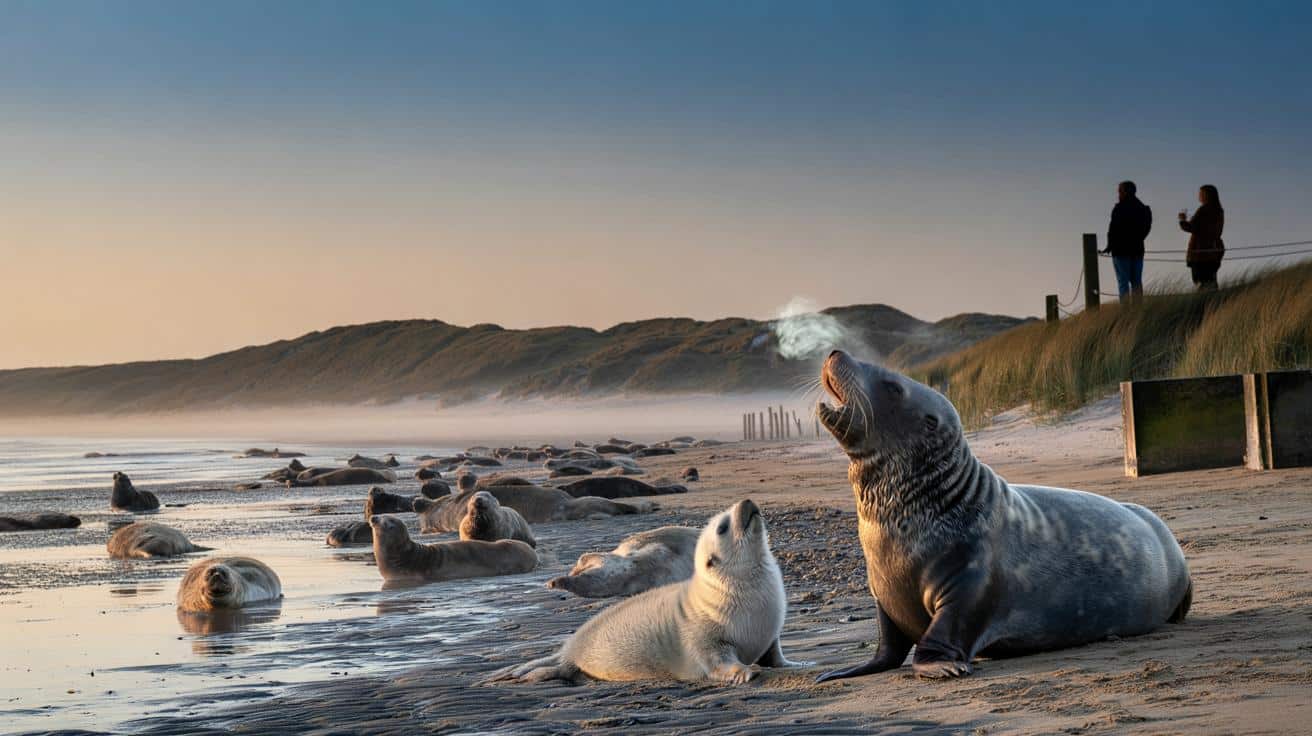
A string of low, haunting notes drifting over the dunes has worried dog walkers and delighted night fishermen along the Norfolk coast. Some swear it’s a choir. Others say it’s ghostly. The truth is far stranger and more beautiful: the seals are “singing”, and there’s a reason we can hear them so clearly right now.
A couple stood on the ridge at Horsey Gap, mugs warming their hands, listening as a long moan rose from the dark line of surf. Another voice answered, closer, a hollow vowel that seemed to roll under your ribs. I felt it through my coat. For a moment the beach felt like a church without walls, soft sand for pews, the tide for an organ pedal.
Down on the shingle, something splashed, then stilled. The sound carried again, older this time, a baritone groan, followed by a thread of higher notes. A walker paused, head tilted, smiling without meaning to. “Is that whales?” she asked. It wasn’t. It was Norfolk’s grey seals, doing what they’ve always done, and we’re finally listening. The question is why we can hear them so well.
Why Norfolk’s seals seem to sing
There’s a reason the coast between Blakeney Point and Winterton-on-Sea can feel like a concert hall. Grey seals and common seals vocalise constantly in winter, and Norfolk’s geography turns those calls into something that sounds like music. Shallow creeks, high dunes and long, hard beaches act like reflectors. Notes bounce, blend and carry inland on a north-easterly breeze.
On still nights, low frequencies travel absurd distances over flat water. They pool in the dips behind dune lines, then rise again like breath. Stand in the right place and the colony’s mixed chorus — mothers bleating to pups, bulls rumbling, youngsters practising — fuses into a single, eerie ribbon of sound. That’s the “singing” people talk about, not a tune as such, but a living drone with the odd bright cry stitched through.
It helps that this coastline is bursting with life. Thousands of grey seals haul out here from late autumn to mid-winter. Pups arrive white as chalk, dotting the beaches like dropped feathers. Where there are pups, there are parents. Where there are parents, there are calls: comfort sounds, warnings, courtship signals. And once the tide slides off the sandbars, a natural amphitheatre appears, the sea itself becoming a stage.
Stories, numbers, and a night that sticks
A December dawn at Blakeney Point starts quiet. Then the air thickens with breath and a sound like a boat fender dragging on a quay wall. A bull lifts his head and lets out a long, vibrating call, a bass note you feel more than hear. A few metres away, a pup answers with a thin, urgent bleat. Each voice has a purpose, and the beach begins to speak in parts.
Locals collect these moments the way other people collect pressed flowers. There’s the woman who heard a three-note phrase near Wells-next-the-Sea and hummed it while she drove home. The retiree who swears the dunes “sang back” when the wind shifted. Walk the strandline in late November and you’ll meet dozens of listeners, phones out, eyes soft. We’ve all had that moment when the coast feels like it’s whispering directly to you.
Numbers tell their own story. Norfolk’s winter colonies now draw so many seals that rangers create cordons to protect pups born on the open beach. That brings people to the margins — the high dunes, the boardwalks, the car parks with the best angles — which is exactly where sound carries best. The higher you stand, the more those lower frequencies can clear the clutter of surf and reedbeds, settling into your chest like a second heartbeat.
The science behind the song
Grey seals vocalise both above and below the surface. Underwater, males produce rhythmical knocks, clicks and trills during the breeding season to advertise themselves and define space. Air-born calls are simpler, but no less affecting: grunts, moans, yelps, and the long, vowel-coloured sounds that give the “singing” its name among walkers. Different context, different instrument.
Physics does the rest. Low-frequency sound travels farther because it loses less energy to the air, especially across a flat, moist surface like a retreating tide. On clear, cold nights, a temperature inversion sets up, bending sound back towards the ground so it doesn’t simply drift into the sky. That’s why the beach can “speak” loudly to someone on a dune path and barely at all to a friend thirty metres inland behind a hedge.
Landscape matters. A curving dune bowl acts like a dish, focusing and reshaping the chorus into something that feels layered and intentional. Wet sand reflects; dry sand absorbs. Timber groynes and WWII concrete blocks can throw sound sideways, creating the illusion of a second choir out at sea. And if the breeze shifts mid-listen, the whole performance can change key in a breath. The coast can carry memories as surely as it carries music.
How to listen, kindly
There’s a simple way to hear the “singing” without getting in the seals’ way. Come at dawn or after sunset on a calm day in late November or December. Walk up to the highest legal path behind the dunes, stop, and give your ears a minute to adjust. Face the wind if it’s coming off the sea. Cup your hands just behind your lobes. Then wait. The notes arrive as if coiled in the air. **Grey seals aren’t singing for us; they’re singing to each other.**
Keep distance. Fifty metres is a good rule of thumb on any beach with pups, and more if space allows. Dogs on leads, always. Drones? Leave them at home. If a seal lifts its head and looks at you, you’re too close. Back away slowly, and watch from higher ground. Let’s be honest: nobody really does that every day. But it takes one moment to do the right thing and the beach gets to keep its calm.
Many people make the same honest mistakes: drifting down a desire line for a closer photo, standing between a mother and the sea, or lingering near a pup that looks “abandoned” (it isn’t). If you’re unsure, ask a warden. They’re here to help you enjoy the place, not to police your walk.
“Think of it as dropping into a performance where you’re welcome in the balcony, not on stage,” one local warden told me on a brittle-bright morning. “Stay back and you’ll hear more, not less.”
- Best windows: calm evenings and dawns from late November to early January.
- Best spots: behind the ropes at Horsey Gap, dune paths near Winterton, high points at Blakeney.
- Best etiquette: 50+ metres away, dogs on leads, no drones, keep paths clear.
- Best trick: face the wind, cup your ears, stand still for 60 seconds.
What the voices reveal
These calls aren’t a quaint soundtrack for our walks; they’re the working language of a thriving colony. Hear a rapid series of short grunts and you might be listening to a dispute over space. A drawn-out moan can be a male staking his claim near a channel. Pup bleats rise and fall with simple urgency, like a baby’s cry on a bus. **Keep 50 metres away, more when pups are on the beach.** Give them the quiet they need and the “song” opens up, deeper and more varied, because stress doesn’t clip it short. Nature’s making itself audible as the wind, the sand and the time of year all line up. **The mystery isn’t magic — it’s nature performing in plain air.**
So what do you do with a coastline that sings? Some people record it on their phones and play it back on the drive home, grinning at the tiny speaker’s failure to catch the bass. Others just stand, shoulders dropping, and let the sound do what only certain sounds can: make you feel small and included at the same time. You can share that, if you like. Or keep it, the way you keep a favourite smell from childhood, unposted and a little private.
| Key point | Detail | Interest for the reader |
|---|---|---|
| Why seals “sing” on Norfolk beaches | Grey seals vocalise during breeding season; dunes and tide flats amplify low notes | Explains the eerie chorus many visitors hear at dawn and dusk |
| When and where to listen safely | Late Nov–Jan on dune paths at Horsey, Winterton, Blakeney; calm air, onshore breeze | Gives practical steps to catch the phenomenon without disturbing wildlife |
| How sound travels so far | Low frequencies, temperature inversions, reflective wet sand and curved dune “bowls” | Makes sense of why the coast can feel like a natural amphitheatre |
FAQ :
- Are the seals really singing like whales?Not in the musical sense. Grey seals produce moans, grunts and long calls that blend beautifully in Norfolk’s acoustics, which our ears interpret as “song”.
- What’s the best time to hear them?Calm dawns and evenings from late November to early January, when colonies are busiest and air is cool and still.
- Is it safe to get close for a better recording?No. Keep at least 50 metres away, more with pups present. Use dune paths and zoom, and let the wind carry the sound to you.
- Will I still hear them on a windy day?Wind scatters sound. You might catch snatches, but the full “choir” effect happens on calmer days with a breeze from the sea.
- Are the seals distressed when they’re vocalising?Most of the time, no. Many calls are courtship or contact sounds. Repeated head lifts or retreating movements mean you’re too close — give them space.






This made my morning! The beach as a ‘church without walls’ gave me chills. I’m definitley trying the ear-cupping trick at Blakeney on a calm dawn, thermos in hand.