
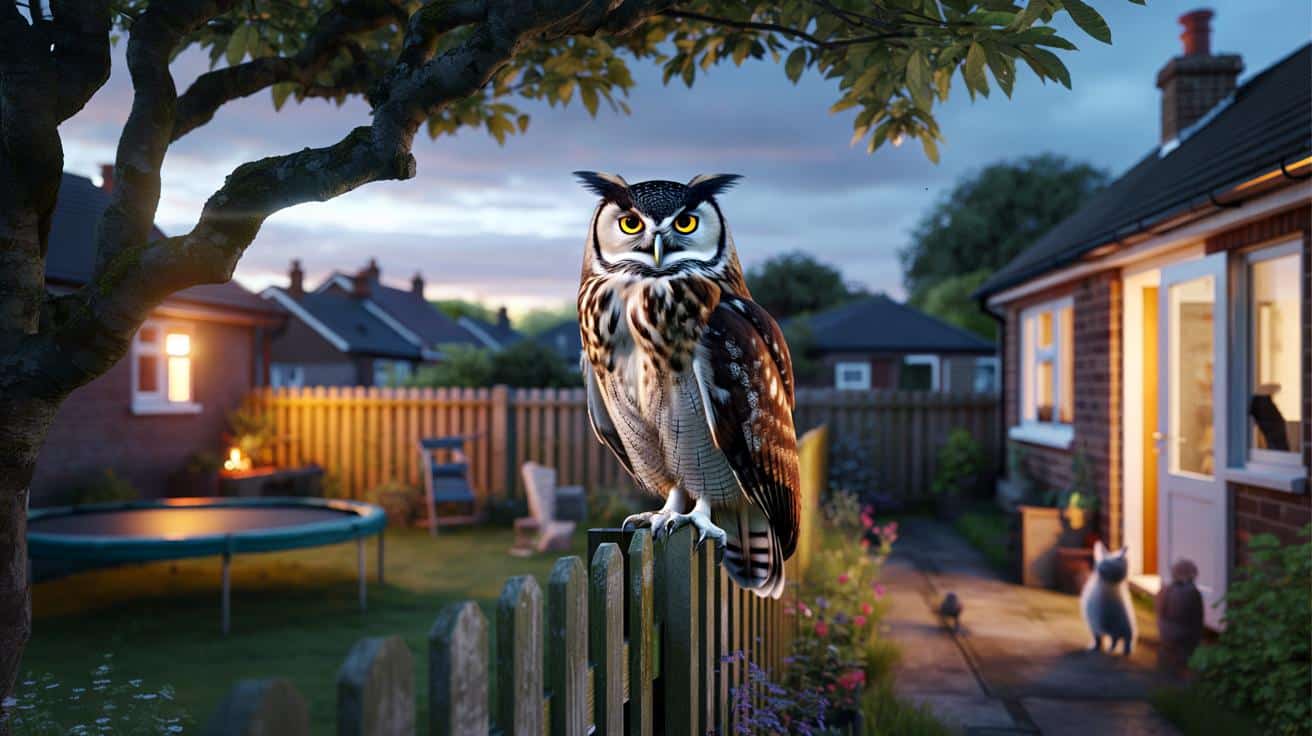
Neighbours whisper. Pets are ushered indoors. Phone cameras tremble in the half-light as everyone wonders the same thing: how do you live with a wild raptor on your fence?
It began at dusk, that hour when the cul‑de‑sac softens and the day exhales. A shape rose from the sycamore, silent as a held breath, and settled on the fence panel between a trampoline and a washing line. You don’t hear the wings, only the moment your skin notices you’re being watched.
We’ve all had that moment when the ordinary glints with something wild. Across the terrace line, garden lights blinked off one by one, as if the street agreed to a truce. For a while, it felt like the garden was listening to itself again. The owl stayed.
A feathered giant on the fence
In the gloaming, size plays tricks, yet this bird looked huge even by clear light. Thick barrel chest, pale flecks on dark plumage, eyes like small moons. It sat unbothered by our human shuffle, swivelling its head like a compass needle over lawns and flowerbeds.
On Tuesday, Priya from number 14 paused dinner mid‑stir, called her son to the patio, and held her breath with a wooden spoon in mid‑air. She filmed ten seconds on her phone and sent it to the road WhatsApp group. By morning the clip had travelled to a local Facebook page, then further, and strangers were commenting about a “garden eagle owl” with heart emojis and exclamation marks.
The owl’s calm is part theatre, part biology. Suburbs are a buffet: mice under decking, rats near bins, pigeons roosting on TV aerials. A quiet fence line offers a perfect perch with near‑zero energy cost. The street is a mosaic of cover and open pockets, exactly what a nocturnal hunter reads like a map.
How to live with a garden owl
First rule: Keep your distance. If the owl turns its body away or blinks hard, you’re too close. Step back, dim the patio light, lower your voice. Swap the motion floodlight for a softer lamp in the evening, and bring in pet food that might be waving rodents in like a neon sign.
Resist the urge to feed or flush. Raw meat can spread disease and teaches the wrong lesson; chasing for a better photo only drives the bird away. Let kids look from a window, keep small pets indoors after dusk, and leave tree cover intact. Let’s be honest: nobody keeps perfectly quiet in the garden every evening.
Listen to people who watch birds for years, not days.
“Treat it like a visiting neighbour you’re lucky to have,” says Melissa, a volunteer with the local bird group. “Give it space, and it will show you more than any close‑up ever could.”
- Do not feed the owl; watch hunting from a distance instead.
- Shift to warmer, lower lights at night — Let the night be dark.
- If sharing images online, skip street names to reduce crowds.
What this visitor tells us
The owl isn’t just a spectacle; it’s a mirror held up to our edges. Gardens are the last, scruffy fields left in cities, stitched together by hedges and fences, alive in the hours we rarely sit still. A child seeing a silent wing beat for the first time learns the shape of patience without a word.
People say “giant” because surprise magnifies everything. Maybe it’s a tawny with broad shoulders, maybe a lost escapee with ear tufts and a stare like amber glass. Either way, the feeling is the headline. On a street of bin day reminders and parcel drop‑offs, a wild bird keeps time for a while. Neighbours speak to neighbours again. The night feels taller.
There’s a practical side too. Lock compost, tidy food waste, move feeders if rats appear, and try a red or amber bulb. Small gestures add up. The owl reads your garden as a field guide you’re editing in real time.
It might leave tomorrow. It might return next week when the wind sits right. The only guarantee is this: a wild thing chose your fence for a minute, and that minute is now inside your house like a story with the door on the latch. Share it, lightly.
| Key point | Detail | Interest for the reader |
|---|---|---|
| Coexistence basics | Space, soft light, no feeding, pets indoors after dusk | Clear steps to keep the owl calm and your home peaceful |
| Why it’s here | Easy perches, urban prey, quiet pockets between houses | Understanding turns curiosity into calm and care |
| When to act | If the owl looks weak, tangled, or grounded by day | Know the line between watching and needing help |
FAQ :
- Is a “giant” owl dangerous to pets?Attacks are rare, but keep small pets indoors after dark and supervise dogs at night.
- Which species could it be?A chunky tawny owl is common; a very large bird with ear tufts could be an eagle owl, sometimes an escapee.
- How long will the owl stay?Anything from a single evening to a couple of weeks, depending on food, disturbance, and weather.
- Can I use flash or a spotlight for photos?Skip both; bright beams can dazzle a nocturnal hunter and ruin the moment for everyone.
- What if the owl seems injured?Note time and location, keep back, and call a local wildlife rescue or RSPCA for advice before approaching.







Loved this piece—especially the advice to dim the floodlights. We swapped ours for a warmer bulb last winter and the garden feels calmer. The line about “the night feels taller” is lovely. Definately keeping the pet food indoors now.
Giant, huh? Are we sure it isn’t just the gloaming playing tricks on our eyeballs from that fence angle? Cool story, but I’d like measurements, not moon-poetry.