
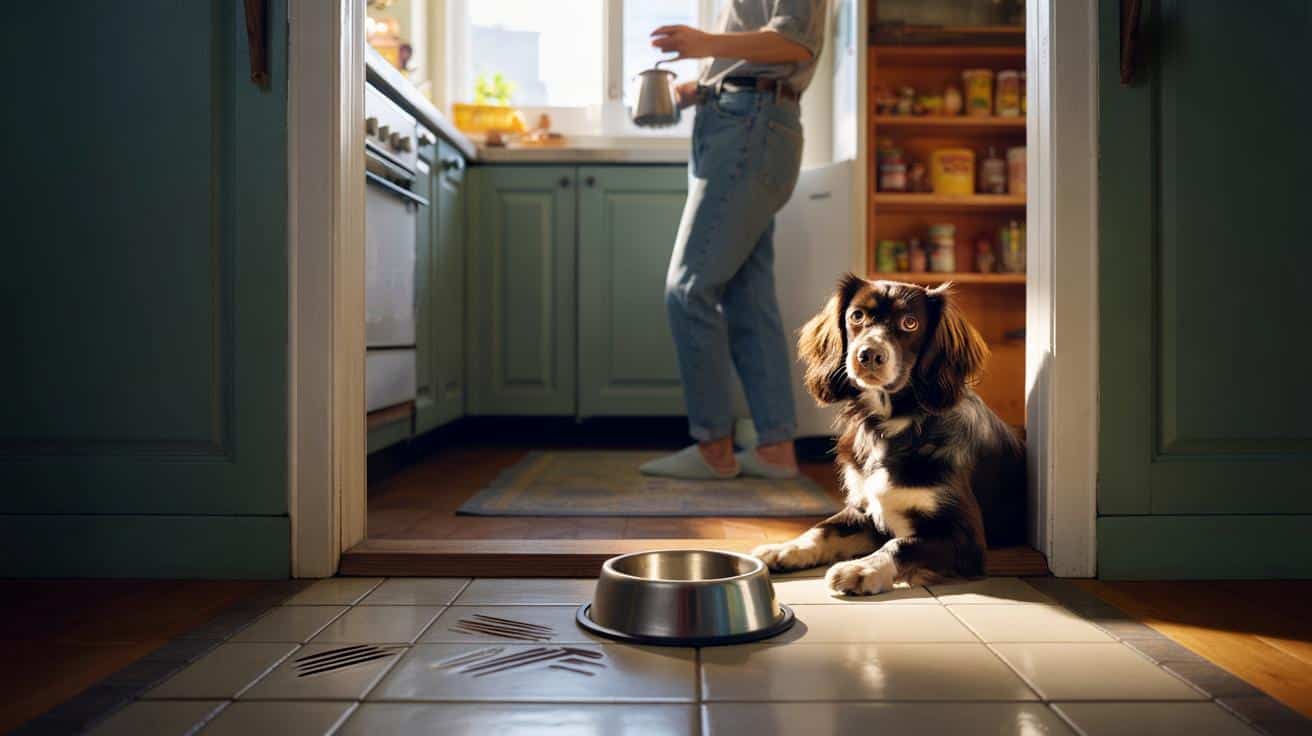
Your dog has a way of telling you he’s hungry long before the bowl hits the floor. The trick isn’t teaching him new words — it’s learning the ones he already uses.
Your dog lifts his head, pads across the tiles, and plants himself in the doorway like a bouncer who recognises his moment. He looks at you. Then the bowl. Then back. The tiniest huff, a tilt of the head, a soft paw on your ankle — and somehow it all feels like a clear sentence.
He walks a short loop to the cupboard, pauses, glances over his shoulder, as if to say, “Come on, this way.” You pour your tea, he slides the bowl two inches with a hopeful scrape. It’s not a bark. It’s not begging as you imagine it. It’s choreography. At the centre of it all sits a single, stubborn truth you can feel more than explain.
He’s talking to you.
Decoding the dinner-time code
Dogs rarely use one signal when hunger hits. They stack them. A long, fixed stare flickers into a quick look at the bowl, then a purposeful walk to the food cupboard. Behaviourists call it **gaze alternation** — an elegant way to point without fingers. You’ll often see a quiet sigh or a gentle nose-bump to seal the message.
We’ve all had that moment when the clock reads five minutes to dinner and a furry metronome starts pacing the kitchen. My neighbour’s spaniel, Mabel, pulls a classic: she sits on the mat by the fridge and blinks slowly until you laugh, then trots to her bowl. It isn’t random, it’s a ritual that makes you part of the story.
What looks like “asking for food” is more like a conversation built on shared habits. You move at predictable times; he learns the rhythm. He tries a signal; you respond; the loop tightens. Over days and weeks, those little moves stack into **referential signals** — behaviours designed to draw your attention to a thing. Once you see the pattern, you can’t unsee it.
Signals you’re missing — and what to do with them
Start by watching the order, not just the act. A hunger message often runs in a sequence: eye contact, location change, object touch. Wait two beats and see if he repeats the chain. If he does, give a calm phrase — “Dinner soon” — then prep the meal at the next planned time. You’re acknowledging the ask without being pushed off your schedule.
Big mistake: feeding on the first whine. That teaches the fastest route to food is noise. Another trap is the “accidental second dinner” when someone else in the house has fed already. Keep a simple note on the fridge or use a shared app. Let’s be honest: nobody really does that every day. Still, one tick on a whiteboard can save a dozen confusing signals.
When in doubt, offer a different need first. A brief sniffy walk, a handful of low-calorie veg, or a puzzle feeder can reveal if it was hunger or boredom talking. *The bowl is empty, but the bond is full.*
“Your dog isn’t being cheeky; he’s being clear. Our job is to hear the message and answer in a language that keeps everyone steady.”
- Watch for the “bowl glance — you — bowl glance” loop.
- Note kitchen thresholds: doorways and mats act like quiet “buttons.”
- Listen for the soft exhale right before a paw tap.
- Look for the stillness: a held sit can be louder than a bark.
- Track time-of-day patterns that your dog treats like appointments.
Why this ‘language’ matters more than you think
Feeding isn’t just calories; it’s trust. When you recognise the signal and respond consistently, you’re telling your dog the world makes sense. You reduce frantic energy before it starts. You also create space for your own needs, because routine gives both of you a map.
There’s a quiet bit of science humming under the surface. Dogs read our gaze, track our footsteps, and learn tiny sounds — the click of a lid, the slide of a drawer — faster than we admit. Responding with a set phrase and a calm pace lowers arousal and turns meal prep into a cue for patience. That’s gold on a busy weekday.
And there’s a practical win. If you can “hear” hunger, you’re less likely to mistake thirst, stress, or sore tummies for a food request. That saves vet visits, waistlines, and your nerves. A small skill, learned once, that pays off daily.
How to speak back without feeding the frenzy
Create a reply your dog can predict. Choose a meal cue — “Dinner time” — and make it mean one thing only: food is truly coming. If he signals early, give a neutral bridge phrase like “Not yet” and return to calm activity. Feed at consistent windows, use the same bowl spot, and keep your movement slow. You’re writing punctuation into his day.
Handle the pre-meal buzz by adding a tiny job. Ask for a sit on a kitchen mat, then place the bowl down when hips touch the floor. Lift it if he pops up, and try again without scolding. The message becomes clear: quiet behaviour opens the kitchen door. A week of this turns chaos into a soft routine you barely notice.
Mind the human side. Family schedules wobble; alarms are ignored; someone slips a bit of toast under the table. It happens. Keep the aim, not perfection. If you do go off-plan, bring the next meal gently back to the usual time and carry on. That steadiness is your superpower.
“I tell clients: be boring at meal times. Predictable beats perfect. That’s when the magic happens.”
- Pick one cue phrase and stick to it.
- Feed in one place only; locations are part of the language.
- Use a slow feeder to stretch meals without extra calories.
- Confirm someone hasn’t already fed — a quick check prevents mixed signals.
- Keep scraps scarce; table food rewrites the dictionary in seconds.
The bigger conversation hiding in a small bowl
This “secret language” isn’t mystical. It’s domestic life turned into signals you can read at a glance. Every look, every shuffle toward the cupboard, every patient sit on the mat is a thread in the rope you’re both holding. Tug too hard and the rope burns. Hold it gently and the day runs smooth.
There’s also joy here. Watch your dog “ask nicely” and you’ll notice how much he’s learned about you. He knows your steps, your moods, your 6 p.m. sigh. When you answer with calm cues, you show him he’s been heard. That’s the sort of everyday kindness that makes a house feel warm.
Once you hear it, you’ll start to share it. Friends swap stories of bowl nudges and doorframe stares. Families invent tiny rituals that become folklore. Your dog writes his sentence. You reply with yours. And dinner, somehow, tastes better for both of you.
| Key point | Detail | Interest for the reader |
|---|---|---|
| Recognise the sequence | Look for the stare → bowl glance → move to cupboard chain | Turn guesswork into a clear “I hear you” moment |
| Build a steady reply | Use one cue phrase and a calm, repeatable routine | Less chaos before meals, more patience after |
| Avoid mixed messages | Limit scraps, track who fed, keep the feeding spot fixed | Fewer begs, fewer extra calories, happier evenings |
FAQ :
- How do I tell hunger from boredom?If a brief sniffy walk or a simple puzzle settles him, it wasn’t hunger. True hunger signals often repeat in a tidy sequence and cluster around usual meal times.
- Why does my dog beg right after dinner?Some dogs link your plate, not their bowl, with “bonus food.” Clear the table routine and a no-scraps rule stop the loop. A chew after his meal can fill the gap.
- Is free-feeding a good idea?For most dogs, set meals beat an always-full bowl. Routine supports healthy weight, better training, and clearer signals.
- What if he wakes me at 5 a.m. for breakfast?Shift breakfast later in five-minute steps over a week. Keep mornings quiet, lights low, and only feed after a calm pause. Dawn demands fade when dawn stops paying.
- Do some breeds “talk” more at meal times?Individuals vary more than breeds. That said, herders and hounds often show crisp pointing behaviours. The rule holds: watch the sequence, not the stereotype.







Loved the breakdown of gaze alternation and the “you—bowl—you” loop. I started watching the order, not just the act, and it clicked: eye contact, doorway hoverr, nose-bump. Saying “Dinner soon” actually calmed him. Small nit: could you link to a study on referential signals in pet dogs vs. shelter dogs? Thanks!
Isn’t this just anthropomorphism? My lab stares at everything. How do you seperate hunger from attention-seeking without over-reading? The “offer a sniffy walk first” bit feels hand-wavy—got any data, or am I being too pedantic?