
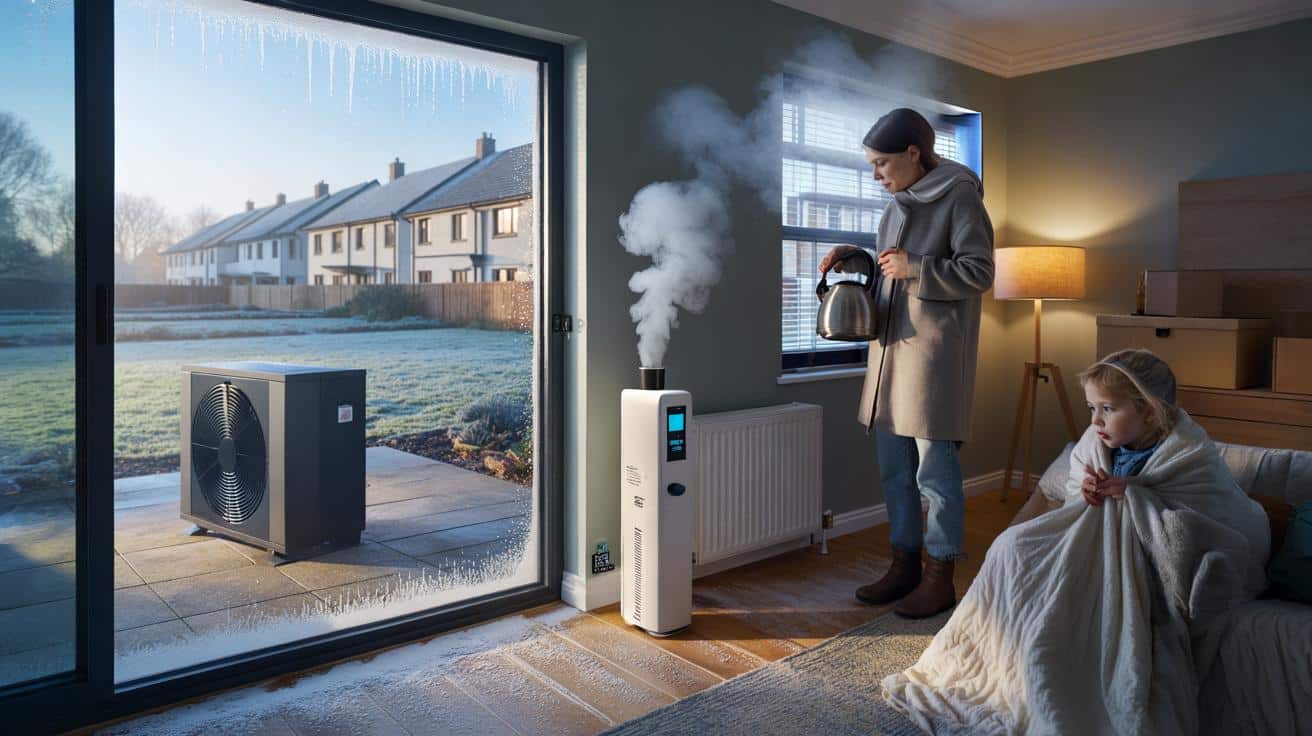
Families in brand‑new, high‑rated homes are shivering in coats, tapping thermostats that won’t budge, and watching bills climb. The promise was low‑carbon comfort. The reality for thousands is colder rooms, costlier heat, and a runaround between developers, installers and heat suppliers.
14am on a glistening cul‑de‑sac where every front door still smells of fresh paint. A father carries a kettle between rooms like a mobile radiator, steam fogging in the chilly air. The heat pump outside hums like a distant fridge, the app says “eco mode,” yet the toddler’s room sits at 16°C and the towel rail is lukewarm to the touch. In the residents’ WhatsApp, neighbours volley photos of frost on inside panes, flow temperatures, and bills that read like car‑finance payments. The developer’s email arrives: “This is how modern, efficient systems feel.” A mother laughs into her scarf.
Then the hot water runs cold mid‑shower and everyone stops laughing. The boiler didn’t break. Something else did.
Why so many brand‑new homes feel cold and cost more to heat
Across the UK, glossy “new build” brochures promised clean tech, low bills, and an A on the EPC. The reality for a chunk of owners is different: rooms that never reach set temperatures, air source heat pumps cycling, and communal heat networks that charge more than expected. **Green by design, chilly in reality**. People didn’t sign up for a science project; they bought a house that was supposed to work.
Take a mid‑rise block tied to a district heating scheme. Residents tell me the standing charge feels like paying rent on warmth, even before a single degree rises. Others describe outages that turn evenings into camping trips with electric blankets. In suburban estates with individual heat pumps, homeowners report the same three clues: radiators that were fine with gas but now underperform, hot water that runs out after two showers, and an outdoor unit frosting over like a winter lawn.
The pattern isn’t one villain. It’s a stack of small misses. Developers optimise for SAP points and airtightness on paper, while heat pumps need bigger radiators or underfloor loops to deliver low‑temperature heat. Some systems are sized for “average days” rather than cold snaps. Commissioning gets rushed: weather compensation left off, flow rates not balanced, thermostats placed in sun patches. On heat networks, poorly insulated pipe runs and complex tariffs amplify the pain. The end result feels like the same house, only less warm and more complicated.
What actually goes wrong — and practical ways to get warmer
Start with the system you have. **Do this first**: set your heat pump to run steadily at a lower flow temperature, not in short, on‑off bursts. Open TRVs fully in main spaces and let the wall thermostat lead. Enable weather compensation so the system nudges flow temperature up and down with the forecast. If you have underfloor heating, check that manifolds are open, actuators click freely, and loops are balanced. Ask your installer for the MCS handover pack, the commissioning sheet, and the room‑by‑room heat loss calculation. They’re not optional paperwork; they are your map.
Common traps are surprisingly human. People keep knocking the thermostat up and down, which confuses a heat pump built for gentle, continuous work. They set big night setbacks and wake to a system that can’t claw back the whole house by 7am. Filters clog on MVHR, fresh air flows fall, and humidity creeps in. Let’s be honest: nobody really reads the manual. Keep a simple log for a week — outside temperature, flow/return temps, room temperatures, and times — and you’ll spot patterns. We’ve all had that moment when the fix was hiding in plain sight.
If you’re on a heat network, read your Heat Supply Agreement and find the unit rate, standing charge, and any “capacity” fee. Log outages and temperatures in every room. Developers will respond faster to data than to despair. *It feels unfair to become your own heating engineer, but clarity wins disputes.*
“Most problems I see aren’t ‘broken heat pumps’,” says an independent heating engineer who commissions new builds. “They’re systems designed for one reality, installed to another, then left un‑tuned. Ten minutes with weather compensation and radiator balancing can add two degrees across a home.”
- Ask for the commissioning sheet and design flow temperature in writing.
- Photograph radiator sizes and compare them to the heat loss for each room.
- On heat networks, request the outage log and insulation spec for risers.
- Clean MVHR filters and check supply/boost settings match your layout.
- Escalate in writing to the site manager, then the developer’s customer care, then the warranty provider if deadlines slip.
The hidden mechanics: why comfort fails in “efficient” homes
Heat pumps love big, gentle surfaces and time. Small radiators sized for 70°C gas don’t sing at 45°C. Microbore pipework strangles flow just when you need volume. A heat pump that’s a touch too small will cope in October and stumble in January. In flats, cylinders are slim to save cupboard space, so showers outrun recovery. On heat networks, long pipe runs bleed heat into service cupboards unless insulation is perfect, which it rarely is. None of this is exotic. It’s detail.
Developers chase EPC points with solar, airtight membranes, and clever controls, which looks fine in an assessor’s spreadsheet. Yet the spreadsheet doesn’t feel the draught near a poorly sealed socket, or the cold bridge around a balcony bracket. Thermostats end up behind curtains or on warm internal walls. Smart controls get left in factory mode. **Hidden design shortcuts** travel invisibly from drawing to living room, where they show up as a shiver.
Then comes the bureaucracy loop. The builder says “it’s an energy‑efficient system, give it time,” while the installer blames the spec, and the heat supplier points to terms and conditions. Owners end up as informal project managers. That’s why documents matter: an MCS certificate, commissioning numbers, and the heat loss for each room turn comfort from a feeling into a case. Numbers are awkward to argue with.
How to turn the tide — without tearing the house apart
Think in steps. Begin with commissioning hygiene: weather compensation on, flow temperature sensible, continuous set‑point with minimal night setback, and TRVs wide open in lived‑in rooms. Bleed radiators, clean strainers, and set pump speed to maintain delta‑T around 5–8°C for underfloor, 10–12°C for radiators. Run a hot‑water boost at midday when air is milder, not dawn. If rooms still lag, you may need one or two larger radiators or a fan‑assisted convector in the coldest spaces. That swap is cheaper than ripping floors for new pipework.
On heat networks, clarity beats confrontation. Ask the operator to explain your tariff structure, metering accuracy, and any compensation policy for outages. Keep a calm file: dates, temperatures, photos of condensation, and any vulnerable occupants. Developers respond to timelines, not tirades. If progress stalls, the New Homes Ombudsman and your warranty provider can jolt momentum. Soyons honnêtes: personne ne fait vraiment ça tous les jours. Translation aside, schedules and screenshots move mountains.
There’s a human layer too. Young families stretch routines around “towel‑rail hour” and early showers. Older residents ride out cold lounges to dodge peak rates. People didn’t buy an energy course; they bought a home.
“If your house never reaches set‑point on a freezing day, the system is under‑delivering by design or by setup,” says a building physicist who audits post‑handover homes. “Fix the flow temperature, balance the emitters, and if needed, swap one radiator. That often flips a ‘cold house’ into a ‘quietly warm one’.”
- Priority move: get the design documents and the commissioning sheet.
- Quick win: enable weather compensation and stop on/off cycling.
- Low‑cost upgrade: one larger radiator in the coldest room.
- Paper trail: log temperatures during the coldest week of the year.
- Escalation path: site team → developer care → warranty/ombudsman.
Where this leaves buyers — and what might change next
Regulation for heat networks is tightening, which should bring standards and recourse closer to the gas and electricity world. The next wave of building rules will push low‑carbon heat deeper into the market. Both moves can help, if comfort becomes the measure and not just the certificate. Buyers are already nudging the system there. They’re swapping a couple of radiators, getting commissioning right, and asking questions once saved for engineers. The more that happens, the less “new build” will mean “new problems.”
Some developers are listening. Smarter designs are emerging: bigger emitters as standard, honest handover packs, clearer tariffs. It’s not perfection. It’s progress. The crisis many feel this winter came from a mismatch between paper efficiency and everyday warmth. Close that gap, and these homes can be as good as promised — quietly warm, cheap to run, and drama‑free when the frost bites.
| Key point | Detail | Interest for the reader |
|---|---|---|
| Heat pump comfort relies on low‑temp design | Larger emitters, balanced flow, and weather compensation matter more than high set‑points | Practical tweaks can add 1–2°C across rooms without ripping floors |
| Heat networks carry unique costs and risks | Standing charges, metering accuracy, and outage policies vary by operator | Know your tariff and your rights to avoid bill shocks and secure remedies |
| Paper beats opinion | MCS handover, commissioning sheets, and room heat losses turn comfort into evidence | Faster resolutions with developers, installers, and warranty schemes |
FAQ :
- Why is my brand‑new home colder than my old one?Low‑carbon systems run at lower temperatures and need bigger radiators or underfloor loops. If emitters are small or unbalanced, rooms stall below set‑point.
- Are heat network charges capped like normal energy bills?No price cap applies in the same way. Regulation is expanding, but tariffs and standing charges are set by your operator and contract.
- How can I tell if my heat pump is undersized?On the coldest days, if it runs constantly yet rooms never reach set‑point, size or emitters may be short. A room‑by‑room heat loss check is the proof.
- Will turning the thermostat up make the house heat faster?Not with a heat pump. It just lengthens run time. Use steady temperatures and weather compensation for better comfort and cost.
- What should I ask my developer right now?Request the MCS certificate, commissioning report, room heat loss calcs, radiator schedule, and any heat network tariff details. Then agree a timeline to fix gaps.







So after all the EPC A ratings, why are people colder—was the heat loss calc wrong or the emitters undersized? Genuine Q: who’s actually liable when commissioning is botched—the developer, the M&E contractor, or the heat network operator?