
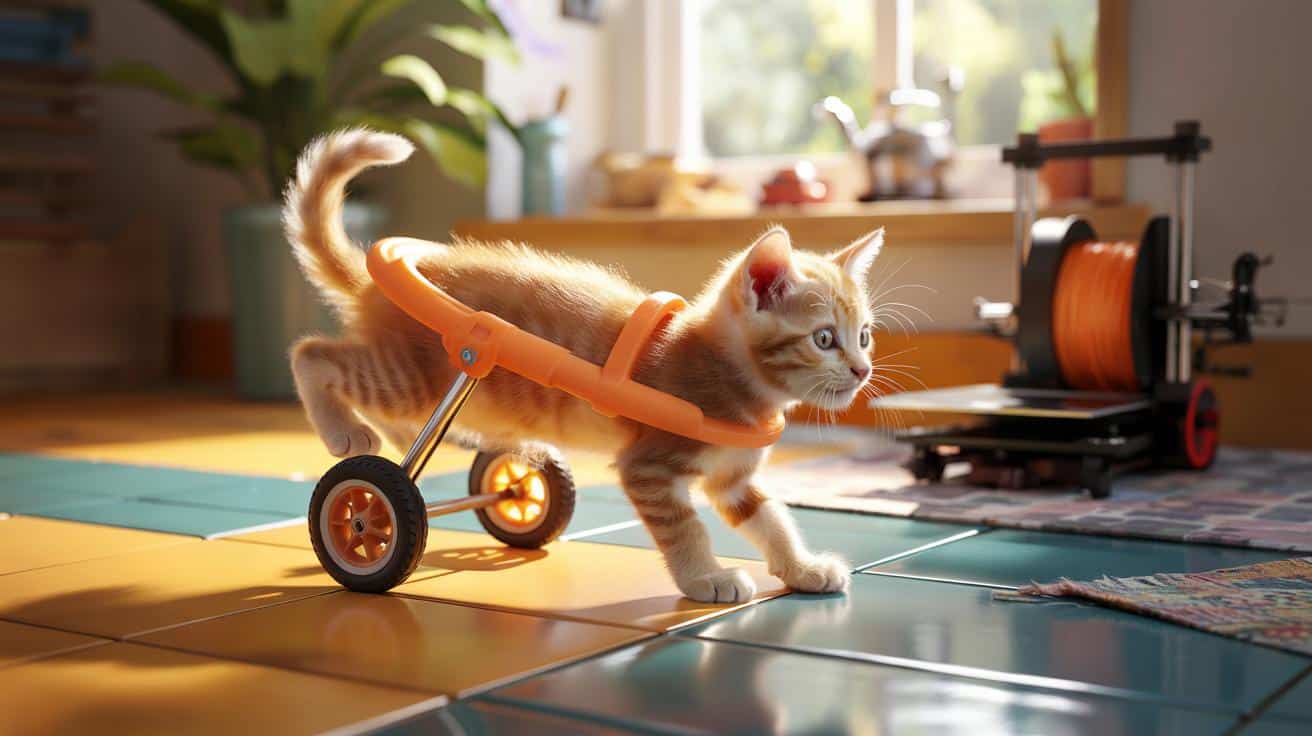
This one did. A home 3D printer, a £12 spool of filament and a rescue volunteer with patience turned a hard diagnosis into something else: motion. Not perfect, not pretty, but real movement across a kitchen floor. That tiny shift changed how a neighbourhood, and a lot of strangers online, looked at what “can’t” actually means.
The kitten arrived in a carrier that smelled faintly of biscuits and the road. He was the size of a loaf of bread, all eyes and elbows, back legs splayed like punctuation. While the kettle clicked, he dragged himself towards the light patch on the tiles, leaving a slow smudge, unimpressed by sympathy. The printer in the corner ticked to life, that familiar stair-step hum of motors and hope. Plastic became lines, lines became a shape. Then the wheels turned.
Meet Pip, the kitten who wouldn’t sit still
Pip was found behind a row of bins at the end of a wet week, a blur of ginger fluff and stubborn noise. Vets wrote “severe hind limb paresis” on a form; he wrote a different sentence with his front paws, scooting towards the nearest moving thing. He didn’t want cradles. He wanted chase. **Pip didn’t read the prognosis.** The shelter team called Maya, who prints replacement clips for broken rabbit hutches on weekends. She said yes before the tea had cooled.
First came the measuring. Hip width, belly girth, shoulder height, the tiny gap under his tail that would set the axle. Maya sketched a frame on a napkin and then on CAD. She printed a test rig in cheap PLA, two small indoor scooter wheels attached with miniature bolts scavenged from a defunct drone. The first attempt sat too high. Pip tipped. The second hugged his belly and floated his legs. *The room went quiet as Pip took his first clumsy roll.* **A £12 spool of filament changed the story.**
3D-printed mobility isn’t magic; it’s leverage, weight and balance worked out in millimetres. The trick is getting the centre of mass forward enough that the front legs do the work, while the back is supported without pinching. Lightweight frames spread pressure; curved edges stop chafing. Small wheels spin fast on kitchen tiles but stick on rugs, so a slightly larger diameter gives better clearance over thresholds. It looks like a toy. It behaves like a tool. Pip didn’t care that it was orange.
How to build a featherweight wheelchair for a kitten
Start with gentle measurements when the kitten is calm. Neck-to-belly strap length, belly circumference, shoulder height to floor, hip-to-hip spacing. Sketch the frame as a U that cradles the belly and avoids the ribs. Print a main hoop with two lateral arms and a rear axle slot. PETG offers a touch more flex than PLA, though either works if you add fillets to stress points. Fit with soft Velcro straps that fasten on top, away from paws and mischief.
Common pain points sit where plastic meets fur. Sand every edge to smooth, then wrap the belly contact in thin foam or vet wrap. Choose wheels with slightly soft tyres; hard plastic rattles and skids. Keep the axle just behind the hips so the back legs can rest without dragging. Let’s be honest: nobody measures a kitten’s bum for wheel spacing on a Tuesday night. Mistakes happen. Keep spare straps, print two sizes, and let the cat tell you what’s wrong by where they try to wriggle.
The frame should be light enough to forget yet strong enough to crash into a skirting board and laugh it off. Start with short sessions, five minutes of supervised zooms, treats at each stop, and tiny adjustments between runs.
“I thought I was printing a frame,” Maya told me, “but what came out was time. Time for him to be a kitten first, a diagnosis second.”
- What you’ll need: a basic FDM 3D printer (0.4 mm nozzle), PETG or PLA filament, two 50–70 mm soft wheels with small bearings, M3 bolts and nuts, Velcro straps, soft foam, fine sandpaper.
- Optional extras: a cheap luggage scale to weigh the frame, rubber O-rings as shock absorbers, silicone spray for bearings.
- Design tip: add slot holes for strap adjustability; kittens grow like weeds.
Watch their gait more than the gadget. Movement is the mentor.
What changes when a creature can move
Pip didn’t suddenly sprint like a cartoon. He rolled, paused, recalibrated, and rolled again, nose twitching at the oven and then at the door. Maya’s hallway became lanes: rug to floor to rug, a circuit of discovery. The wheels weren’t a cure; they were a translator. Strangers saw a video, then another, and sent messages like a tide. We’ve all had that moment when a small creature pins you with a look and you choose the messy option that might just work.
Freedom looks different when it fits in your palm. Pip started to build muscle in his shoulders and chest, which altered everything downstream. With the frame taking the load, his joints got a break from scraping. He learned to steer using whiskers and smell, bumping the baseboards like a tiny bumper car. Maya learned to listen with her hands, fingers reading the heat of friction and the story of a small body. **Small wheels can move big hearts.**
The ripples didn’t stop at one kitchen. A neighbour asked if the files could be shared. A school wrote for a STEM project, kids swapping their fidget time for CAD time, printing test frames for plush toys before graduating to a rescue day. Vets who’d only seen heavy, expensive animal wheelchairs tried something home-brewed, lighter, kinder. A maker in Leeds posted an upgrade with quick-release straps. A grandmother in Kent printed one for a cat called Toast. The idea travelled faster than Pip could roll, which is saying something.
| Key point | Detail | Interest for the reader |
|---|---|---|
| 3D printing turns scrap ideas into mobility | Simple U-frame, soft wheels, adjustable straps, printed in a few hours | Shows a low-cost path from problem to action you can copy at home |
| Fit matters more than fancy materials | Measure calmly, sand edges, protect fur, adjust axle position by a few millimetres | Practical tweaks that make the difference between a toy and a tool |
| Movement changes behaviour and health | Short, happy sessions build strength, confidence and curiosity | Proof that compassion plus craft delivers real-world gains |
FAQ :
- How does a 3D-printed kitten wheelchair work?It supports the belly and hips on a light frame while the front legs pull. The rear wheels carry weight so the back legs can rest or trail safely.
- Is it safe for a growing kitten?Yes, if it’s light, smooth and adjusted often. Print two or three frame sizes and use soft straps so you can tweak fit as the kitten grows.
- How much does it cost and how long does it take?A small frame uses a few pounds of filament and common hardware. Printing can take 3–6 hours, with an evening for sanding, strapping and testing.
- What if I don’t own a 3D printer?Ask a local makerspace, school or library, or use an online print service. Many rescues now share open files and will help you source parts.
- Can a kitten graduate from wheels to walking?Some do, as muscles strengthen and coordination improves. Others rely on wheels long-term and still live full, playful lives that fill a house with noise.







This story absolutely knocked me over—’Small wheels can move big hearts’ indeed. Pip, you legend 🙂
Honest question: is there any longterm risk to shoulder overuse with this setup? How do you monitor skin chafing and posture over weeks, not just days? Vet follow‑ups recommended?