
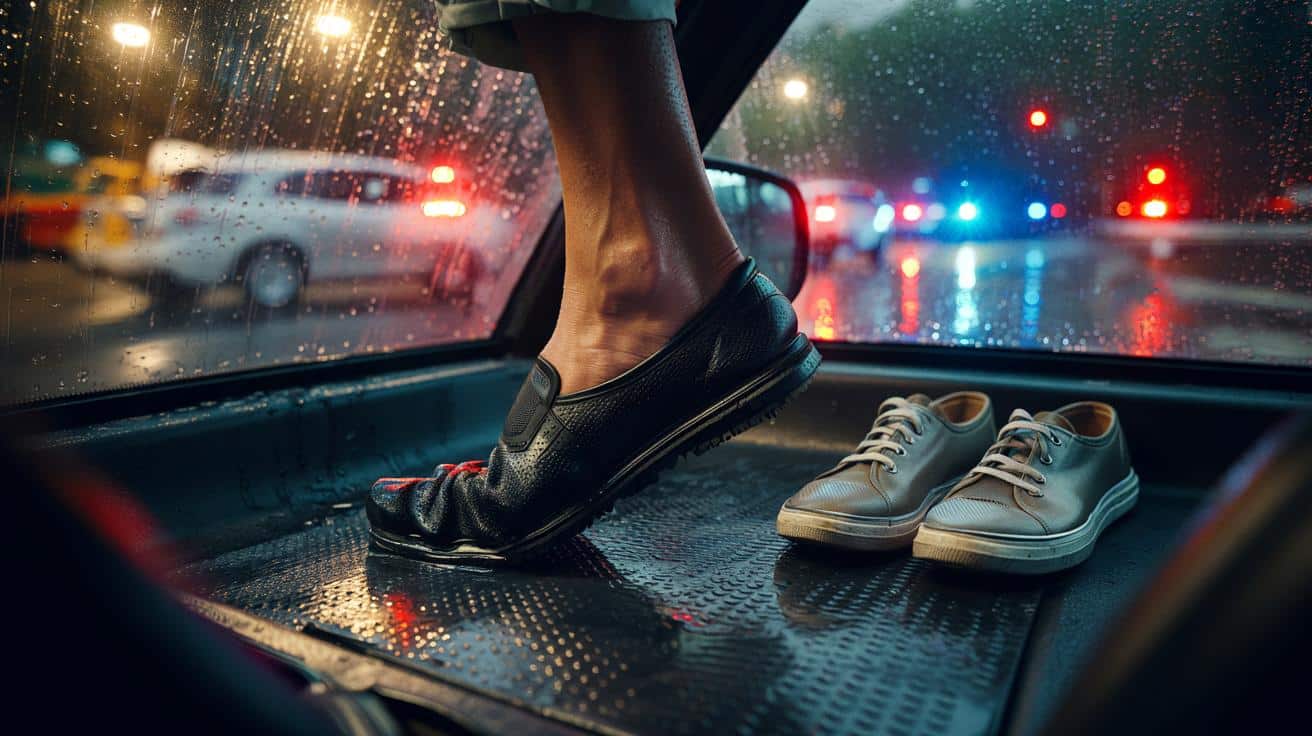
Yet the wrong pair of shoes can be all it takes for an insurer to say you weren’t in proper control of the car. That small detail in the footwell could decide whether a claim is paid or pushed back.
The rain started as a drizzle on the supermarket roof, then turned hard and fidgety. A woman in wet sliders shuffled across the car park, trolley squeaking, bags biting into her fingers. She dumped everything in the boot, slid into the driver’s seat and stamped the rubber mat twice, trying to shake off the water. The brake pedal felt different beneath her foot. Slicker, numb. She edged out, nudged the throttle, and the sole rolled under the pedal like a coin. Her heart went light. Traffic didn’t care.
It seems harmless. Until it isn’t.
Footwear that quietly puts your cover at risk
When you press a pedal you need grip, feel and stability. The shoes that fight that are the quiet culprits. **Flip‑flops, sliders, high heels and bulky boots are the repeat offenders.** Open backs can slip off, heels shift your foot angle, thick soles kill sensitivity, and wide soles can straddle two pedals at once. Even soft slippers fold and snag. None of this looks dramatic in the mirror. It shows up at the worst moment, when inches matter.
There’s a pattern buried in claim files and roadside chats. Drivers admit they “just nipped out” in sandals and rolled into a post, or they wore towering heels to a wedding and blipped the throttle instead of the brake. A motoring club survey once found a swathe of people driving in flip‑flops and sandals after hot days, then regretting it. The stories rarely end in headlines. They end in awkward phone calls with insurers and a quiet lesson nobody taught us at school.
Here’s where insurance bites. The Highway Code says your clothing and footwear should not prevent you using the controls in the correct manner. That line turns up in police notes and loss adjuster letters. If an investigator decides your shoes hindered control, they may argue careless driving or a failure to take reasonable care. **If your footwear is blamed for poor control, your claim might be reduced or refused.** Not every case goes that way. The risk is real, and it’s avoidable.
Make your feet road‑ready in two minutes
Keep a plain pair of driving shoes in the car. Slim trainers with a thin, flexible sole work well, ideally around a centimetre or so, with a secure heel and proper laces or a snug strap. Step into the driver’s seat, place your heel on the floor, and pivot between brake and accelerator. The shoe should let you feel the bite point and modulate smoothly. Do this in your driveway once and you’ll know instantly which pair earns the front‑seat spot.
Watch the small traps. Wet soles turn pedals into ice; a quick wipe on the mat helps. Heavy winter boots numb the pedal; switch to your car pair before you set off. Long, pointed toes can snag the carpet or land on two pedals at once, and thick wedge sandals deaden everything. We’ve all had that moment where the shoe shifts and your stomach drops. Let’s be honest: nobody actually swaps shoes every single journey. Build a tiny routine that still works on your laziest day.
“Footwear isn’t banned by name. We look at whether you had proper control of the pedals. If your shoes undermined that, it can weigh heavily against you,” a veteran driving instructor told me.
- Pick a thin, grippy sole that bends with your foot.
- Avoid open backs and towering heels for any distance.
- Clear floor mats so nothing catches under your heel.
- Dry wet soles before you move, even on short trips.
- Keep a dedicated car pair within arm’s reach.
The rule, the grey areas, and the real‑world stakes
Insurance isn’t judging your fashion. **Your policy cares about control, not fashion.** The principle is simple: if something you chose made the car harder to control, liability shifts. That’s why you’ll see adjusters ask what you were wearing and how it felt at the pedals. The Highway Code guidance isn’t a criminal ban on flip‑flops or heels. It’s a standard. And a standard becomes a yardstick once money and fault are on the table.
One more thing sits in the grey. Driving barefoot or in socks isn’t illegal either, and some drivers swear they feel more via skin than rubber. The trade‑off is grip and protection. Bare soles slip when damp, and hard braking can bruise. There’s also the floor mat ridge and debris. It feels harmless until it isn’t. If a stop goes wrong and an officer notes bare feet, that can still be framed as a question of control. Context matters. So does common sense.
We’ve all seen the quick errand logic: a short hop to the shops, a school run, a beach detour. The shoe choice follows the mood. On a bright day, you barely notice your toes on the rubber. Then the bus ahead anchors up and your sandal slides, or your wedge catches, or your boot mutes a vital millimetre of braking. No drama until there is. That’s the nature of small risks. They lurk on quiet streets and surface when your phone rings with a claims handler on the line.
A last thought from the driver’s seat
The car is the loud part of driving. The engine note, the indicators, the traffic’s hum. The quiet part is under your right foot. When it speaks, it speaks in millimetres. A thin sole reads those whispers; a loose flip‑flop doesn’t. Your insurer will never care about what your shoes look like in a photo. They care about whether they turned a simple stop into a nudge, a swerve, a claim. If you’ve ever felt a pedal skitter under a wet sandal, you already know the answer. Swap the shoes, nudge the odds your way, and tell a friend who still drives in beachwear after sunset. The fix is small, a habit you barely notice after a week. Yet the peace of mind is larger than it looks.
| Key point | Detail | Interest for the reader |
|---|---|---|
| Risky footwear types | Flip‑flops, sliders, high heels, thick‑soled wedges, soft slippers, bulky winter boots | Spot the usual culprits before your next drive |
| What the Highway Code says | Rule 97 advises that clothing and footwear must not prevent correct control of the vehicle | Understand how police and insurers assess “proper control” |
| Claim consequences | Claims can be challenged, reduced or refused if footwear hindered control | Protect your payout by changing a small habit |
FAQ :
- Is it illegal to drive in flip‑flops in the UK?No law names specific shoes, but guidance says footwear must not hinder control. If it does, you could face a careless driving allegation.
- Can my insurer refuse a claim because of my shoes?They can challenge or reduce a claim if evidence shows your footwear contributed to poor control. It isn’t automatic, yet it’s a known risk.
- Is barefoot driving safer than bad shoes?Bare feet can offer feel but lose grip and protection, especially when wet. Many instructors prefer a thin, grippy shoe for consistency.
- What’s the best kind of driving shoe?A light, secure shoe with a thin, flexible sole, good pedal feel, and a firm heel. Think slim trainers rather than chunky boots.
- Should I tell my insurer what shoes I wore?If asked during a claim, be honest about conditions, footwear and what happened. Clarity tends to help more than it hurts.







Do insurence companies really enforce this or is it scaremongering?