
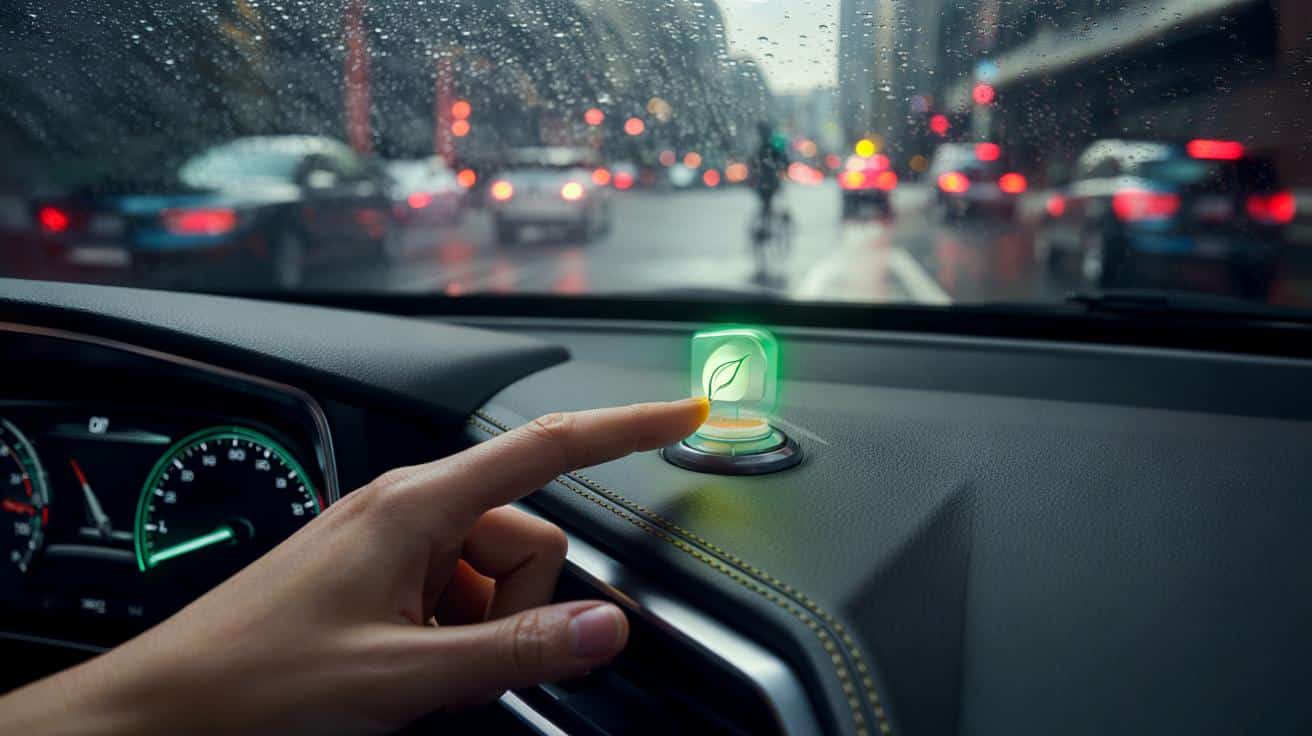
Hidden in plain sight, there’s a small, unglamorous button on your dashboard that can trim your fuel use by around 10%. Not a gadget. Not an app. Just a button people ignore.
I noticed it on a wet Tuesday in Leeds, tailing a line of brake lights as the drizzle smudged the windscreen. A delivery driver in a battered van nudged ahead. A cyclist ghosted through a gap. Inside my car: the usual twitchy right foot, the subtle tug to go-faster than traffic allowed. Then I tapped a small switch labelled “ECO”. The throttle softened, the engine note settled, and something curious happened—my driving calmed down with it. The next day’s fill-up didn’t sting as much. A week later, the figures were different again. Tiny change. Real difference. A small button doing something big.
The dashboard button you skip—and why it matters
That “ECO” button is not a gimmick. It tweaks how your car responds, nudging you into smoother acceleration and gentler gear shifts. In many models it also reins in the air-con compressor and optimises engine mapping. On paper that sounds dull. On the road it lowers revs, reduces stop‑start fuss, and quietly shaves fuel use. Drivers who use it regularly report 5–12% savings in mixed traffic. That’s a chunk of your weekly spend without changing where you go or when. It’s the lazy win most of us want.
Take Sarah, who commutes from Croydon to Clapham in a five‑year‑old hatchback. She toggled ECO for a fortnight as an experiment. Same route, same drop-offs, same coffee stop on Kennington Lane. She logged her receipts and the trip computer. Average went from 41.8 mpg to 46.1 mpg. Not headline stuff, but at today’s prices that’s several pounds per week. Over a year it’s a service bill. She said the car felt “a beat slower off the line”, yet she stopped jabbing the throttle in gaps she couldn’t actually use. The commute didn’t take longer. The stress might have.
Why does a simple mode do this? Because most fuel is wasted in the first two seconds after you decide to go. Aggressive throttle, unnecessary downshifts, over‑cooling the cabin—these are small drains that stack. ECO changes the car’s behaviour at the margins: duller pedal response, earlier upshifts in automatics, slightly softer climate control. Those micro‑tweaks reduce the spikes that guzzle fuel. It also helps your head. When the car feels calmer, you drive smoother, brake less, and time lights better. That feedback loop pays out, especially in stop‑start traffic where the biggest wins live.
How to use ECO mode and actually get the 10%
Press it before you set off, not after you’re frustrated. Use it in town, school runs, retail parks, ring roads, and any crawl where average speed sits under 30 mph. Pair it with gentle launches—count “one‑two” before pushing past half‑throttle. On dual carriageways, set a steady pace and let the car hold a taller gear. If you need a burst to overtake, kick down, do the move cleanly, then settle back into ECO. Think of it as a rhythm tool. The car sets a smoother beat; you follow it.
Common slip-ups? Using ECO on a steep, twisty B‑road and wondering why it feels a bit laboured. Expecting miracles with a cold engine on a two‑mile hop. Flicking ECO on but blasting the A/C to Arctic because you got in hot. We’ve all had that moment when the fan’s at full and you’re basically chilling the street. Let’s be honest: nobody really resets tyre pressures every week either, yet under‑inflation can wipe out your gains. Treat ECO as the foundation, not a magic wand. It works best with little habits nudged in the same direction.
This isn’t about being slower. It’s about being smoother, which in traffic is faster than it looks.
“ECO mode just takes the spikes out,” says Mark H., a London driving instructor. “You still get there. You just spend less getting there.”
- Tap ECO before rolling, not at the junction.
- Short trips? Keep revs under 2,500 until the engine’s warm.
- Air‑con: cool the cabin, then settle to 20–21°C instead of max cold.
- Cruise control on flat stretches; drop it in hilly urban bits.
- Check tyres monthly; a quick top‑up saves fuel and sharpens steering.
The quiet mindset shift hiding behind a small switch
Pressing that button is a nudge to drive the road you have, not the one you wish for. Traffic won’t part. Lights won’t sync just because you’re late. ECO mode lowers the emotional temperature. *It’s almost comically tiny, and yet it changes the feel of a drive.* That explains why people stick with it after trying; the saving shows up at the pump, but the calmer rhythm shows up in your shoulders. You notice you glance further ahead. You notice you brake earlier. You notice the cabin noise softening a notch, like a room where the hum stops.
I’ve met drivers who only use ECO on bad days, and they’re onto something. The gains are biggest when the roads conspire against you. **Stop‑start touring of life—schools, shops, diversions—rewards the gentler map.** On the motorway, use it when traffic thickens or when you’re cruising a long flat stretch with the family asleep. Switch out of it for a sharp overtake, then go back. No dogma, just options. The button is there to be used like a dimmer switch, not a vow.
What does a 10% cut mean to you? Maybe it’s £6–£10 off a week, depending on your car and miles. Over a year, that’s a weekend away. Over five, it’s a set of tyres or a timing belt. **Small money, big feeling.** You’re not buying a new vehicle or learning a hypermiling ritual. You’re pressing something you already own, and your driving style follows. If that nudge spreads—one car after another—our city air gets a shade cleaner, our streets a touch quieter. The button isn’t heroic. It’s ordinary, repeatable, and quietly contagious.
| Key point | Detail | Interest for the reader |
|---|---|---|
| The “ECO” button trims spikes | Softer throttle, earlier shifts, calmer A/C | Immediate, low‑effort fuel savings |
| Use it where traffic wastes fuel | Towns, school runs, ring roads, queues | Real‑world gains close to 10% |
| Pair ECO with simple habits | Gentle launches, steady pace, monthly tyres | Compounds savings without pain |
FAQ :
- Where is the ECO button and what does it look like?Usually on the centre console or near the gear selector, labelled “ECO”, “Eco”, or a green leaf. Some cars hide it in the drive‑mode menu on the infotainment screen.
- Will ECO mode make my car dangerously slow?No. It softens response but full throttle is still available. Push harder and you’ll get the power. For quick overtakes, briefly use more pedal or switch modes, then return to ECO.
- Does ECO mode damage the engine or gearbox?Not at all. It uses manufacturer‑approved maps designed to reduce load and revs. Many engines last longer with smoother driving because wear and heat spikes are lower.
- Can I use ECO mode on the motorway?Yes for steady cruising and mild traffic. In rolling hills or when you need brisk acceleration, you might prefer Normal mode. It’s fine to toggle—use the tool for the moment you’re in.
- What if my car doesn’t have an ECO button?Mimic it. Short‑shift a manual, be light on throttle, keep a steady gap, and set the climate to 20–21°C instead of blasting cold. The same principles deliver most of the benefit.




Great read—thanks! I toggled ECO on my 2016 Fiesta for a week and saw mpg creep from 42.3 to 46.0. Throttle feels softer but the commute didn’t take longer. Defintely calmer, and the pump receipt hurt less. Surprised something so small actually helps.
Curious: is the 10% realy from the mode, or just from people driving more gently because they know it’s on? Any proper A/B data, same route, same temps?