
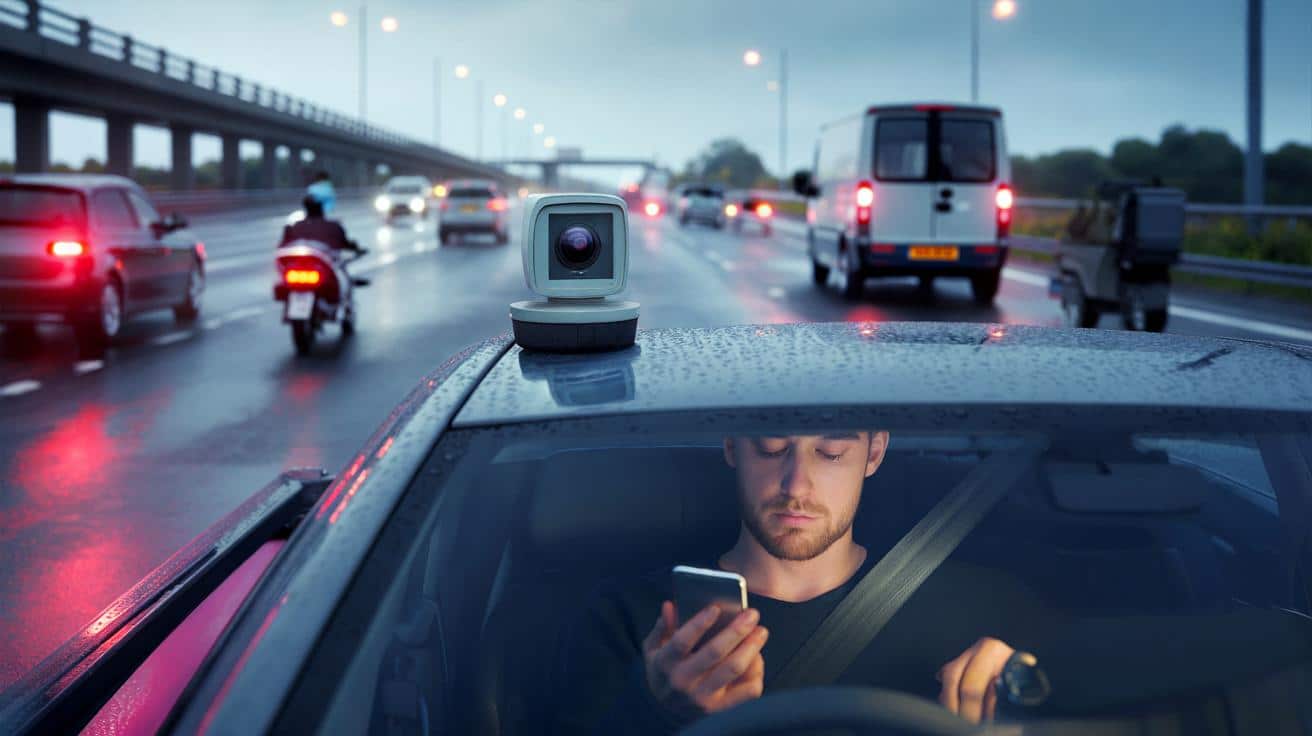
It promises fewer deaths and injuries, yet invites a familiar jolt: how much seeing is too much seeing?
It was a late grey afternoon on the A-road into town, wipers clacking, traffic inching. Up on the overbridge sat a small grey box with a dark window, almost shy among the grit and signage. A motorcyclist glanced up, a parent in a people carrier looked down, a courier’s thumb tapped a glowing screen. The camera didn’t blink. It read angles, wrists, and the empty sweep of shoulder straps. It could tell a podcast tap from a WhatsApp scroll. It could spot a seatbelt that never clicked. No siren, no gesturing officer. Just a silent beady eye among the raindrops, and a file saved to a secure server. It already saw you.
The eye above the motorway
The new system uses a high‑resolution lens and infrared flashes to see into your car, day or night, rain or sun. The tech doesn’t just “look” — it interprets posture and hand position, flagging likely phone use or missing seatbelts. A human reviewer then checks the heads‑up images to confirm what the algorithm thinks it saw.
Trials across parts of England and Wales have produced a flood of cases in days, not months. On one stretch of dual carriageway, a temporary unit flagged thousands of suspected offences within a few weeks, many at low speed in queues and at junctions. **Penalty: £200 and six points for holding a phone while driving in the UK.** New drivers can lose their licence outright.
How does it see through reflections and angled windscreens? The unit sits high — on gantries or in vans — looking down at roughly a 15–20 degree angle, using polarising filters and infrared to tame glare. **The camera doesn’t need to see your screen — it looks for the tell‑tale grip and posture.** Think phone cupped low like a snack, or a thumb dance just above your lap. A second model checks for the diagonal seatbelt line across the chest. The AI narrows the pile; trained reviewers make the call.
What it catches, what it misses, what you can do
Create a 60‑second pre‑drive routine. Set your sat‑nav, choose your audio, switch on “Do Not Disturb While Driving,” then place the phone in a fixed cradle or stash it in the glovebox. Hit voice control for anything else. **Hands‑free doesn’t mean hand‑on.** If you need to use the device, park somewhere safe and legal, engine off.
We’ve all had that moment when the lights stay stubbornly red and the hand drifts to “just a quick check.” That’s exactly where the camera shines: slow traffic, stop‑starts, the bored scroll. Let’s be honest: nobody actually does that every day. The system also spots seatbelt slip‑ups on short trips — school runs, corner shops, “it’s only two streets.” Those two streets are where crashes still happen.
There’s a fair question about mistakes and context, and reviewers do reject a lot of borderline frames. The unit can’t read your messages or listen in; it’s looking for behaviour, not content.
“If your hand touches the phone while you’re in control of the car, the law treats that as using it — even if you’re not making a call.”
- Mount the phone in a secure cradle at dashboard height.
- Enable auto‑reply and Do Not Disturb while driving.
- Use voice commands for navigation and audio.
- Stop in a safe place before touching any screen.
- Wear your seatbelt properly, every trip, every seat.
The grey area: safety, privacy and the road ahead
The promise is seductive: fewer collisions, fewer heartbreaks, less distracted driving. Images of compliant drivers are typically binned within days, and only suspected offences move to human review, then to an evidence vault. Some forces are still in the education phase, sending warning letters before fines; others have already shifted to enforcement. *This tech is arriving faster than most drivers realise.*
What about edge cases — a phone on a lap as a sat‑nav, a smartwatch nudge, a driver picking up a dropped device while stationary in traffic? The law is blunt: if you’re holding it while in control of a vehicle, that’s an offence. You can challenge a ticket, and you should if the image doesn’t show what the notice claims. Yet the broader shift is obvious: the cabin is no longer a blind spot. Routine phone fiddles are becoming as visible as speeding.
The smart camera is less a future gadget and more an invisible seat at the table — part cop, part nudge, part mirror. It will spark arguments about surveillance and consent. It will also save lives we’ll never read about. If that tension makes you uneasy, you’re paying attention.
| Key point | Detail | Interest for the reader |
|---|---|---|
| How the camera works | High‑angle lens with infrared flags hand‑held phone use and missing seatbelts; humans verify | Demystifies the tech and shows what behaviour is risky |
| What the law says | Holding a phone while driving is a £200 fine and six points; hands‑free only via mounts/voice | Clear stakes — what could hit your licence and wallet |
| Staying safe and legal | Use a one‑minute pre‑drive setup, cradle, DND mode, and voice control | Practical steps you can do today to avoid a ticket |
FAQ :
- Does the camera record video of my whole journey?No. It captures still images or short bursts at fixed points, then runs an AI check. Non‑offenders are typically purged within days, while suspected offences go to a reviewer.
- Can it see through tinted windows or at night?Front windscreens and driver windows can’t be heavily tinted by law. The unit uses infrared and polarising filters to reduce reflection, so night and rain often aren’t a shield.
- What if I’m using my phone as a sat‑nav?That’s legal only if the phone is in a cradle and you’re not holding it. Set your route before moving and use voice controls for changes. Touching the screen while moving can still count as “use.”
- Will I get points for checking my phone at a red light?Yes, you’re still considered “driving” when stationary in traffic or at lights. Park safely and switch the engine off if you need to handle your phone.
- How do I contest a ticket if the image is unclear?Follow the instructions on the notice, request the evidence image, and set out your account plainly. If there’s legitimate doubt — for example, you were handling a wallet — you can challenge in court.







Great, now even my bored thumb at the lights has an audience 🙂 Does it ever flag a driver scratching their ear as ‘phone use’?