
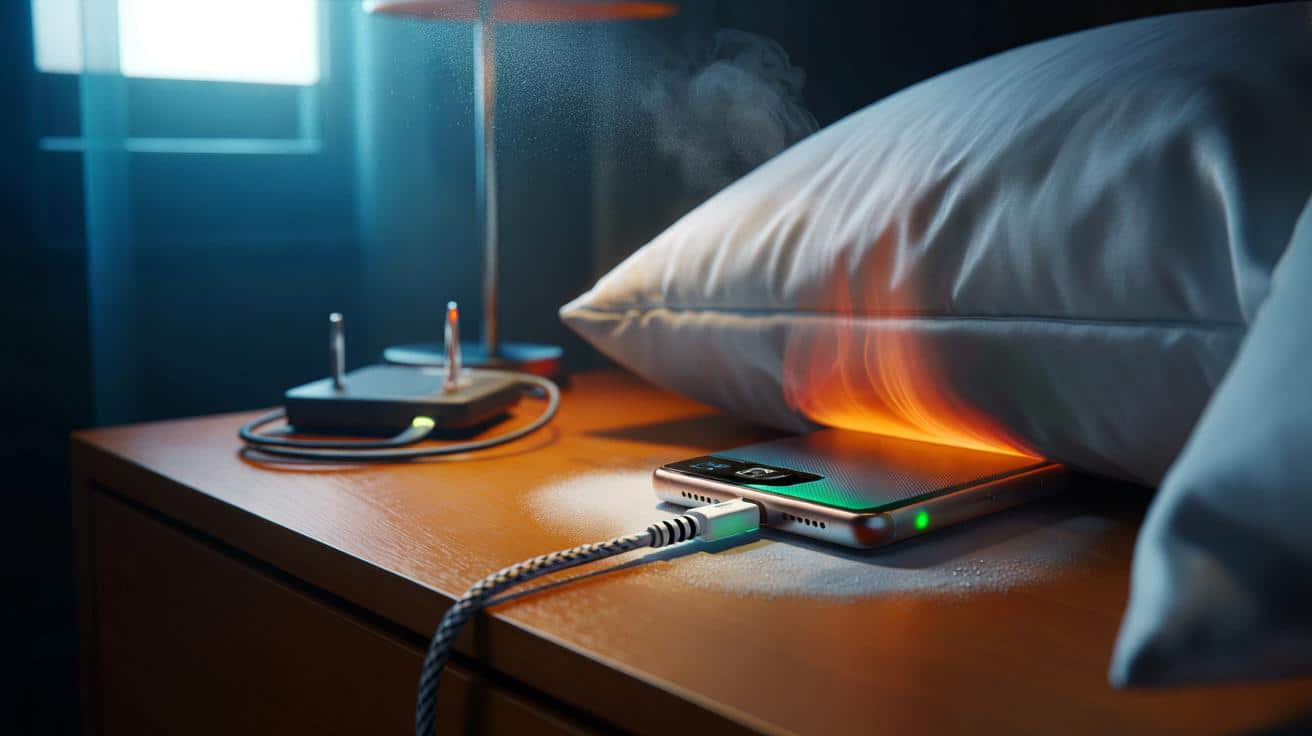
Your phone rests on the nightstand, a cable snaking to the wall, a tiny LED winking through the dark. It looks harmless. This month, it’s worth rethinking that habit — not out of doom, but because small shifts right now can save your battery, your energy bill, and maybe a headache you don’t need.
m. to the pale glow of a screen I didn’t ask to see. A push alert, minor and needless, lit up the room while the phone lay baking on a wooden tray, case wrapped tight, charger humming under the duvet I’d dragged over the corner. The battery read 100% and had probably been pinned there for hours, like a runner frozen on the start line in the rain. I lay there listening to nothing, realising the device I rely on is at its most stressed while I’m asleep. A tiny ritual felt suddenly loud. Something’s off.
What overnight charging really does to your phone
Your phone’s battery isn’t a fuel tank, it’s a living chemistry set. Lithium‑ion cells age fastest when they sit full and warm, and an all‑night top‑up holds them near that upper voltage for six, seven, eight hours. The system does protect itself, but it still nudges the battery in little pulses to keep 100% on the screen. Over time, those hours add up. The quiet cruelty of the habit is that the damage is invisible, until one day your noon battery looks like 5 p.m.
We’ve all had that moment where your phone leaps from 30% to panic in a quarter of an hour. Nights on charge help create that slope. In colder months the contrast bites harder: you bring a chilled device indoors, plug in a fast brick, then tuck it beneath blankets or under a pillow to dim the glow. Heat can build in that pocket of fabric, the battery’s chemistry drifts, and the phone spends the small hours juggling temperature, voltage and trickle. It still works. It just ages faster.
Think of battery stress like microwaving leftovers with cling film on. The energy goes in, pressure builds, everything looks fine from the outside until a seam gives. High state‑of‑charge grows the internal layer that steals capacity, and raised temperatures act like a foot on the accelerator. Engineers talk about ageing roughly doubling for every 10°C climb. That’s why the same device feels different in July traffic or January central heating. At night, with no movement and a tight case, the compromises sit there longer than they need to. This isn’t about panic; it’s about patterns.
What to do instead, starting tonight
Shift the charge window earlier. Top up from, say, 30–40% to 80–90% in the evening while you cook or scroll, then let the phone rest. Many models now offer “optimised” charging or a hard cap at 80% — switch that on and let the software learn your routine. If you really need a full tank for an early train, use a scheduled charge or a smart socket to kick in two hours before you wake, not eight hours before. Small, boring tweaks. Big payoff.
Keep it cool and breathe. Charge on a hard surface with space around it, not under cushions or inside a bag on the floor. Take the case off if it runs warm, use a slower charger at night, and avoid stacking devices in a single nest of cables. Let’s be honest: nobody really does that every day. But doing it most days changes the curve. The aim is simple — spend fewer hours at 100%, and fewer minutes feeling toasty.
Your phone already wants to help. iPhone has Optimized Battery Charging, Androids from Google, Samsung, OnePlus and others offer Adaptive or Protect modes, and some let you set an 80–85% ceiling or a “charge limit while you sleep.” Use it, and pair it with a habit that fits your life rather than the charger’s timetable. If you can’t change the when, change the how: slower, cooler, capped.
“Charge slow, stay cool, leave room to breathe — that trio does more for battery life than any magic app ever will.”
- Set an 80% cap or “optimised” mode tonight.
- Charge in the evening, not all night.
- Place the phone on a hard, uncovered surface.
- Use a slower charger while you sleep, a faster one only when you’re watching it.
- Keep cables and plugs from reputable brands with proper certification.
The bigger picture: little habits, long life
This month brings colder rooms, thicker duvets, and newer software features rolling out on the quiet. That mix is the nudge. The risk of immediate failure is low, yes, yet the long‑term drag is real, and the fix lives in easy margins — ten minutes earlier, a softer cap, a cooler spot. Multiply that by a whole household and you shave money, heat, and stress you don’t need. The best charging routine is the one that disappears into your day and leaves your battery younger tomorrow than it would have been. Your future self, stuck on 3% outside a station, will be glad you started this month, not the one after.
| Key point | Detail | Interest for the reader |
|---|---|---|
| Avoid pinning 100% overnight | High voltage and heat speed up battery ageing during long, idle charges | Longer battery lifespan and fewer midday drops |
| Switch on charge caps/optimised modes | Modern phones can hold at ~80–85% or delay the final top‑up | Automatic protection with zero daily effort |
| Charge earlier, slower, cooler | Short evening top‑ups, hard surfaces, and slower bricks at night | Safer charging and more consistent performance |
FAQ :
- Is overnight charging dangerous?Quality chargers and phones include safety features, and fires are rare, but heat plus soft furnishings raises risk while also ageing the battery. Give the device air and skip the all‑night top‑up.
- Does stopping at 80% really help?Yes. Keeping the battery away from the top end reduces chemical stress, which preserves capacity over months and years.
- What if I need 100% every morning?Use a schedule: start charging before your alarm so the phone hits 100% near wake‑up, not at midnight. Or keep a cap on most days and go full only on travel days.
- Should I let the phone hit 0% sometimes?No for daily use. Deep drains strain the cell. A full drain a few times a year can help recalibrate the gauge, not the chemistry.
- Do fast chargers ruin batteries?They don’t “ruin” them, but they create more heat. Save the rapid bricks for quick pit stops you can watch, and rely on slower charging when time is on your side.







Is this a bit alarmist? My phone’s been charging overnight for years and the batttery’s fine… I think.