
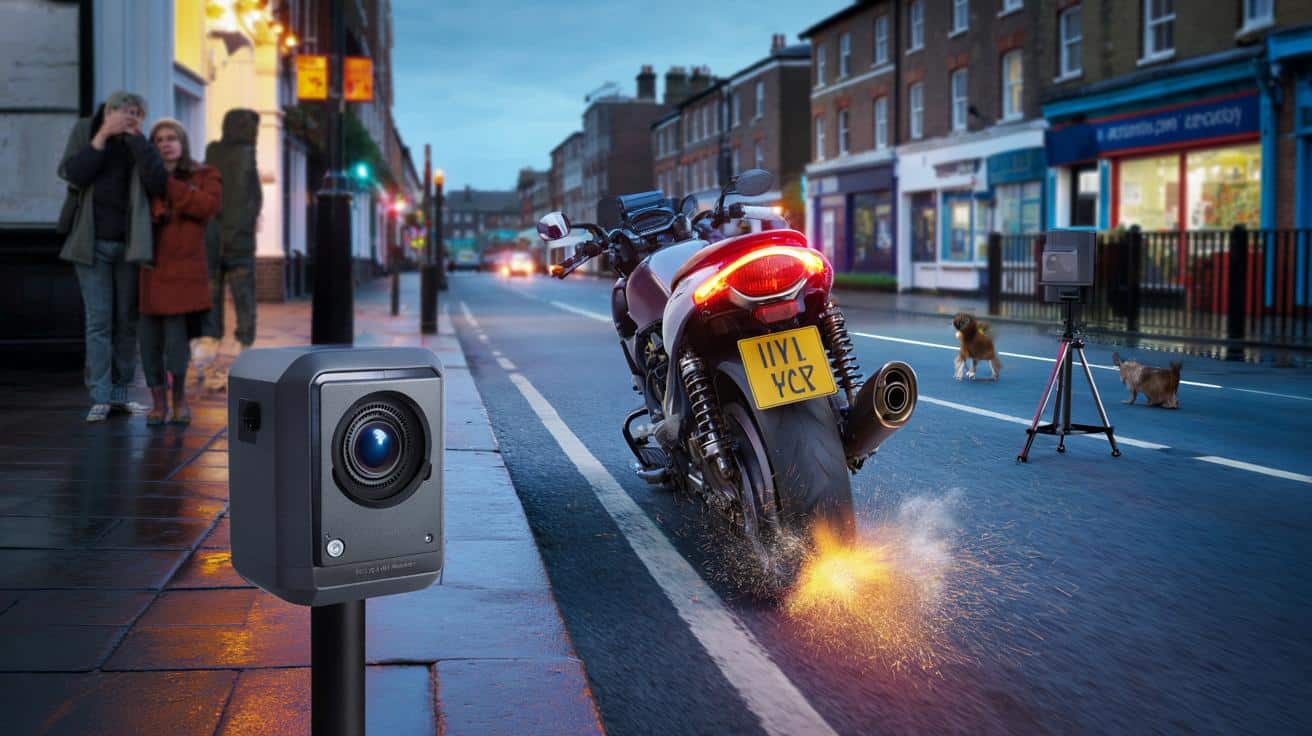
A new wave of “noise cameras” is being switched on across the UK, primed to catch cars and bikes with antisocial exhausts. Councils say they’re answering residents who can’t sleep. Riders worry about false readings and mission creep. The list of locations is growing, and some are closer than you think.
A bike rips through the high street, exhaust barking off brick and glass, the kind of sound that doesn’t just pass — it stamps. A dog barks back. Someone at the bus stop mutters an oath. In the quiet that follows, a little grey box on a lamp post clicks alive, watching, listening, waiting.
By morning there’s fresh talk in the café. “They’ve put one outside the school.” “My mate got a letter.” The barista shrugs, as if to say: finally. The city adjusts when it must. Your street might be next.
New noise cameras: what they are, why they’re arriving, and where first
Noise cameras pair an array of calibrated microphones with a camera and number plate recognition. When a passing vehicle breaches a preset decibel threshold, the system triangulates the source, snaps the plate, and logs the evidence. Think speed camera, but for sound. It measures a burst, not your mood, and it’s built to ignore footsteps, chatter and the bin lorry two streets away.
Local leaders say the timing isn’t random. Complaints about loud exhausts have surged since lockdown-era modifications and late-night deliveries changed street rhythms. Hospitals and schools near busy roads report sleepless nights and disrupted lessons. The World Health Organization classifies chronic traffic noise as a public health risk. A resident near a pilot site put it plainly: the loudest five seconds of someone’s fun can ruin an hour of everyone else’s evening.
Under UK law, vehicles must have effective silencers and not emit “excessive noise.” There isn’t a one-size roadside limit, so the tech uses a locally set trigger — often in the mid-to-high 80s dB at a defined distance. That isn’t whisper-quiet; it’s the difference between a well-kept stock system and a cut-out that shouts. Officers review clips before any action, which aims to weed out one-off bangs, sirens and shared blame from traffic echo. It’s not perfect, but it’s not guesswork.
Is your area on the list? How to check, what to expect, and how not to get caught out
Start with your council’s notices page. New acoustic enforcement often appears under traffic management or environmental health, sometimes as a “trial of acoustic cameras” or a “public realm noise initiative.” Scan cabinet papers and minutes — search terms like “noise camera,” “acoustic camera,” and “exhaust enforcement” help. Local papers are quick to spot kit on lamp posts. If you’re still unsure, an FOI request to the council or police can confirm whether devices are live, in test mode, or purely collecting data.
On the ground, the boxes are compact and discreet — a weatherproof unit with a small multi-mic array and a camera facing the carriageway. You might see temporary units on tripods during early testing, sometimes with a mobile “noise van.” Expect warning letters first in many schemes, then targeted stops or penalty notices where officers verify an offence. Let’s be honest: nobody checks every bolt and baffle before a 7 a.m. commute. A quick weekend look can save you a nasty Monday letter.
If you ride or drive, keep it simple. Stock or approved aftermarket systems with intact baffles almost always sit below trigger levels in normal use. Watch cold-start blips near homes. Fix leaks — a tiny gap can make a lawful exhaust sound lawless. If you’re curious, a phone dB app gives a rough idea, though it’s not evidence. One more thing: we’ve all had that moment where a short tunnel begs for a cheeky downshift. Resist near schools and hospitals. Your neighbours will notice.
“This isn’t about punishing classics or car culture,” says a council cabinet lead from a pilot town. “It’s about the bikes and cars measured well above what’s reasonable at midnight on residential streets.”
- Early pilot and rollout watchlist (publicly reported since 2019): Bradford, Birmingham, South Gloucestershire, and Great Yarmouth featured in national trials. London boroughs have run site tests around hot spots. Several northern and Midlands authorities have confirmed exploratory work. The list shifts fast, so check your council’s latest notices.
- What triggers a capture: A brief exceedance of a set decibel level at a measured distance, with microphones triangulating the loudest source before the camera fires.
- What usually happens first: Data collection and warning letters. Penalties tend to follow only when officers corroborate persistent breaches or clear equipment tampering.
What this could change on your street — and how the sound of your city might soften
Noise isn’t just loud; it’s place-breaking. In streets where these cameras go up, late-night roar gives way to a different feel — windows stay open longer, conversations linger, light sleepers reclaim a few precious hours. Enthusiasts don’t disappear, they adapt routes and habits. Car meets shift earlier. Garages report a bump in legal baffle refits. It’s a nudge, and you can hear it.
There’s a fairness thread running through this. People who love machines deserve roads that still feel civil. People who love quiet deserve to keep their windows ajar in summer. The tech only works if those two truths hold together. Some will see overreach in every grey box; others will see a small victory on a long, sleepless street. Both reactions make sense. Streets are where our compromises become real.
The question now isn’t whether sound can be measured — it can — but how we decide what’s acceptable for a shared life. Cities grow loud, then learn to listen, then adjust. Your area might be doing that this month. Or next. Listen out, in every sense.
| Key point | Detail | Interest for the reader |
|---|---|---|
| What a noise camera records | Short sound bursts over a set dB level, tied to a number plate via ANPR and time-stamped audio | Know what evidence exists if you receive a warning or notice |
| Where they’re appearing | Pilots in selected towns and cities, expanding via council-led deployments at complaint hot spots | Check whether your street could be in the next wave |
| How to stay on the right side | Use compliant exhausts, fix leaks, avoid high-rev antics near homes, especially at night | Keep your licence clean and avoid unexpected costs |
FAQ :
- Are there fixed legal dB limits for roadside checks?UK rules require effective silencers and ban excessive noise, but roadside decibel limits aren’t universal. Camera thresholds are set for trials and reviewed by officers to screen out false triggers.
- Will I get an instant fine from a noise camera?Most schemes start with data gathering and warning letters. Enforcement follows when evidence shows persistent breaches or clear modifications that defeat silencers.
- Can classic cars and bikes get caught unfairly?Older vehicles can be louder by design, yet still lawful. Officer review and context — time of day, throttle behaviour, measured level — usually decide next steps.
- What about privacy and data?Images and sound snippets are processed under traffic enforcement and environmental rules, with retention limits. The systems target vehicles exceeding thresholds, not general conversation.
- Is my area on the current list?Councils publish trials and deployments in meeting papers and notices. Search your council site, check local news, or file a brief FOI for confirmation where signage is unclear.







Living near a school, I’m glad to see this moving beyond talk. Chronic traffic noise really does grind you down; WHO calls it a health risk for a reason. If officers actually weed out one-off bangs, this is a fair nudge. Definitley time for quieter nights.