
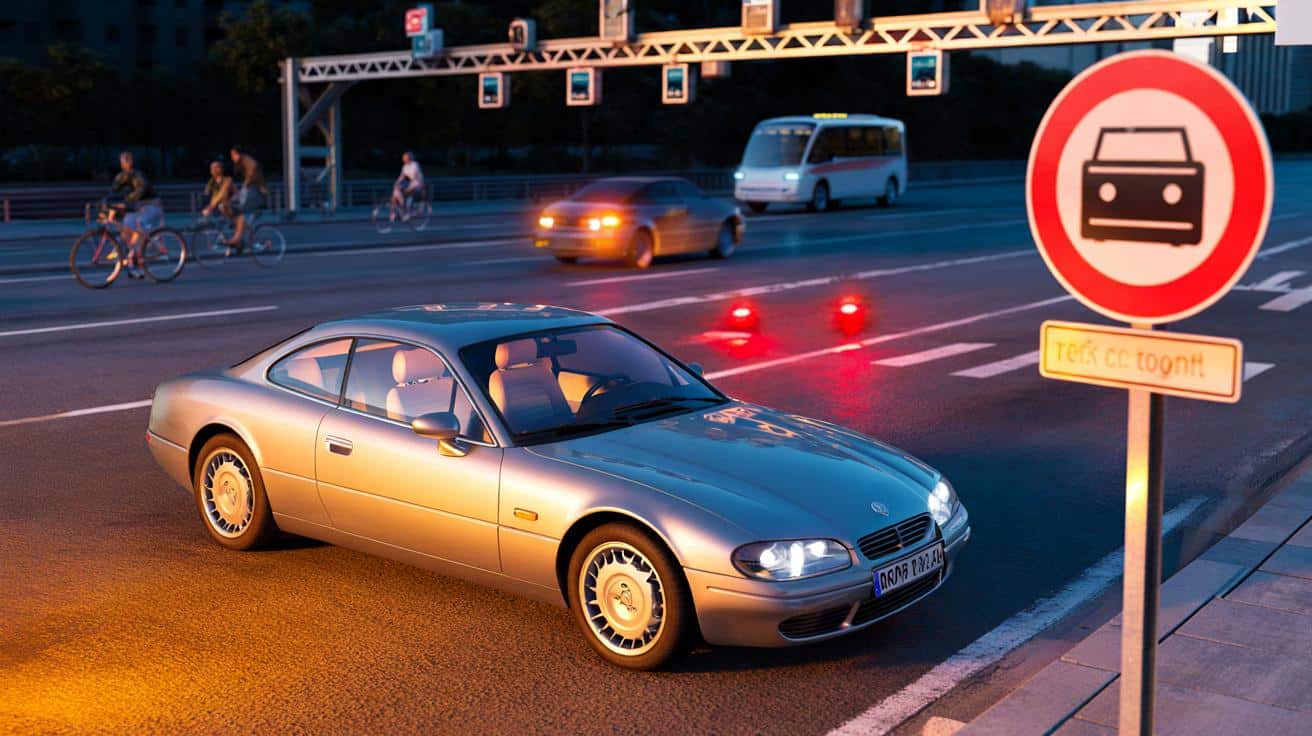
A growing web of clean-air rules is quietly turning age into a red line. Hit 20 years old and your beloved “modern classic” can find itself shut out of city centres, tolled into oblivion or pinged by a camera for simply cruising a familiar street. The badge might say GTI, Turbo or VTEC. The sign on the gantry says something else entirely.
A driver noses a 2004 saloon towards town for coffee and a flea market run. The old stereo crackles, the cabin smells faintly of warm leather and petrol. Then a phone buzzes: “Low Emission Zone active.” The sign ahead blinks. Automatic enforcement. Fines if you don’t comply.
The car is cherished, pampered, barely does 2,000 miles a year. It’s also, by the calendar, about to cross a line. You can feel the mood shift with a single beep.
One short idea sits heavy: age equals risk.
The “20-year rule”: a blunt line creeping across maps
Talk to owners’ clubs and you’ll hear the same phrase: the **20-year rule**. Nobody in Whitehall wrote that into law. It’s the rolling reality of emissions standards meeting council boundaries. Once a petrol car predates Euro 4 (roughly 2005) or a diesel predates Euro 6 (2015), doors start closing. Some cities charge. Some simply don’t let you in.
In Scotland, the **Scottish LEZ** network in Glasgow, Edinburgh, Aberdeen and Dundee now blocks non‑compliant vehicles outright, enforced by cameras and penalties. That means most petrol cars from 2004 and earlier, and many diesels up to 2015, are off-limits in the core. London’s ULEZ takes a different tack, applying daily charges rather than bans, but the effect on older metal is similar. Cross the line in a 2003 hatch and you’ll feel it in the wallet.
On the continent, the pattern is spreading. Paris’ ZFE-m uses Crit’Air stickers that track age and Euro class, with tighter thresholds on the way. Milan’s Area B bars a swathe of older diesels on weekdays, with limited carve-outs for registered historic vehicles. Dutch cities restrict older diesels via emissions class, while Germany’s Umweltzone green sticker locks out cars that can’t meet it. It’s not a single statute. It’s a map of red circles growing slowly, year by year.
How it hits you on an ordinary drive
We’ve all had that moment when the car feels perfect and the road says no. Picture a tidy 2004 MX‑5 rolling towards a riverfront you’ve visited for years. Fresh tyres, new plugs, a paint correction because you care. A small detour becomes a maze of camera zones. You bail early, park two miles out and walk. The coffee tastes different when the route home is a question mark.
The numbers give that feeling hard edges. Euro 4 for petrol arrived around 2005; anything older can be classed as a higher polluter. Euro 6 for diesel came a decade later; so a 2006 diesel estate, cherished and economical, still falls foul in many cores. In Scotland’s LEZs, penalties start after a first warning; in London, charges add up with every trip. It doesn’t matter if your car is spotless or barely driven. A camera can’t see care, only compliance.
There are exceptions, and they matter. The **historic vehicle exemption** in the UK kicks in at 40 years old for tax and, crucially, ULEZ/LEZ relief. Scotland recognises DVLA “historic” status, too. That’s great if you run a 1986 coupe. For “modern classics” from the early 2000s, the gap is real. Twenty years means a rolling risk window where insurance is cheap, joy is high and access gets awkward. The rule isn’t written, yet it’s everywhere.
Keep driving: practical ways to stay legal without killing the joy
Start with your car’s exact emissions status, not guesswork. Check the V5C for Euro spec, then use official tools: Transport for London’s checker for ULEZ, your city’s LEZ portal in Scotland, and council maps elsewhere. If the Euro class isn’t listed, ask the manufacturer for a certificate of conformity. Keep screenshots or a printout in the glovebox. It’s not romantic, but it stops arguments.
Route like a local, not a sat-nav zombie. Flip to map view and look for rings and shaded polygons that mark zones; even Google and Apple Maps are getting better at this. Save “safe” waypoints on the outskirts with good parking, then enjoy the final miles on foot or bike. Let’s be honest: nobody checks a council PDF before every Sunday drive. Build a short list of favourite spots instead. It lowers blood pressure and parking tickets.
Owners often trip on myths. A cherished plate doesn’t change your car’s Euro class, and a flawless MOT isn’t a pass for a camera zone. Retrofitting helps for vans and buses; for passenger cars it’s rare and usually not officially recognised. Insurance add‑ons won’t cover fines. One more thing: note the residents’ grace periods where they exist, and don’t rely on them lasting. It feels unfair when a well‑kept coupe gets lumped in with smoke‑belching bangers.
“I baby this car, but the cameras don’t care how it’s maintained. Either I plan my route or I pay for the privilege of nostalgia.”
- Find your Euro class: V5C, manufacturer letter, official zone checker.
- Plan edges: save two or three car‑friendly hubs just outside restricted cores.
- Join a club: pooled knowledge, group runs, and zone-savvy meet points.
- Think timing: early mornings and weekends can be friendlier in some cities.
- Keep proof: screenshots of compliance checks and any exemptions on your phone.
Why the line keeps shifting — and what it means next
The “20-year rule” isn’t a conspiracy. It’s a blunt proxy for emissions in a world that loves simple triggers. Policymakers need thresholds they can explain on a poster; Euro classes do that job, and age is an easy stand-in. The nuance of a carefully tuned 2003 sports car just doesn’t read at 30mph past an ANPR camera. That’s why this feels personal, even when it isn’t.
The flipside is opportunity. Cities are starting to carve practical corridors: park-and-ride sites with chargers and good security, Sunday events with exemptions, outer belts that stay friendly to older cars. Clubs are getting savvier with meet locations and joint representations to councils. There’s room for smarter rules too, like mileage-based permits for verified low-usage classics, or broader recognition of certified “vehicles of historic interest” under European guidance.
Age-blind tools could help. Imagine a roadside test that verifies real-world emissions rather than birthday candles, granting a rolling permit to cars that demonstrably run clean. Tech exists, appetite varies, and politics will set the pace. Until then, this is the game: know your maps, know your car, share intel with other drivers. The culture survives when the knowledge passes hand to hand. That’s always been part of the magic.
| Key point | Detail | Interest for the reader |
|---|---|---|
| Rolling “20-year” risk window | Pre‑Euro 4 petrol and pre‑Euro 6 diesel face bans or charges in growing zones | Spot when your car crosses from free roaming to restricted access |
| Ban vs charge | Scotland’s LEZs prohibit entry; London’s ULEZ bills daily | Choose between rerouting entirely or budgeting for the drive |
| Exemptions exist | DVLA “historic” (40 years) often exempt; local carve‑outs vary | See if your car, or your situation, can legally slip through |
FAQ :
- Is there an official UK law that bans all 20‑year‑old cars?No. “20‑year rule” is shorthand for how age correlates with Euro emissions classes used by many zones.
- Will my 2004 petrol be allowed in Scottish LEZs?Most 2004 petrol cars are pre‑Euro 4, so they’re typically non‑compliant and barred from entry.
- Do London classics under 40 years get any exemption?Not by age alone. ULEZ exemption generally applies to vehicles in the DVLA “historic” class, which starts at 40 years.
- Can I retrofit my car to comply?For passenger cars, recognised retrofits are rare and hard to certify. Vans and buses have more options.
- How do I check my car quickly before a trip?Use TfL’s ULEZ checker, your city’s LEZ site, and your V5C or manufacturer letter for the Euro standard. Save the results.







Isn’t this just a stealth ban on anything pre‑Euro 4, dressed up as “clean air”?
So my 2003 MX‑5 is fine to sip fuel on Sundays but Public Enemy No. 1 on Tuesdays? 😅 Appreciate the route‑planning tips and the reminder to screenshot checks!