
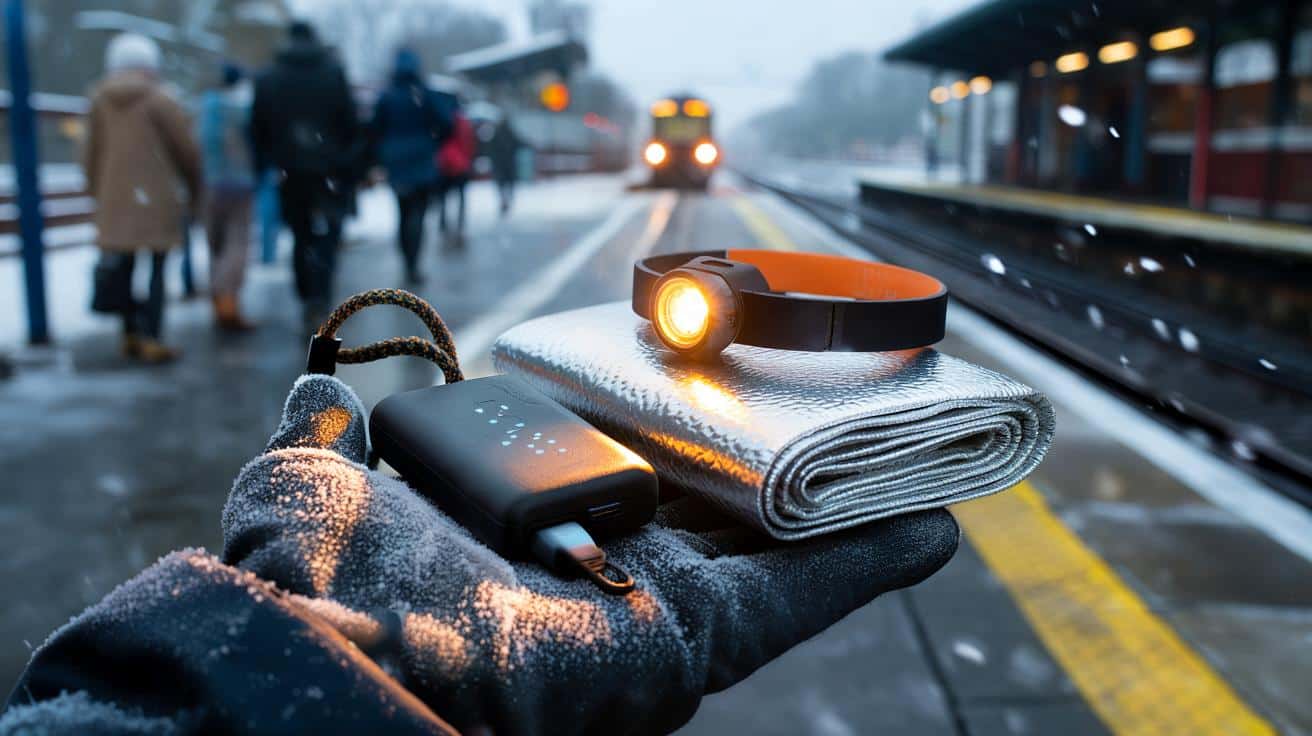
It just arrives, flattening streets and plans alike, turning a familiar commute into a slow-motion puzzle. You don’t need a full survival rucksack to handle that pivot. You need a tiny backup plan for when the day goes sideways and the weather bites harder than expected. An “emergency winter kit” sounds grand, but the smartest version fits in your hand. The trick is choosing the right three things—and keeping them where you can reach them.
It’s a small hour on a dim platform, the sort of grey British morning that tastes like metal. Trains delayed. Breath hanging like speech bubbles. Someone’s phone blinks red at 3%. Another person cups their hands for warmth, rubbing like they’re trying to light a fire by willpower alone. A cyclist rolls past with a head torch that steals the darkness for a few metres and then gives it back. The man next to me pulls a crinkled silver blanket from his tote and suddenly looks, if not warm, then less worried. Nothing heroic, just prepared. The whole scene changes tempo when one person is ready. What fits in a pocket can change the night.
Why this tiny kit punches above its weight
Experts talk in categories—heat, light, communication—because those three needs crash the party first when winter goes wrong. One handles the cold shock, one lets you see and be seen, one keeps you connected to help and each other. With the right trio, the chaos settles into something you can manage. You’re not building a bunker. You’re buying time. Time to think, to call, to wait, to move safely without bleeding warmth. That’s the heart of a good winter kit.
Think about the moments that test you. A car stuck on a frosty B-road behind a jack-knifed lorry. A rolling power cut the night your toddler spikes a fever. A hillwalk where the weather switches from “brisk” to “hostile” in twenty minutes flat. In each case, people who carried light, warmth and power coped longer and worried less. Breakdown patrols talk about queues that stretch across lay-bys. Community responders remember homes that feel colder by the minute once the lights dip. The pattern repeats in different places with the same hinge point: those three basics make the waiting bearable and the next step possible.
This isn’t gadget worship. It’s risk math. Hypothermia starts as a whisper—shiver, clumsy zip, foggy thinking—and a thermal layer interrupts that slide. Darkness multiplies small hazards, from an unseen kerb to a spin on black ice; a torch cuts that risk in half. Phones don’t just call people; they are maps, torches, tickets, and emergency beacons. Keeping one alive keeps options alive. *Small tools that stretch options are the most valuable tools you own.* You don’t need many. You need the right ones.
What to pack: the expert trio, used right
Start with a **power bank** around 10,000 mAh. That’s enough for two to three phone charges and a head torch recharge if it’s USB-based. Add a short, tough cable that actually matches your device, and stash both in a zip bag. Then choose a compact head torch or sturdy torch that throws a clean beam, ideally with a low mode for long runtimes and a flashing mode for signalling. Lastly, carry a foil thermal blanket or—better yet—a reflective bivvy sack that wraps heat around you instead of letting it leak into the air.
Put this trio where you live your life: coat pocket, rucksack front pouch, glovebox. Not buried under shopping or the kids’ boots. We’ve all had that moment when the thing you need is “somewhere safe,” which turns out to be somewhere useless. Charge the power bank on a Friday, skim a 10-second torch check on Monday, and swap the blanket to your winter coat when the clocks change. Let’s be honest: nobody does that every day. Build tiny habits that survive busy weeks.
Skip the novelty stuff. Cheap lights dim when you most need them. Huge batteries never get charged. Overstuffing a kit means you stop carrying it. You want muscle memory, not admin. Light, warmth, connection—everything else is nice-to-have.
“Warmth keeps your core steady. Light keeps small problems small. Power keeps you in the conversation.”
- Power bank: 10,000 mAh, single button, cable that fits your phone, stored at room temperature.
- Torch or head torch: 150–300 lumens, a flood beam, lockout to stop accidental switch-on.
- Thermal blanket or bivvy: reflective, tear-resistant, big enough to cover your whole body.
Make it a habit, not a hassle
Winter kits fail when they become chores. They work when they become part of the way you leave the house, like grabbing your keys. Treat the trio as a tiny insurance policy with real-world dividends: a warm friend on the pavement while you wait for the night bus; a lit path across a car park iced like glass; a phone that still rings when the temperature nags your battery into quitting early. Share the trick. Put a set in your partner’s bag. Keep a spare in the office drawer. Test it once, and you’ll trust it. And once you trust it, you’ll carry it.
| Key point | Detail | Interest for the reader |
|---|---|---|
| Power that lasts | 10,000 mAh bank with the right cable, topped up weekly | Phone stays alive for maps, calls, tickets and updates |
| Light that works | 150–300 lumen torch or head torch with long runtime modes | See hazards, be seen by drivers and rescuers |
| Warmth that buys time | Reflective blanket or bivvy that traps body heat | Slows cold stress while you wait or walk |
FAQ :
- Do I really need only three items?For a daily carry kit, yes. These three cover heat, light and connection—the core needs that tend to fail first in winter surprises. Add extras for the car or longer trips if you like.
- Head torch or handheld torch?Head torches free your hands on icy ground and in broken lifts; handheld torches can be tougher and brighter. Pick the one you’ll actually carry. Many people keep a head torch in the coat, a torch in the car.
- What’s the difference between a foil blanket and a bivvy?A blanket wraps around you; a bivvy is like a reflective sleeping bag. Bivvies trap heat better and block wind. Blankets are lighter and cheaper. Either is a huge step up from nothing.
- How often should I charge the power bank?Once a week in winter keeps it reliable. Set a calendar nudge for Friday afternoon or tie it to a routine like the weekly shop. Short top-ups are fine with modern banks.
- What about water, snacks, or a first aid kit?Great additions for the car or a longer day out. The pocket kit is about the minimum that still changes your odds. Build up from there based on your routes and your people.



Does a 10,000 mAh bank really give two or three charges when it’s -5°C? Mine drops fast in the cold. It definately seems worse below freezing. Any tips beyond “keep it warm”? Inside-jacket carry? Short cable? A bank with passthrough? Are those capacity claims measured at room temp or in real winter?
Loved the heat–light–connection framing. Simple, actionable, and not doomsday-ish. Thanks! 🙂