
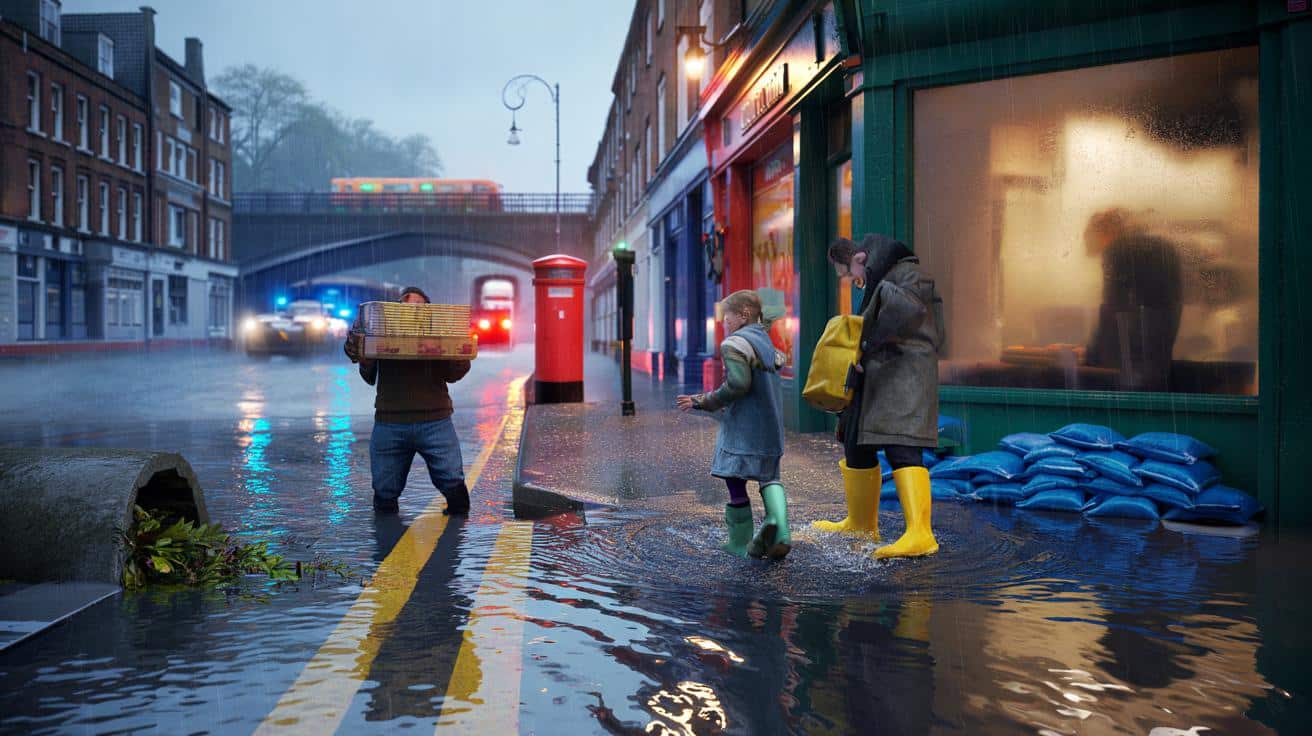
Roads that once puddled now resemble shallow estuaries. Commutes shift, plans wobble, and the map of daily life redraws itself in water.
The café windows steamed in the half-light, and the barista kept glancing at the door as if the rain might walk in. On the street, gullies gulped and overflowed, the drains thrumming like bass speakers under the pavement. A delivery driver rolled up his jeans, shrugged at the sky, and carried bread through a veil of drizzle, while school kids in oversized wellies tested the depth of a mirrored curb.
Trains crept. The river rose. At the station, an announcement apologized for “ongoing weather.” People smiled that thin January smile, the one that means we’ll get on with it. Then the sirens started.
When the month forgot to stop raining
This isn’t just a statistic and a grim headline. It’s how the rain pushed across counties, loaded clouds spinning through the same corridor, and the ground ran out of places to drink. The air felt constantly washed, as if someone left the sky’s tap slightly open.
From Cornwall to Cumbria, the pattern was repetition. Day after day, showers stitched themselves to fronts, and fronts welded themselves to storms. **Some towns saw back-to-back flood alerts for more than a week.** You could sense it in the chatter at bus stops: “Again?”
Provisional Met Office figures point to a national series that now surpasses previous January benchmarks, a record that reaches back into the nineteenth century. The jet stream sat low and lively, aimed at us like a firehose, while milder-than-usual seas kept feeding the conveyor belt. *Water carries memory, and by week three the soil remembered every drop that fell.*
One street, many stories
In a market town by a braided river, blue sandbags became part of the street furniture. A newsagent taped a line on the back wall to mark last year’s high-water scar, then watched this year’s line climb higher by a hand’s breadth. He turned the sign to “open” anyway and sold batteries until the lights flickered.
On a new-build estate outside Cardiff, families shuttled furniture upstairs with the odd calm that comes from knowing you’re not alone. Bin bags bloomed on the verge. A flood warden showed a neighbour the flood map on her phone, swiping between yellow and amber with the same resignation as checking a weather app for sun. People who never met before shared brooms and tea.
In London, the issue looked different. Less water in the living room, more seep into the schedule. Short flights grounded, buses diverted, travel times lengthened by a dozen tiny hesitations. The city can stomach inconvenience, yet it hates uncertainty. The problem wasn’t only the volume; it was the relentlessness, the refusal of the rain to blink.
What the science is quietly shouting
Weather is weather, but it doesn’t sit in a vacuum. Warmer air holds more moisture, around seven percent per degree, so showers can arrive heavy and quick. The UK sits beneath a tangle of Atlantic patterns, and this January those patterns lined up like dominoes.
El Niño likely nudged the jet stream, sea surface temperatures held the atmosphere’s hand, and the conveyor kept rolling. Saturated catchments turn rain into runoff faster, which is why late-month showers did more. You could feel it underfoot on towpaths that squelched like sponges.
Researchers describe a simple equation: incrementally warmer climate plus a locked-in storm track equals bigger rainfall peaks, especially where rivers and roofs already struggle. The models don’t predict every squall or gust, but the trend should surprise nobody. The records are not occasional outliers anymore; they are footsteps on a path we’re already walking.
Your next practical moves
Start with the doorway, then move inwards. Fit temporary flood boards or even a thick, well-secured plank wrapped in a plastic sheet for a quick seal. Create a little rise for appliances using bricks or purpose-made feet, and lift rugs onto tables to keep them from wicking water up.
Drying a damp room is about airflow plus extraction. Crack windows on the sheltered side and run a dehumidifier with doors closed, alternating rooms in three-hour cycles. Aim fans across the wet surface, not at it, so the air skims and lifts moisture. Keep heat steady and low; rapid blasts just push humidity into colder corners.
Do not switch anything on until a qualified electrician has checked it. Treat floodwater like it’s contaminated, because it often is. Gloves, masks, and a dedicated mop bucket reduce exposure. Bag soft furnishings quickly if they’re beyond saving, to keep spores from getting a head start.
Common mistakes to avoid, and kinder ways to cope
Don’t rip out plaster immediately; let professionals test with a moisture meter. Many walls need slow, consistent drying to prevent cracking and salt blooms. Keep a photo diary for insurers, and label every box you move upstairs so you’re not unlocking chaos later.
On the roads, don’t try to ford the pretty-but-deep puddle that hides a pothole or a manhole lid. Breaks become landslides in fields and verges; park with that in mind. Let’s be honest: nobody checks a grab-bag every day, but a torch, spare phone charger, and old-school map live happily by the front door without fuss.
“We mopped until 2am, then we just listened,” said a resident in York. “You learn the sound of the water leaving. It’s almost hopeful.”
- Quick kit: torch, power bank, gaffer tape, gloves, bin bags, basic first-aid, copies of IDs.
- House moves: lift electrics off floors, photograph meter readings, label keys and shut-off valves.
- Community actions: share dryers, rotate dehumidifiers, and set up a WhatsApp check-in loop.
What this wet January tells us about the year ahead
Infrastructure is a living thing. It ages, it creaks, it signals where attention must land next. After this month, that signal is loud: drains demand investment, floodplains need room, and planning must match the water we actually see, not the water we used to expect.
Insurance will be a bigger conversation at kitchen tables. Farmers will eye planting calendars differently, thinking about soils that stayed soggy long past their usual cue. The cultural rhythm shifts too, from festivals to football fixtures, when weather is less a backdrop and more a lead character.
We’ve all had that moment when a small plan unravels—school run, train connection, a walk to clear your head—and you feel the limits of your own map. The cure is rarely grand. It’s neighbourly competence, realistic prep, bit-by-bit resilience, and an eye on the forecast with less dread and more strategy. There’s agency in that.
| Key point | Detail | Interest for the reader |
|---|---|---|
| Record rainfall | January 2026 now tops the Met Office’s national series dating back nearly two centuries | Frames the scale of what you just lived through |
| Why it happened | Moister air, warm seas, and a low, fast jet stream kept storms queuing over the UK | Turns confusion into clarity and practical awareness |
| What to do next | Property-level protection, safe drying techniques, and community coordination | Immediate actions that actually make a difference |
FAQ :
- What exactly did the Met Office confirm?That January 2026 delivered the highest UK-wide January rainfall on record in the national series.
- Is this just freak weather?It’s weather, yes, but amplified by a warmer atmosphere and ocean. Records are getting easier to break.
- Should I install flood protection now?If your street splashes regularly, yes. Start with door guards, non-return valves, and moving sockets higher.
- How do I dry a room without mould?Steady heat, airflow across surfaces, and a dehumidifier in cycles. Clean with biocidal wash once it’s touch-dry.
- Will the rest of 2026 be this wet?No one can promise that. Seasonal patterns shift, but preparedness pays off whatever the sky decides.






Thanks for the clear explainer—finally makes sense why the ‘ongoing weather’ announcements never stopped. The stats plus jet stream/El Niño combo was helpful. Also appreciated the practical bits: dehumidifier in 3-hour cycles, airflow across surfaces, and not switching electrics on. I’ll definitley be moving sockets higher and grabbing non-return valves.