
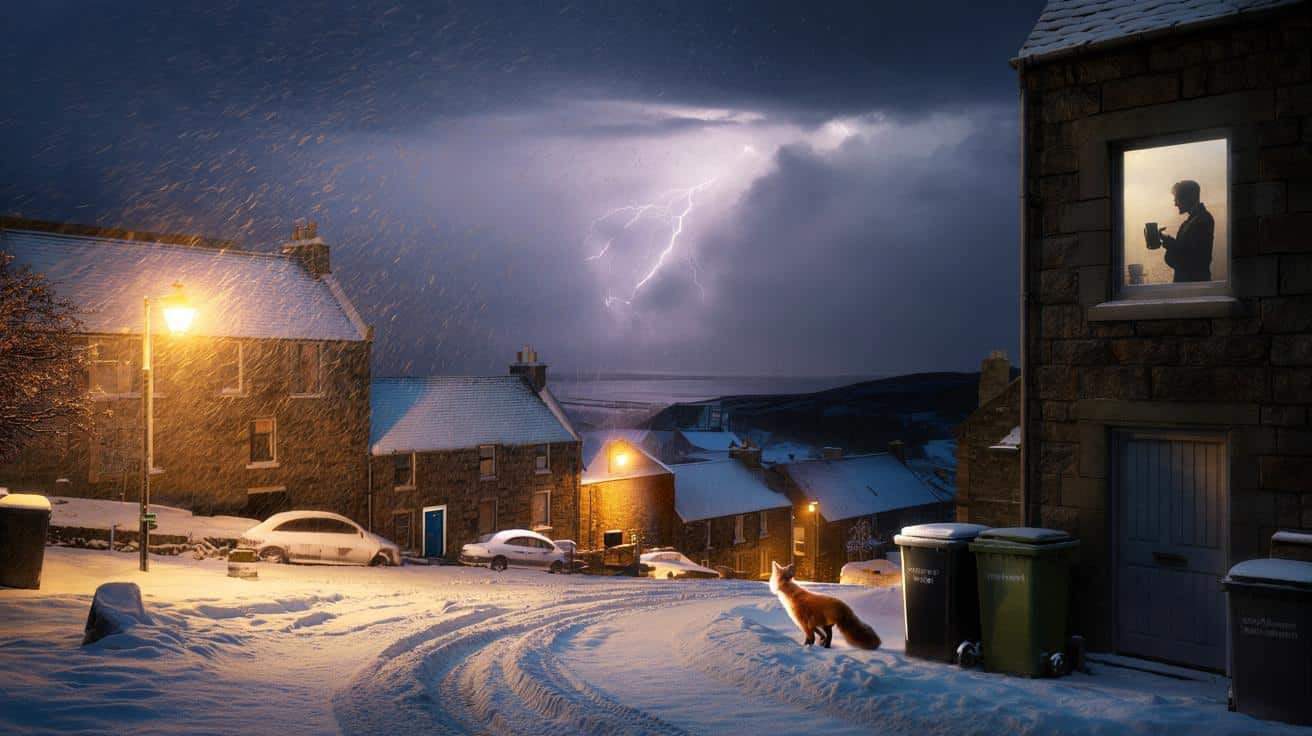
A rare burst of “thundersnow” is on the cards for parts of Scotland and the North, with forecasters flagging the Highlands, Aberdeenshire and exposed east coasts first in line. Night-time travellers, early commuters and curious sky-watchers may all hear thunder roll over falling snow — a winter soundtrack that feels both eerie and thrilling.
Streetlights caught them and turned the air into a slow-motion swarm, the sort of snowfall that hushes a town. Then, without warning, the night blinked white. A bang followed, not crackling like summer, but deep and muffled, as if someone had slammed a door on the sky.
Heads tilted from windows. A fox froze by the bins. Somewhere, a dog barked and then stopped mid-growl, as if confused by the rules of sound. The thunder sounded like a cupboard door closing in the next room. It lasted a heartbeat, then the snow fell thicker. Another flash. Another rumble. And for a moment, winter felt electric. It won’t be the last time this week.
What thundersnow looks and sounds like on the ground
When lightning fires inside a snow shower, everything about the storm feels wrong in a very right way. Light scatters off the flakes, so the flash is diffuse, almost creamy, more lantern than strobe. The thunder doesn’t crack and ricochet. It thuds, softened by the snow-laden air, arriving late, like a memory of a storm rather than the thing itself.
People describe it with kitchen words — a pan dropped, a heavy drawer slammed — because that’s how it lands on your chest. In Scottish towns under a North Sea feed, the effect can be oddly intimate. The street goes silent between gusts, then a distant drumroll crawls in from the firth and shivers the windows. You step outside with a mug, snow stippling your sleeves, and the whole scene seems to breathe. **Thundersnow is lightning inside a snowstorm, but it’s also a mood.**
Physically it’s simple, and not simple at all. You get unstable, very cold air moving across relatively warmer water, picking up moisture and energy, then dumping it as lines of snow showers over land. Inside those clouds, soft hail — graupel — rubs past ice crystals, trading electrical charge. Enough separation builds, a path opens, and the cloud discharges. The snow absorbs some of the sound and light, so what reaches you is filtered and strange. Think of it as summer convection wearing a winter coat.
Where and when to catch it safely — and what not to do
If you’re in the Highlands, Grampian, the Moray coast, or along exposed parts of Fife and Northumberland, keep an ear out overnight into the early morning, when the air is coldest and shower lines are most organised. Watch for short, sharp bursts of heavy snow with gusts, the sort that whiten a road in minutes, then move on. The best vantage is a window facing windward, lights low, eyes adjusted. A thermos helps. So does patience.
Drivers on higher routes — A9, A96, the A66 over the Pennines — should slow early when a shower approaches. Visibility can vanish between one bend and the next. We’ve all had that moment when the world goes white and the sat nav is your only friend. Keep a scraper, warm layers, a small shovel and a phone battery pack within reach. Let’s be honest: nobody checks their torch batteries every day. Do it tonight and you might thank yourself by dawn.
Chasers and photographers feel the pull most, but pick your battle. Wind-blown snow hides kerbs and black ice hides everything else. If you must head out, tell someone and set a time to check in. No picture is worth a slide into a ditch.
“Thundersnow is rare, not mythical,” a senior forecaster told me. “We see the right ingredients a handful of times each winter, mainly with a polar maritime airmass. If you hear one rumble, don’t be surprised if a second follows within the hour.”
- Storm-night checklist: layers, hat, gloves, grippy boots, torch, phone power, scraper, a bag of grit, water, snacks, and a bright beanie if you’re near roads.
- For photos: tripod, manual settings (ISO 800–1600, f/4–f/5.6, 1–4 sec), lens hood to keep flakes off, and a microfibre cloth. Shoot from cover, not the middle of a pavement.
- Indoors: unplug delicate kit if lightning is close, keep pets calm with low music, and clear the flat balcony drain; sudden snowmelt can flood faster than you think.
Why this burst of weather says something about our winter now
Thundersnow loves contrasts — cold over warm, dry over wet, calm between bursts and then a sudden hit. Our winters are serving more of those contrasts as seas run milder and the atmosphere holds more moisture, yet polar air still dives south in sharp-edged slabs. This isn’t a forecast of endless thunder in the snow; it’s a reminder that winter now has a wider palette, especially near coasts. Communities notice it in tiny ways. Posties change their routes. Builders check scaffolds twice. Night-shift nurses swap tips on the best side of the car park to avoid drifts.
Social feeds fill with shaky clips and startled laughs, and you can almost hear the hush before the rumble through the little speakers. **It’s weather as a shared moment**, even if you’re alone at the window with a cup of tea. The science is fascinating. The feeling is the point. Thundersnow isn’t common, yet when it comes, it makes a neighbourhood listen to itself.
| Key point | Detail | Interest for the reader |
|---|---|---|
| Where it’s most likely | Highlands, Grampian, Moray coast, Fife, Northumberland, Pennines under North Sea shower lines | Know if your area might see a flash and rumble tonight |
| When to listen out | Overnight to early morning with the coldest air, during intense snow bursts | Plan travel and get that window seat ready |
| What to do | Watch from indoors, slow on high routes, prep a simple car and home kit | Enjoy the spectacle without the headache |
FAQ :
- What exactly is thundersnow?It’s a thunderstorm that produces snow instead of rain, with lightning and muffled thunder inside a wintry shower.
- How rare is it in the UK?Uncommon but not once-in-a-lifetime, most often near exposed coasts and hills when very cold air crosses relatively warmer seas.
- Is it more dangerous than normal snow?Lightning risk is similar to summer storms, but visibility can collapse rapidly in squally snow. Treat roads with extra care.
- Will the thunder be as loud as in summer?Usually softer. Snow absorbs sound, so the rumble feels deeper and closer, like a drum behind a curtain.
- Can I photograph it with a phone?Yes. Use burst mode or a long-exposure app, brace the phone, and shoot from shelter so flakes don’t blur every frame.







Thundersnow in the Highlands tonight? Can’t wait to listen by the window 🙂 Any tips for catching the flash safely?
Is this actually likely, or just headline hype? I’ve lived in Aberdeenshire 12 years and probly only heard it once.