
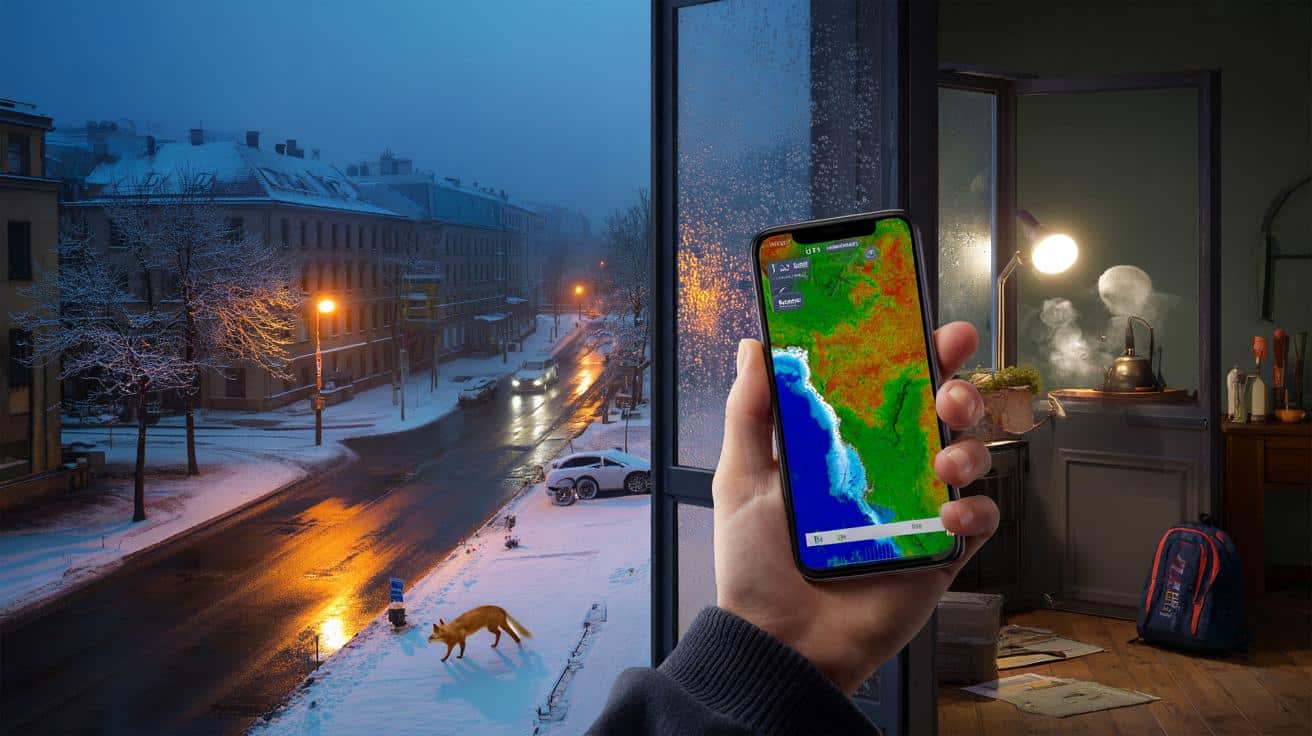
Live snow maps are doing something odd this week: the pale blue band that usually hugs the north is drifting down, bending like a loose zipper. Commuters lean over phone screens, councils shuffle gritting rotas, parents scan school alerts with a hand on the kettle. The question spreading fastest is painfully simple and strangely sticky: Is your city on the list?
47pm, in the glow of a too-bright laptop, I watched the colours slip. Blues deepened along the spine of a country, then spilled into places that usually stay wet, not white. Somewhere two streets over, a neighbour thumped a boot against a step, the sound carrying in the brittle air. A message pinged from a friend in the Midlands: “If that blue drops one more notch, we’re in it, aren’t we?” I stepped to the window. Streetlamp halos hung above quiet cars; a fox padded the kerb as if testing a stage. On the map, the rain–snow boundary curved south, then kinked again, like breath fogging glass. The kettle clicked off. A child’s art of winter, but restless. The line is on the move.
The line that redraws winter
The snow line is the weather’s keyhole, the place where cold bites just hard enough and raindrops turn to flakes. This week’s model runs sketch that keyhole lower on the page, and people are noticing. Screenshots of the 0°C level and “precip type” layers are everywhere, and the vibe is almost giddy in some threads. Cities that normally wash through winter with slush are flirting with proper snow, and that feeling swings between thrill and logistics. It’s a moving border with a messy passport.
Look at the kink arcing towards the American Southeast and across pockets of western Europe. Raleigh’s group chats are buzzing, Nashville’s builders are eyeing timetables, Bordeaux drivers are swapping tyres up in the Gironde hills. In Spain, the foothills outside Madrid count flakes that briefly stick; in Türkiye, a colder tongue noses west from Anatolia and puts Istanbul on alert. Zoom in and the line slides street by street along valleys and ring roads. Copernicus snapshots and Met Office maps show the same dance, a southward sag that feels improbable until it’s at your door.
What pushes the line? A wavier jet stream can funnel Arctic air further south while warm seas feed fat, moisture-rich clouds. When those meet, the line sharpens like a crease. Urban heat then smudges it, raising temperatures by a degree or two across dense neighbourhoods, nudging rain where suburbs get snow. Elevation tugs it uphill, easing the flakes onto ridges and leaving damp pavements below. That’s why two towns ten miles apart can live entirely different stories on the same day.
How to read the map—and stay a step ahead
Start with the basics: open a trusted weather app or site and toggle “precipitation type” so rain, sleet and snow show in different colours. Add the 0°C isotherm or freezing level if you can, and glance at the wet-bulb temperature layer, which tells you how cooling through evaporation might flip rain to snow on the fly. Then check the timing. Snow at 2am with calm winds behaves differently to snow at 4pm over rush hour. Two passes through this routine beats twenty panicked refreshes.
A few traps catch everyone. Chasing a single model run is like trying to read tea leaves while the tea is still swirling. We’ve all had that moment when the band of blue swings towards our home and the heart rate jumps. Step back and compare runs six hours apart, and check a second model for sanity. *Let’s be honest: nobody actually does that every day.* If that’s you, follow one reliable meteorologist, read their short updates, and keep your nerves for the real decision points.
You’ll hear this from forecasters who’ve been burned and learned:
“Snow lines aren’t lines. They’re living edges that breathe with every gust.”
If you want a quick city check, start with places notorious for living near that edge when the map sags south:
- Raleigh and Charlotte, US Carolinas
- Nashville to Birmingham corridor, US
- Greater Bordeaux and the Landes fringe, France
- Midlands belt south of the Peak District, UK
- North of Madrid into the Sierra foothills, Spain
- Istanbul’s Asian-side hills, Türkiye
- Northern suburbs of Tokyo on a northerly wind, Japan
- Plains around Bucharest on a polar dip, Romania
None of these are guarantees. They’re the usual suspects when the edge comes calling.
What this shift says about our winters
This southward tilt is a snapshot, not a verdict, yet it hints at how fragile winter has become. Warmer background temperatures cut the number of marginal snow days in many lowlands, even as moist air can deliver intense bursts where cold arrives on time. Ski towns now plan for rain at the base and blizzards up top on the same weekend. Councils juggle gritting budgets with early daffodils, then scramble when a late-season northerly bites. The maps make that tension visible in a colour you can feel in your bones. **When the blue drops into your postcode, the day changes.** You buy bread earlier. You text the school. You stand in your socks at the back door and measure the air with your face, because that still works.
| Key point | Detail | Interest for the reader |
|---|---|---|
| What the “snow line” really is | It’s the boundary where surface conditions and air profiles flip rain to snow, often tracked with the 0°C isotherm and wet-bulb temperature. | Turn vague colours into a simple, usable concept. |
| Why it can shift south on certain days | Jet stream kinks pull cold air down while moisture surges meet it, sharpening the edge across regions that usually stay mild. | Understand the setup behind surprise snow days. |
| How to act on it in minutes | Check precip type, freezing level and timing, then compare one alternate model before changing plans. | Cut panic-refreshing and make faster, smarter choices. |
FAQ :
- What exactly is the snow line?It’s the shifting boundary where precipitation turns from rain to snow at ground level, shaped by temperature, humidity and elevation.
- Are winters truly getting snowier further south?Long-term trends show fewer cold days at low altitudes in many regions, yet specific setups can still drive southward snow bursts.
- Which map layer should I watch first?Start with “precipitation type,” then add the 0°C isotherm or freezing level and glance at wet-bulb temperatures for marginal events.
- Why does my neighbourhood get slush while the next town gets snow?Small differences in elevation, urban heat, wind direction and timing can nudge temperatures by a degree or two and flip the outcome.
- Can I trust a single model run?It’s a snapshot. Compare updates a few hours apart and check a second model or a local forecaster for context.







Just watched the blue edge slide over Charlotte on Windy—bread, milk, and a shovel, secured 🙂