
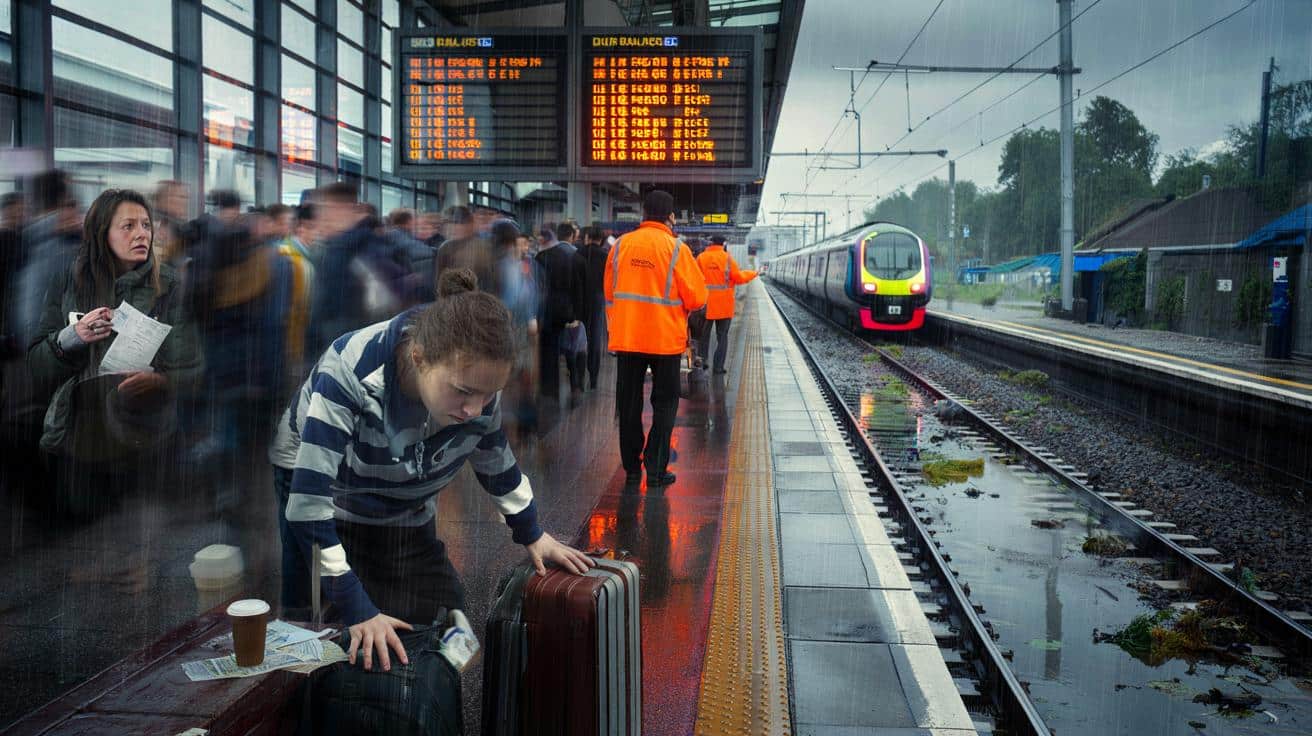
Operators say the mix is ugly — high winds, flooding risks, debris on tracks, power faults, and heavy engineering all colliding over one long weekend. Commuters, families, match‑day crowds, airport‑bound travellers — the message is the same. Safety first, journeys second. Do not travel unless your journey is essential. Refunds are in play, ticket easements too, but the advice is tough love. It’s not about spoiling plans. It’s about keeping people alive and crews out of danger. The truth is, this one’s bigger than a few late trains.
The station clock was ten past nine when the board began to flicker red. A lad in a football scarf kicked his heel against a case. A mum whispered into her phone, “We might not make it,” and watched a coffee go cold. The loudspeaker cleared its throat, twice, then came the line nobody wants to hear: “Advice is not to travel.”
We’ve all felt that instant where the plan in your head just… dissolves. Staff were doing the rounds with gentle voices and sharp eyes, pressing paper refunds into hands and pointing people towards home. It felt like the railway had pressed pause. And then came the small miracle you only see in a crisis: strangers trading tips, splitting taxi fares, laughing at the sheer absurdity of it. One announcement later, the concourse was a tide turning back to the exits. One short sentence can change a weekend.
Where the ‘don’t travel’ warning lands
The guidance covers a dozen lines that stitch together big cities, coastal stretches, cross‑country links and airport feeds. Not just branch lines, either — stretches where freight and fast intercity trains share space with local services. Operators describe multiple hazards at once: trees listing over catenary, water rising through cuttings, and the kind of winds that turn loose fencing into missiles. The combination raises the risk beyond “delays and diversions” into the territory of stranded trains and blocked routes. That’s when the message shifts from “disruption expected” to a simple no.
Take a snapshot from late morning: crews called to a landslip near one junction, overhead lines tripping out two counties over, and a flooded underbridge closing a vital chord. Within minutes, knock‑on delays spill across the timetable like ink. One commuter from Leeds told me he’d made it one stop before his train was terminated and sent back. A family headed for a city break in Bristol got as far as the platform announcement, then rerouted to a hire car. Nobody likes to give up. People do the maths and realise that staying put beats being stuck.
Rail bosses hate blanket warnings. They know how much trust they burn. The decision arrives when the equation stops balancing: too many failure points, too few safe workarounds, and crews already stretched by rescue moves and block patrols. This isn’t about pessimism. It’s a risk calculation shaped by the infrastructure we’ve got — Victorian earthworks meeting modern climate, long‑planned engineering rubbing shoulders with gusts and tides. Keep running, and you could trap a full set and crew in the wrong place for days. Hit pause, and at least you reset safely for Monday.
If you must move, how to do it with less pain
Start with one ruthless question: can your trip wait until after the warning lifts? If the answer is no, shift from “train person” to “options person”. Book a coach seat now, not at the kerb. Look at two‑hop routes via cities with big bus hubs. If you drive, set your route to avoid low‑lying roads, add 30 percent time, and plan a daylight arrival. For flights, contact the airline before heading to the airport; many will rebook for free when ground transport is compromised.
People trip up on the same three things. They check once, then stop checking. They gamble on a half‑running service and get stranded at an intermediate station with no taxis. They wait until they’re already at the station to ask about refunds. Be the boring one who keeps refreshing. Keep a power bank charged, carry water, and write down a taxi number in case the signal dies. Let’s be honest: nobody really does that every day. On weekends like this, the boring one gets home first.
Think in layers: information, comfort, fallback. Save the National Rail live map, your operator’s X/Twitter feed, and the local highways account. Pack light, wear waterproofs, bring a paper map if you’re headed rural. If a friend can pick you up from a different station, agree a plan B now and a cut‑off time if the train never shows.
“The advice is not what we want to say,” a duty manager told me, “but it’s the safest advice we can give. We’ll be here turning the railway back on the second it’s ready.”
- Check live updates at T‑45 minutes and again at T‑10 minutes.
- Screenshot refund and easement pages before you travel.
- If you change mode, keep receipts for claims via your operator.
- Tell someone your route and your latest safe arrival time.
What this weekend means for Monday, and the week that follows
Monday is the reset target, not a magic wand. Crews will be out through the night clearing lines, testing signalling, and walking routes that took water or wind. Some stock will still be in the wrong place at dawn. Expect a soft start: fewer early services, tighter dwell times, and crowding where gaps appear. If you’re on a flexible ticket, aim mid‑morning and give the railway a beat to breathe. The bigger question sits beyond Monday. Weather‑driven “do not travel” alerts are more common than they used to be, and the network is choosing caution. That’s a culture shift. It frustrates, but it saves lives. The weekend brought a hard lesson, and also a kind of honesty about the limits of what steel and timetables can do. Share that with the person who needs to hear it.
| Key point | Detail | Interest for the reader |
|---|---|---|
| — | — | — |
| — | — | — |
| — | — | — |
FAQ :
- Which 12 lines are affected?The operators have flagged a dozen routes spanning intercity corridors, coastal stretches and airport feeders. The exact list is on their live updates, which change through the day as inspections finish and incidents clear. Check your operator’s page and National Rail before you set out.
- Are tickets valid on different days?When a “do not travel” message is in force, many operators relax the rules and let you use the same ticket on later dates, often through Monday. Keep screenshots of easement pages and carry ID if you’re moving the trip.
- Can I get my money back?Refunds are available even on advance tickets when the operator advises “Do not travel”. You can claim via your retailer or operator, online in most cases. If you’ve switched to a coach or taxi because trains weren’t running, submit receipts with your claim where the operator allows it.
- What if I still try to travel?You may find no trains, or you’ll be shunted into long diversions with replacement buses that fill fast. Staff will help, but resources are finite and you could be left at an intermediate station without onward options. Better to rebook while you’re at home with Wi‑Fi.
- How will I know when it’s safe again?Watch for the message to shift from “do not travel” to “disruption” or “reduced service”. That’s your cue that lines are reopening and stock is moving. Check live updates right before you leave and again at the station. If your trip is optional, give it a few extra hours.






Is this just cover for engineering works they wanted to do anyway? The blanket « do not travel » is becomming the default, no?