
January has a way of catching you off guard: a clear night, a hard frost, your street transformed into glass by morning. You’re late, your tyres spin, and the hill outside your house turns into a stage for embarrassment. This is the month when a tiny, unglamorous item in your boot decides whether you move… or don’t.
The car doors cracked open with that faint frozen sound, the windscreen chipped with a film of stubborn rime, the cul-de-sac a mirror; I nudged the clutch, the wheels spun, and a neighbour in a bobble hat gave that sympathetic tilt of the head that says, “You’re not going anywhere.” Then a woman from three doors down wandered over with a repurposed protein tub and shook a line of coarse crystals under the tyres, a small sparkle in the weak sun; we waited thirty seconds, she told me to feather the accelerator in second, and the car eased forward as if the road had changed its mind. The cure cost £3.
The humble bag that beats the freeze
Experts are urging drivers to keep a bag of salt in your car this January because it solves two winter problems at once: ice that needs melting and tyres that need grip. A handful scattered beneath the contact patch cuts into the slick, making gritty micro-edges where rubber can bite, while salt works on the chemistry of the ice itself to loosen its hold on the tarmac. It’s quick, it’s cheap, and it fills the gap between mythic gritters and real streets at 7am.
Breakdown services talk about “cold snaps” like storms, because calls don’t trickle, they surge; there’s always that morning when the phones light up and engines refuse. One delivery driver told me he keeps a 5kg bag of rock salt in a storage box next to his high-vis and flask, and says it’s the only reason he didn’t lose a week of wages last January: a sprinkle under each driven wheel and a breadcrumb trail to the clear road, repeated twice on an icy estate in Leeds, and his van kept earning while others whined and smoked on the spot.
The logic is simple, and it’s not magic. Salt lowers the freezing point of water, which turns the rigid sheet under your tread into a slush that can be displaced, and the coarse grains themselves act like tiny chocks, improving friction where the rubber meets the world. Rock salt does this better than table salt because the larger crystals last longer and provide more texture, though table salt will work in a pinch. A bonus is weight: a bag in the boot gives a smidge more load over the rear axle, and on rear-wheel-drive cars that can mean steadier pull-away on frosty mornings.
How to carry it, and how to use it fast
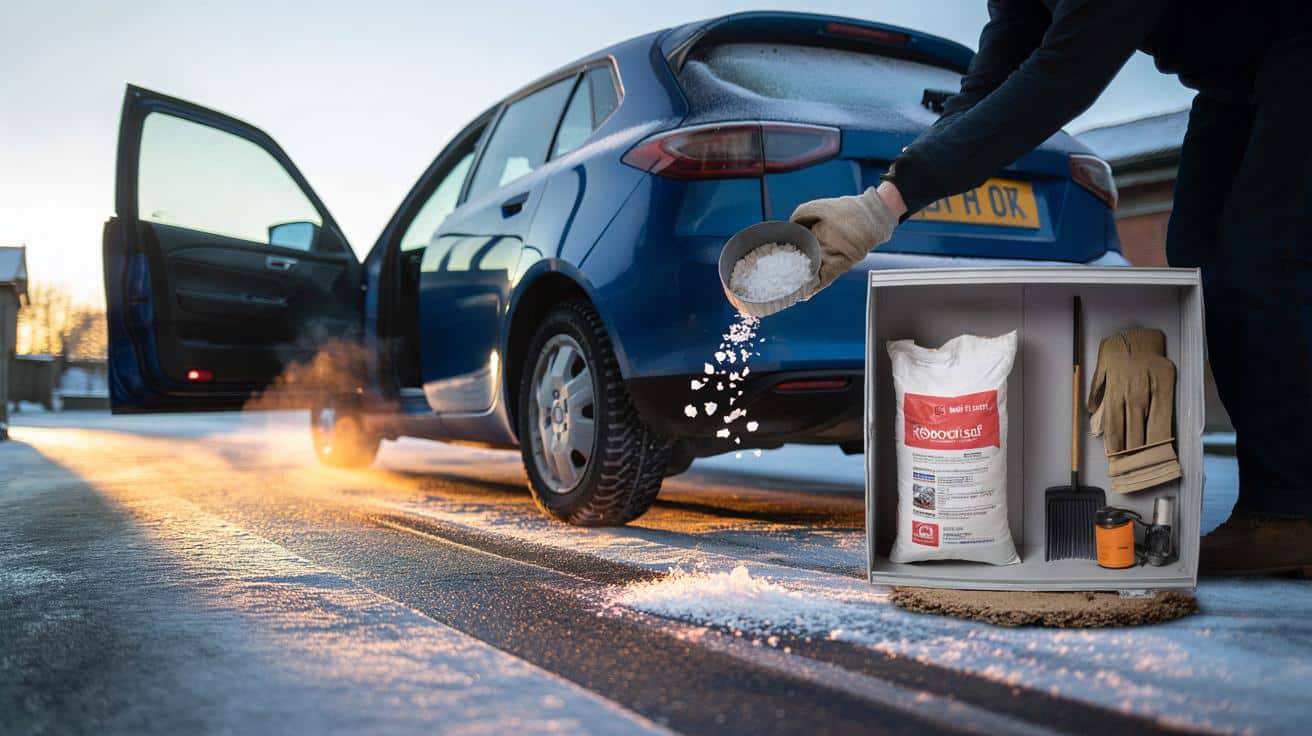
Get a sealed 5kg bag of rock salt and store it in a lidded plastic box in the boot, then decant a cupful into a small shaker or tub you can keep in the door bin. When you hit an icy patch, clear loose snow with a brush, spread a generous handful directly in front of and behind your driven tyres, then create a thin path a metre or two towards clear tarmac, wait a minute, and try a gentle pull-away in second gear, rocking forward and back if needed.
Don’t pour water, don’t stamp the accelerator, and don’t panic-brake once you’re moving. We’ve all had that moment when your heart spikes and your foot does the wrong thing, but calm is traction’s best friend. Keep salt off paint and away from brakes, wipe any spills, and wash the car after icy weeks to reduce corrosion; Let’s be honest: nobody really does that every day, yet a quick rinse at the petrol station once the thaw sets in goes a long way.
Think of this as a tiny winter ritual you can actually stick to, especially when you don’t wait for the gritter to find your road. It’s a small act that buys time and control on mornings that try to steal both from you.
“A scoop of salt is the cheapest breakdown you’ll never have,” a roadside patrol veteran told me, half-joking and wholly right.
- Keep next to the salt: foldable shovel, work gloves, torch, an old doormat for extra traction, and a resealable tub for quick spreading.
- Swap table salt for rock salt when you can, but use what you’ve got if you’re stuck.
- Mind pets and gardens at home: use sparingly on driveways and brush up the excess later.
A small thing that changes how you face January
This is not about doomsday prepping, it’s about dignity at the kerb. A cheap bag of crystals sitting in your boot is a nudge towards independence when the calendar deals in frost and delay, a way to turn “I can’t” into a shrug and a solution. Those slow, breath-cloud mornings become less about that helpless wheelspin soundtrack and more about a quick routine: shake, wait, go. It’s almost silly how empowering it feels to outwit a patch of black ice with something you can buy at the corner shop. Share it with a neighbour, keep a cup in the office car park, toss a trail across that sneaky camber outside your kid’s school. The cold still bites, but it stops biting at your plans.
| Key point | Detail | Interest for the reader |
|---|---|---|
| Carry rock salt | 5kg in a sealed box, plus a small shaker in the cabin | Fast access when you’re stuck without rummaging |
| Use a simple method | Scatter under driven tyres and along a short exit path, wait, pull away in second | Immediate traction with minimal effort |
| Protect your car | Keep salt off paint and brakes, rinse after icy spells | Reduces corrosion while keeping winter mobility |
FAQ :
- What kind of salt should I carry?Rock salt or “grit” is best for traction and staying power, though ordinary table salt will still melt ice if that’s all you have.
- How much do I need?1–5kg covers several incidents; a couple of handfuls usually free a stuck car and create a safe path to clear tarmac.
- Will salt damage my car?Salt can encourage corrosion if it sits on metal, so keep it contained, wipe spills, and rinse the car after icy weeks.
- Can salt replace winter tyres or chains?No—salt helps you get moving and clear small areas, while winter tyres and chains improve grip over longer journeys.
- Is it okay to use salt on public roads?Yes, spreading a small amount around your vehicle for safety is common-sense; be considerate and avoid excess near drains or gardens.






Okay, adding rock salt to the boot today.