
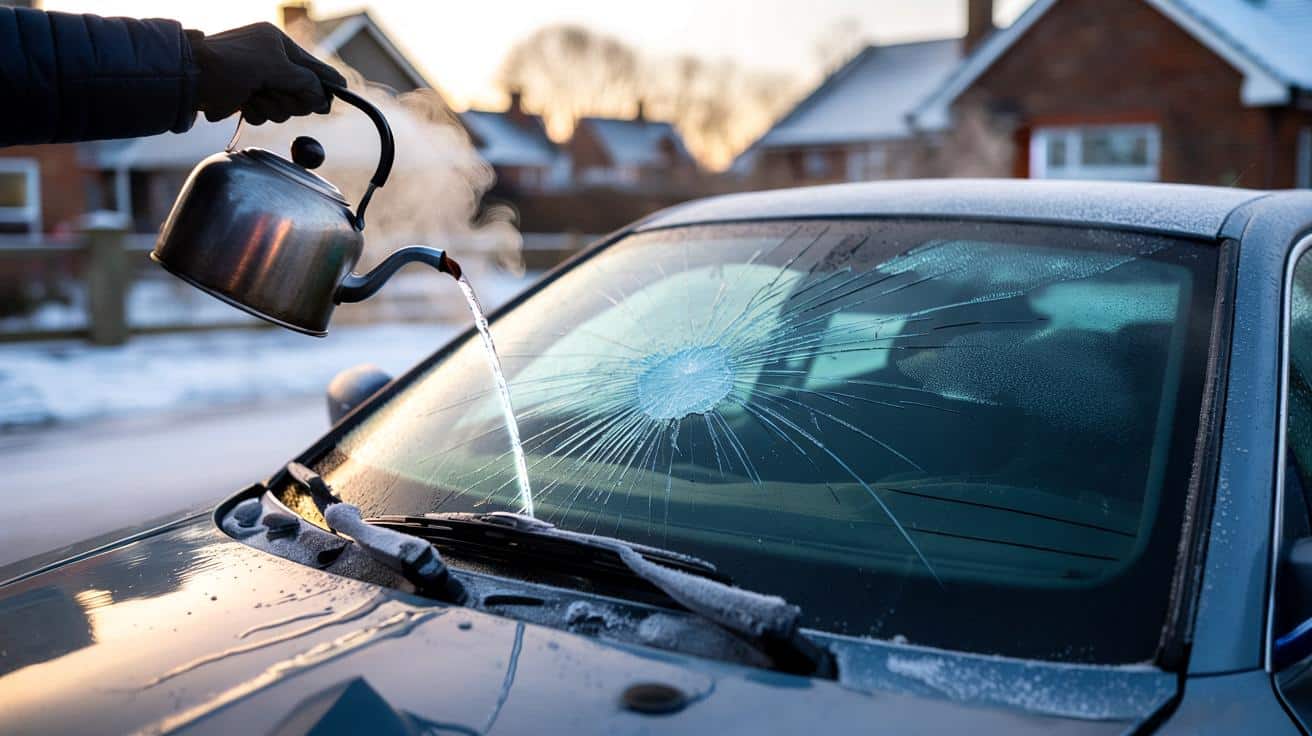
Steaming water meets frozen glass, a hiss, a swipe, and the thought that you’ve won a minute back from the morning. That shortcut can turn a crisp dawn into a costly repair in seconds.
It was 6:47am on a Leeds cul-de-sac, the kind of cold that bites your fingertips through your gloves. A neighbour jogged out with a kettle, steam pluming like a ghost. He tipped it over his windscreen and, for a heartbeat, it looked glorious — ice melting in glassy rivers, wipers freed like magic. Then came a sound you don’t forget. A sharp tick, the kind a pebble makes, only this pebble stretched into a pale crack that ran like a vein across the glass.
*Glass doesn’t like surprises.*
Why boiling water and a frozen windscreen will never be friends
We’ve all had that moment when you’re late, your breath fogs in the air, and the windscreen looks like frosted sugar. The kettle whispers an easy fix. The physics disagrees. **Boiling water + a frozen windscreen = a stress fracture waiting to happen.** Your windscreen is a laminate of two glass sheets and a plastic layer. The outer surface is painfully cold and rigid; boiling water shocks it, expanding the top layer faster than what’s beneath. That tension has to go somewhere. Often, it tears a crack along an invisible flaw. Sometimes it explodes into a spiderweb you can’t ignore.
Ask any local glass fitter about first frosts. They’ll tell you the phone starts pinging before 9am. Not always huge breaks, either. Tiny chips turn treacherous once they meet a dramatic temperature swing. A woman in Harrogate told me she’d poured the dregs of a kettle — “barely more than warm,” she swore — and watched a hairline sliver blossom across the passenger side. Her excess was higher than the repair. That tiny line killed her MOT. The frost was free. The fix took time, money, and a day off work she hadn’t planned for.
Your windscreen isn’t just a view; it’s structural. It helps keep the cabin stiff in a collision and houses sensors for rain, light, and lane-keeping. Sudden heat can loosen adhesives and stress the bonds around those modules. **Thermal shock hits in milliseconds.** Even if the glass doesn’t crack, heat can break the bond along the edges, inviting leaks or fogging later. Then there’s the sneaky bit: hot water runs down into wiper wells and door seals, where it cools and refreezes into a crust that jams blades and locks. You fix one problem, and you quietly seed two more.
Faster, safer ways to clear a frozen windscreen
Start simple and controlled. Fire up the engine, set the fan to the windscreen, and choose cool-to-lukewarm air first, stepping it up gradually. Keep the AC on to dry the air; it pulls moisture off the glass from inside. Outside, use an aerosol de-icer or a spray made from isopropyl alcohol and water (two parts alcohol, one part water, a drop of washing-up liquid). Scrape with a plastic blade that has a soft edge and work in smooth, patient lines. **Use the car’s defroster, not the kettle.** It feels slower for about a minute, then you watch the ice turn to slush and glide away.
Think about the night before, not the panic after. Park facing east to catch the first light. Lift wiper arms so they don’t glue themselves down. A proper windscreen cover takes 30 seconds to fit and saves five minutes at dawn. Let’s be honest: nobody actually does this every day. So pick your battles. Keep a small de-icer in the door pocket, and a microfiber cloth to mop meltwater before it runs and refreezes. Avoid metal scrapers, kettles, and credit cards — they all score the glass or stress it. Move the wipers only when the blades and the screen are fully free.
It helps to hear it from people who see the results.
“We can often spot the kettle jobs,” says Jake, a mobile glass tech in West Yorkshire. “The crack starts neat, then races when the heater’s on. It’s not bad luck — it’s thermodynamics. Warm it gently and you’ll be fine.”
- Keep heat gradual: inside fan first, low to moderate, then up a notch.
- Spray, wait 30 seconds, then scrape in straight strokes.
- Clear the whole windscreen, not just a porthole.
- Check blades for ice before switching wipers on.
- Top up with winter-grade screenwash to prevent refreeze.
The little habit that saves your glass, your sensors, and your morning
What feels like the slow route is the one that prevents cracks, fogging, and busted wipers. Ten minutes of gentle heat, a decent scraper, and a quick spray avoids the shock that boiling water brings. It also guards the invisible bits — the camera cluster behind the mirror, the rain sensor, the sealant along the edges that keeps your cabin quiet and dry. A windscreen should last years; most don’t fail by drama, they fail by small, avoidable stress. The kettle looks clever. The bill looks smarter when it never arrives. And the part you’ll remember is this: the glass will forgive patience far more than it forgives a surprise.
| Key point | Detail | Interest for the reader |
|---|---|---|
| Thermal shock cracks glass | Boiling water expands the outer layer faster than the inner, creating instant tension | Prevents a pricey windscreen replacement and a failed MOT |
| Use gradual warming | Start with cabin fan on the screen, low to medium, plus alcohol-based de-icer | Clears ice quickly without damage or fogging |
| Protect sensors and seals | Gentle heat preserves ADAS modules, adhesives, and wiper wells | Keeps modern safety features reliable in winter |
FAQ :
- Can I use warm water if it’s not boiling?Avoid anything hot. Tepid water is less risky, but it can still refreeze in crevices. Safer to use the car’s defroster and a de-icer spray.
- Why do some people get away with the kettle?Sometimes the glass has no pre-existing flaws and the temperature gap is small. The risk is invisible until the day it isn’t.
- Does laminated glass make it safer?Laminated windscreens resist shattering but still crack under thermal shock. The plastic layer can mask damage until it spreads.
- Will pouring hot water damage my wipers?Heat can distort rubber and drive hot meltwater into the wiper well, where it refreezes and locks the mechanism.
- What’s the fastest safe method on a brutal morning?Engine on, demist to windscreen, AC engaged, alcohol-based de-icer sprayed, then a plastic scraper. Clear mirrors and lights before you move.






Oof—glass doesn’t like surprizes. Never pouring from the kettel again.
Honest question: if the water is just lukewarm (not hot), is the thermal shock still a big risk, or mostly when the temps are brutally low? Trying to balance speed vs safety.