
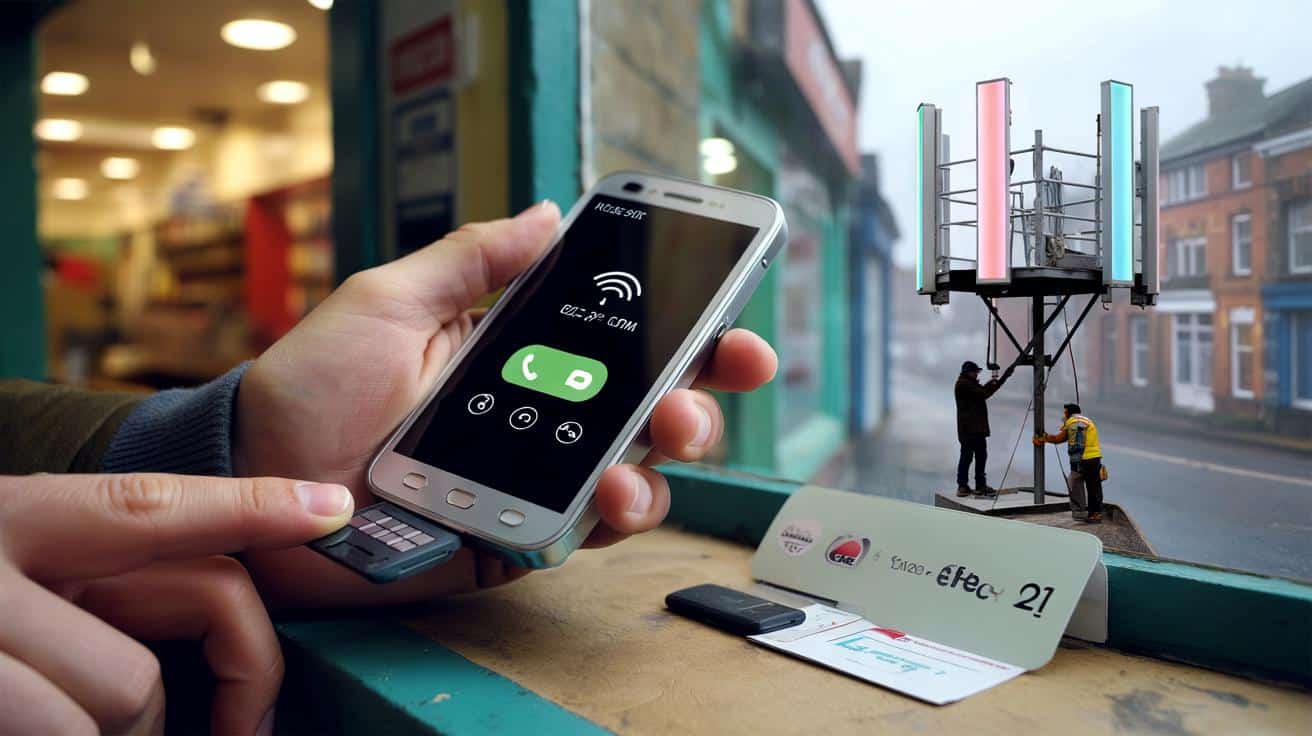
That’s why millions of people who see “4G” on their screens are being nudged to “upgrade” — not to chase the latest phone, but to keep calls working when the switch-off hits.
On a chilly morning outside a corner shop in Leeds, a man kept redialling his GP. His phone showed 4G bars, yet every call died in silence. The shopkeeper shrugged and pointed to a hand‑written sign: “3G turned off in this area — ask about VoLTE.” Inside, a queue of puzzled faces traded stories about missed calls, broken voicemail pins, and texts arriving hours late. The internet still worked. Voice didn’t. The strange part? Most of them already “had 4G”. They just didn’t have the right kind of 4G for calls. The switch-off isn’t a cliff edge, but it is a line you’ll notice when you cross it. The line is moving.
What’s actually switching off — and why 4G users still need to act
Across Vodafone, EE and Three, 3G has been winding down, with O2 following through 2025. 2G will linger longer for basic connectivity and some legacy devices. **3G is going, not 4G.** That’s the crux. Yet a surprising number of 4G users still rely on 3G in the background for voice calls, because their phone or SIM never enabled “4G Calling”. When 3G disappears in your area, your screen may still say 4G for data, but calls can fail, become one‑way audio, or drop to 2G with muffled quality. It feels random. It isn’t.
Meet Sandra, 62, with a perfectly decent 4G smartphone from 2017 on a low‑cost plan. She streams radio fine and checks bank apps on the bus. After a local 3G shutdown, her calls to the pharmacy stopped connecting unless she was near the window, where the phone clung to a faint 2G whisper. A shop assistant swapped her ageing SIM for a new one, toggled a setting called “4G Calling”, and asked her to restart. Calls sprang back instantly. No new handset needed. That tiny, unglamorous change — enabling the right voice tech — is what “upgrade” means for many 4G users right now.
Here’s the logic. Voice over LTE (VoLTE), branded as 4G Calling, pushes your calls through the 4G data layer instead of dropping to 3G. Many phones support it, yet some models need a software update, a carrier-configuration file, or a newer SIM to light it up. Others support it only on certain networks. If 3G goes dark before your device is set for VoLTE, voice either falls back to 2G, which not every mast can provide robustly, or fails outright. That’s why networks are urging “upgrades” — not necessarily to 5G, but to a VoLTE‑capable setup that keeps your calls alive.
How to ‘upgrade’ without overspending
First, check your current phone. Open Settings, look for Mobile/Cellular, then Voice & Data. If you can select “4G” or “LTE” for voice, switch it on. On iPhone, it’s Voice & Data > 4G/LTE with VoLTE toggled. On Android, look for “VoLTE calls” or “4G Calling” in Mobile Network settings. Update your operating system, then restart. If the option doesn’t appear, contact your provider for a SIM swap or carrier settings update. Many MVNOs now enable VoLTE by default, but older SIMs can be stubborn.
Next, add Wi‑Fi Calling. It’s a quiet lifesaver in thick‑walled homes and rural kitchens where 4G fades by the toaster. Turn it on in your phone settings, register your emergency address if prompted, and test a call to a friend. Keep your number security in mind during SIM swaps; move your accounts and two‑factor apps with care. Let’s be honest: nobody really does this every day. That’s why a short checklist — and ten patient minutes — beats yet another missed call from the school office.
We’ve all had that moment when a phone setting turns out to be the whole problem, not the mast at the end of your lane.
“This is the bit people miss: you can have 4G data and still lose voice if VoLTE isn’t active,” says a network engineer I spoke to. “The fix is often a SIM swap and a toggle, not a £900 handset.”
- Turn on 4G Calling (VoLTE) and Wi‑Fi Calling, then restart your phone.
- Ask your provider for a modern SIM or eSIM if options don’t appear.
- Update software and carrier settings; check for a network‑specific profile.
- Test a call in the spots where you usually struggle, not just at your desk.
- Consider a refurbished 5G phone if your current 4G handset doesn’t support VoLTE on your network.
What this means over the next two years
For most of us, the story isn’t about speed tests or bragging rights. It’s about being reachable when the nursery closes early or a relative hits the alarm pendant. Older telecare boxes, lift lines and alarms that once chatted over 3G will need upgrades too, often arranged by the service provider. Rural coverage maps will keep shifting as 3G spectrum gets re-used for 4G and 5G, sometimes improving 4G reach after the change bedded in. **You might lose calls, not data.** That’s why the “upgrade” being nudged is smaller than you think: a SIM refresh, a ticked setting, maybe a modest handset step‑up.
This isn’t about chasing the latest gadget. It’s about reducing friction in ordinary life. If you do end up changing phones, a reputable refurbished 5G model can be cheaper than a mid‑range new device and usually supports all the right calling features out of the box. Ask your provider for clear compatibility lists. Keep one eye on battery life and updates, because a phone that lasts the school run and gets security patches is the one you’ll trust when the power flickers and you need to ring next door.
| Key point | Detail | Interest for the reader |
|---|---|---|
| 3G switch‑off timeline | Most UK networks have retired 3G or will by 2025; 2G stays longer | Explains why calls may change before you change phones |
| VoLTE/4G Calling | Enables voice over 4G; needs a compatible phone, SIM and network profile | Keeps calls working even where 3G is gone |
| Upgrade path | Start with settings and a SIM swap; consider refurbished 5G if needed | Minimises cost while future‑proofing your number |
FAQ :
- Is 4G being switched off in the UK?No. 4G remains the workhorse for years to come, anchoring many 5G setups. The current switch‑off is about 3G.
- Why can’t I make calls if my phone shows 4G?Your device may be using 4G for data but not VoLTE for voice. Without 3G to fall back on, calls can fail or drop to patchy 2G.
- Do I need a 5G phone to be safe?Not strictly. A VoLTE‑capable 4G phone with Wi‑Fi Calling is fine. A 5G handset is a nice upgrade if you’re changing anyway.
- Will a new SIM really help?Often, yes. Modern SIMs carry the right network settings for VoLTE and Wi‑Fi Calling, and can unlock options your old card didn’t show.
- How do I check if my phone supports 4G Calling?Look in Mobile/Cellular settings for “VoLTE” or “4G Calling”, or search your provider’s compatibility list by make and model.







Does this mean my 2018 Moto G6 will stop making calls unless I enable VoLTE? I’m on O2 and can’t see the toggle in settings — do I need a SIM swap or is it a carrier profile thing?
So the “upgrade” is literalyl just a tiny toggle and a fresh SIM, not a £900 slab of glass? My wallet just exhaled. Now to convince mum that Wi‑Fi Calling isn’t witchcraft.