
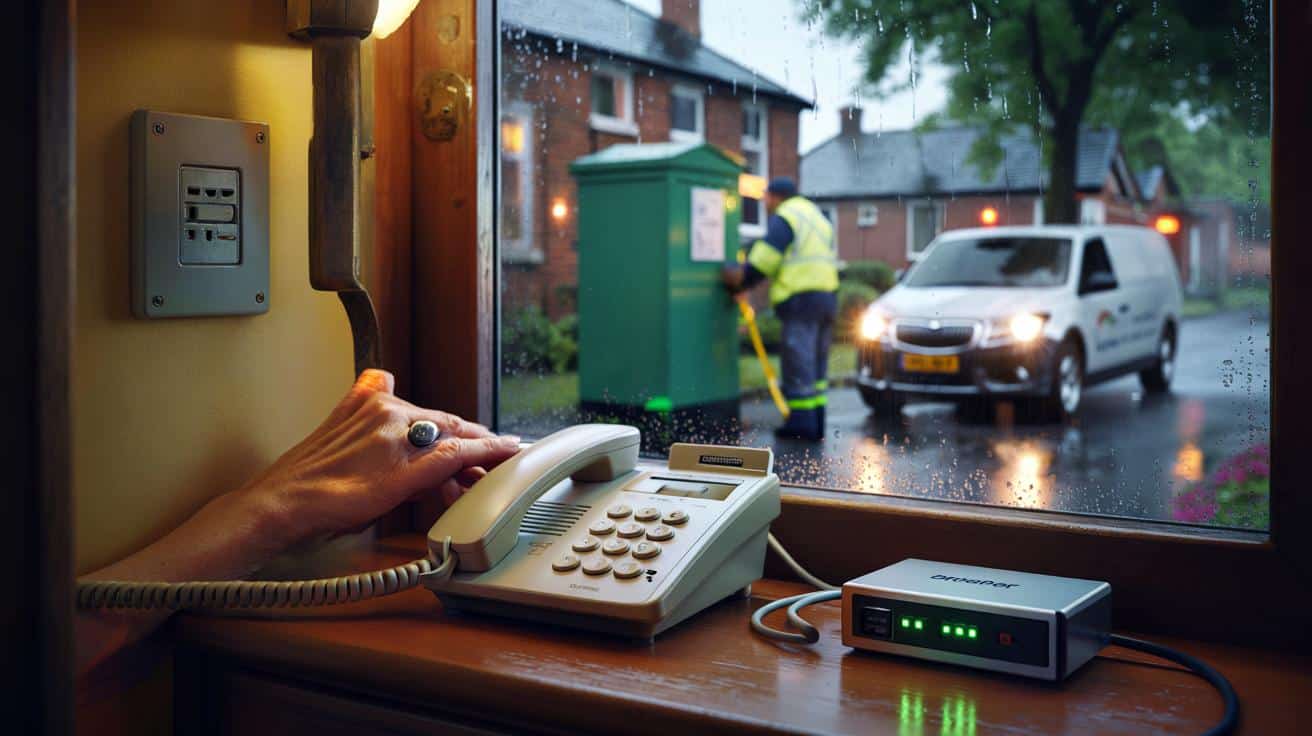
It’s not the end of home phones, but the analogue dial tone you grew up with is being replaced by digital voice over broadband — first in towns where fibre is widespread, then everywhere else. People are asking the right questions: What happens in a power cut? Will my care alarm still work? And why is it happening now?
On a wet Tuesday in Wiltshire, an Openreach van idled under the dripping ash trees. Inside a terraced hallway, a grey master socket sat like a relic, its tiny screw heads polished by decades of thumbprints. Mrs Nolan, 78, lifted her handset and listened to that soft, living hum of the line. “They tell me it’ll be the internet now,” she said, half a laugh, half a sigh. In Salisbury and Mildenhall, this moment has already come and gone. The change slips in quietly, then everything sounds the same — until the lights go out.
What’s actually being switched off — and where first
The headline is stark: **PSTN switch-off is happening**. The Public Switched Telephone Network, the analogue web of copper that carried calls for a century, is reaching retirement. Voice calls won’t vanish; they’ll travel over your broadband using a home hub or a small adapter. The copper itself is being decommissioned in stages, starting in “fibre priority” areas where full-fibre lines cover most premises, and in early migration towns where trials have already proven the model.
If you want a picture, start in Salisbury, the first UK city to go fully fibre-first, and in Mildenhall in Suffolk, where digital voice replaced the old dial tone as a formal pilot. From there, Openreach has been expanding “stop-sell” — no new analogue services — across hundreds of exchanges. That means parts of Greater Manchester, the West Midlands, Yorkshire, the South Coast, the Central Belt of Scotland and swathes of Wales are already in the phasing-out lane. In these areas, letters and emails are landing with migration dates, usually spaced over months.
Why now? Ageing assets cost more to keep alive than to modernise, and the PSTN was built for a different world. Engineers carry spares for kit no longer made. Storms, water ingress and even theft make copper fragile and pricey. Digital voice over fibre is simpler to maintain, uses less energy and sits on the same networks that carry everything from Netflix to GP video calls. Ofcom has signalled the direction for years, and the industry has aligned on a single finish line while still fixing gaps for the most vulnerable.
How to get ready without drama
Start with your provider’s letter. It should spell out your date, kit and options. In most cases, you’ll plug your existing phone into your broadband hub’s phone socket, or you’ll receive a Digital Voice handset pre-paired to the hub. If you have a cherished corded phone, ask for an adapter that gives it a new digital life. Keep the call plan you like; the technology changes, not your habit of ringing your sister on Sundays.
Next, think power. Analogue lines carried their own electricity; digital ones rely on your router. If you or someone you care for needs the phone during a cut, request a battery backup from your provider or buy a small UPS that keeps your hub alive. Check mobile coverage at home as a fallback, and store a charged basic handset in a drawer. Let’s be honest: nobody reads the router manual cover to cover. Do a quick test call, label the new socket with a bit of tape, and you’re ahead of the curve.
Telecare users need an extra step. If you have a pendant alarm, fall detector, or burglar alarm that dials out, call the service provider and your council to confirm it works over digital voice or via a mobile module. Many councils are proactively swapping units. It feels oddly final, but this is the tidy moment to list every thing in your home that “uses the phone line”.
“The landline isn’t dying — the copper is. Your phone moves onto the same resilient network that powers the rest of your life,” a senior Openreach engineer told me on a damp pavement in Swindon.
- Ask your provider for a migration date and any free adapters or handsets.
- If you rely on the phone in a power cut, request a battery backup solution.
- Speak to your telecare/alarm company to confirm digital compatibility.
- Test 999 after switchover from your handset to hear the routing message.
- Keep a charged mobile at home as a second path, just in case.
What this change really means for daily life
For most households, day-to-day calling won’t feel different. The number stays the same, the ringtone doesn’t change, and bills often fold line rental into your broadband price. The bigger shift is structural: one digital pipe for everything, which makes maintenance faster and outages simpler to diagnose. In fibre zones, engineers stop chasing rainwater in ancient ducts and focus on a cleaner, faster network for the whole street.
There’s a cultural shiver too. We’ve all had that moment when a handset sits silent in a power cut and the room feels strangely thin. That’s why the safety net now moves onto batteries and mobiles. Providers must offer solutions for people who need reliable 999 access, and councils are actively upgrading lifeline kits. **Power cuts change the rules** — your plan just needs to change with them.
There are real upsides on the other side. Clearer call quality with HD voice. Fewer nuisance calls once you turn on hub-level call screening. No more paying for a line you barely touch while still keeping the familiarity of a home number. For small businesses, one broadband link can carry multiple lines, voicemail to email, and flexible hunt groups without the tangle of copper. The bumpiness is temporary; the gains will stick.
There’s also the question of “where” — as in, which areas are officially waving goodbye to analogue first. The early adopters are the places with deep fibre coverage and formal “stop-sell” status at their exchanges. Picture Salisbury and Mildenhall, yes, but also city districts in Birmingham, Leeds and Glasgow, dense suburbs around London, and fibre-saturated patches from Cornwall to Aberdeenshire. In these zones, new analogue lines can’t be ordered, and existing ones are being migrated in waves. The rest of the country follows on a set timetable as each exchange hits its fibre threshold.
What about people who don’t have broadband, or can’t get the speeds they want? Providers can supply a data line purely for voice if that’s all you need, and there are hybrid or 4G-based options where fixed lines are slow. **You can keep your number**, even if the underlying technology changes under your feet. No one is cutting the wire and walking away; the message from engineers is: talk to us, and we’ll get you there.
There’s one more truth hiding in plain sight. Scam artists love a national change. If someone calls claiming you must pay today or lose your line, hang up and ring your provider on the number from your bill. Real migrations come with written notice, clear dates, and kit delivered through normal channels. The people in vans are busy enough without going door to door selling panic.
A wider shift, and what to watch next
This isn’t only a telecoms story; it’s a story about how we rely on electricity, mobile coverage and digital systems that sit behind the scenes. When a century-old network bows out, the handover must feel humane. That means battery packs where they’re needed, working alarms for people who sleep easier with a pendant around their neck, and a plain-English route for those who just want to keep a phone on the hall table.
The map will keep changing. As fibre builds push into streets that waited for years, more exchanges hit that “stop-sell” threshold and the analogue sunset rolls on. If you like to be early, call your provider and ask to switch now. If you prefer to wait, the letter will arrive with dates and a number to ring. Either way, you don’t have to become a network engineer overnight. You just have to move your phone to a new home.
What does a landline mean in 2026? Maybe it’s not a line at all, just a familiar handset riding a new wave. The shape of the habit stays the same. The hum changes, the promise — that a call gets through when it matters — must not. That’s the deal on offer. And it’s a deal we’ll judge, in the end, on whether a neighbour can get help when the street is dark and the rain starts again.
| Key point | Detail | Interest for the reader |
|---|---|---|
| PSTN is retiring | Analogue copper lines are being phased out in fibre-priority and pilot areas first, then nationwide | Explains why letters and migration dates are arriving where you live |
| Digital voice replaces dial tone | Calls run via your broadband hub or adapter; same number, similar bill | Shows what actually changes at home and what stays familiar |
| Plan for power cuts and telecare | Battery backups, mobile fallback, and upgraded alarm kits keep 999 reachable | Turns anxiety into a checklist you can act on today |
FAQ :
- Which UK areas are “officially” phasing out landlines?Exchanges with “stop-sell” status — places like Salisbury, Mildenhall and fibre-heavy districts of major cities — are first. Your provider’s letter is the definitive notice for your street.
- Will my phone number change when I move to digital voice?No. In normal migrations you keep your existing number. Porting rules still apply if you change provider.
- How will I call 999 in a power cut?Digital phones need power for the hub. Providers offer battery backup to vulnerable users, and a charged mobile is a simple safety net at home.
- Will my care alarm or burglar alarm still work?Many do with the right adapter or a mobile module, but some older units don’t. Speak to your telecare or alarm supplier and your local council about upgrades.
- What if I don’t have broadband or don’t want it?Providers can supply a low-bandwidth line for voice only, or a 4G-based solution in tricky areas. You still get a home phone, just on a different rail.







So when the lights go out, my phone goes out too? That’s… comforting. Guess I’ll actually read the router manul now.
This feels like cost-cutting dressed up as progress. Who pays for a UPS, and who guarentees 999 when the router dies at 2am? Rural power cuts aren’t rare; some of us lose electricity for hours after storms. Analogue lines had their own power—that safety net matters. Ofcom says providers will help “vulnerable” users, but how do we prove that, and will the backup arrive before the switch date?