
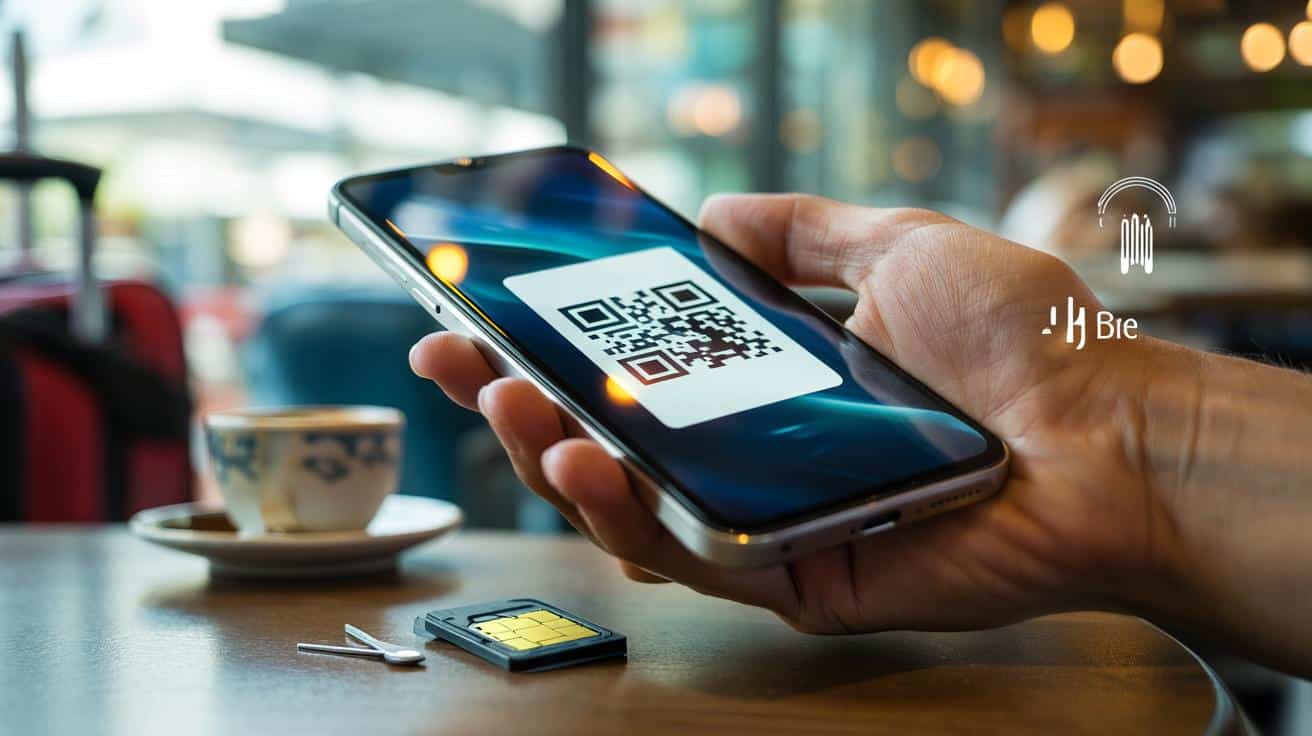
The little plastic card that once meant “new phone, new number, new start” is slipping into history. Not with a bang, but with a QR code and a download bar.
I was in a café near King’s Cross when a traveller at the next table set up mobile data for three countries in under five minutes. No SIM tray click, no paperclip hunt. Just a camera scan, a short wait, and that familiar ripple of bars appearing at the top of the screen. The barista asked if he needed Wi‑Fi. He smiled. “Already online.” We’ve all had that moment where a tiny piece of plastic held us up at the worst possible time. Let’s be honest: nobody keeps that SIM pin in their wallet. He slipped his phone back into his pocket, and the old ritual felt… unnecessary. Something else was about to change.
Why the SIM tray is losing its seat
The first push is simple: phones grew up. Flagships like the iPhone 14 in the US ditched the SIM tray entirely, and Android heavyweights such as Google’s Pixel and Samsung’s Galaxy lines treat eSIM as normal, not novel. That tiny slot takes precious space, invites water, and complicates repairs. Removing it frees room for bigger batteries, stronger speakers, tighter seals. **The SIM tray is dying because the phone no longer needs it.** Once industrial design gets a cleaner path, it rarely looks back.
There’s also a travel story that’s become a tech story. Apps like Airalo and Holafly normalised buying local data in minutes, not queues. Business flyers used to land and hunt for kiosks under fluorescent lights; now they tap “Add eSIM,” choose a plan, and keep walking. Carriers followed the money. Hundreds now support eSIM across dozens of countries, and smartwatches, tablets, and laptops joined the party. The result is subtle but massive: “changing networks” shifted from a screwdriver moment to a software moment.
Security and logistics add weight to the shift. Physical SIMs can be stolen, cloned with dodgy readers, or mailed and lost in transit; eSIMs live in a tamper‑resistant secure element and get provisioned through encrypted channels. It’s not bulletproof — social engineering still trips people up — yet the attack surface moves away from your pocket. For operators, shipping plastic is costly and slow. For manufacturers, fewer holes mean fewer failure points and simpler waterproofing. Multiply that across hundreds of millions of devices, and the old plastic starts to look like dead weight.
How to navigate the eSIM era without drama
Start with a simple habit: keep your number and data separate. Most modern phones let you run two profiles — one for your main line, one for travel or a temporary plan. Install the travel eSIM before you fly, then switch your data line with two taps once you land. That way your main number still rings, but your Instagram uploads go through the cheap local gigabytes.
Don’t rush the first setup. Scan the carrier’s QR code on Wi‑Fi, name the profile something obvious like “Spain Data,” and check the toggles: calls on primary, data on travel, data roaming on for the new profile. If you’re moving phones, use the built‑in transfer tools rather than deleting the old profile. iPhone has Quick Transfer; Android 14 adds eSIM transfer flows that work from Settings. If the app offers a recovery key, write it down. Sounds old‑school, saves headaches.
There are a few easy pitfalls to dodge. People delete profiles they still need, forget to switch the data line, or buy an eSIM that doesn’t support their phone’s bands. A little pause saves a lot of chaos.
“Treat an eSIM like a digital passport: keep a copy, know which border you’re crossing, and don’t throw it out at the gate.”
- Name each eSIM clearly: “Work,” “UK,” “Asia Trip.”
- Keep the QR or activation code in a password manager.
- Test calls and data on Wi‑Fi before you’re in a taxi queue.
- Turn off data on your primary line when roaming to avoid stealth charges.
What’s really replacing the card
The story doesn’t stop at eSIM. The next step is iSIM — the same secure identity, but baked directly into the phone’s main chip. No separate component, no slot, not even a dedicated module. Manufacturers love it because it saves board space and simplifies assembly. Carriers love it because remote provisioning scales to billions of devices, including cars and sensors. **iSIM turns connectivity into software, with hardware‑grade security.** For most of us, that means setup that feels invisible, like Wi‑Fi that follows you.
There’s a cultural shift tucked into all this. The SIM used to be a tiny talisman we carried from phone to phone, proof that our number belonged to us. That ritual mattered in the age of T9 and ringtones. Now our identity travels through cloud backups, eID checks, and device enrolment. The value sits in services, not slots. One day soon, you’ll unbox a phone, log in, and your number will appear like your photos did — quietly, already there.
Some friction remains. Rural carriers lag; older devices stick to plastic; shop counters still lean on habit. And there are fair concerns: porting scams, device theft, the worry that you can’t “just swap” in a pinch. The counter is practical. Keep one physical SIM as an emergency line if your phone still has a slot. Keep your account PIN and recovery details somewhere safe. **eSIM reduces faff, not your choices.** The safety net is still there, only thinner and smarter.
The SIM was never the magic; the connection was. What we’re watching is a tidying of the stack, the moment when connectivity stops interrupting the day and starts behaving like oxygen. No one writes think‑pieces about power sockets anymore; they just work in every café and flat. That’s the shape of the future for mobile identity. The plastic retires, the number stays, and your phone becomes a little more like itself — sealed, simple, ready.
| Key point | Detail | Interest for the reader |
|---|---|---|
| eSIM is mainstream | Flagships support it; US iPhones are eSIM‑only; hundreds of carriers onboard | Confidence that your next phone can drop the tray without hassle |
| Convenience wins | QR provisioning, multiple profiles, instant travel data | Faster setups, cheaper roaming, fewer airport headaches |
| iSIM is next | SIM moves inside the chipset with remote provisioning | Even simpler devices, better battery and durability down the line |
FAQ :
- Can I still use a physical SIM in 2026?Yes, many phones outside the US still include a tray, and most carriers still issue plastic. The shift is fast, not total.
- What if my phone dies and I need service now?Use your carrier’s eSIM recovery or transfer on another device, or pop your emergency physical SIM into a spare phone if you keep one.
- Is eSIM safer than a card?It removes physical theft and cloning risks. Port‑out scams still exist, so keep an account PIN and enable extra verification.
- Will eSIM work for travel everywhere?In most major destinations, yes. Check band support and local eSIM availability before you go, and install the plan on Wi‑Fi.
- Can I run two numbers on one phone?Yes. Most modern phones support multiple eSIM profiles and dual standby, so you can separate work and personal or keep a travel data line.







If my phone gets stolen or dies on the road, how fast can I recover an eSIM vs just popping a spare physical card? Any gotchas with carrier recovery keys or iPhone/Android tranfers?
So… are we holding a tiny funeral for paperclips and SIM ejector pins? Becuase my junk drawer just lost its job.