
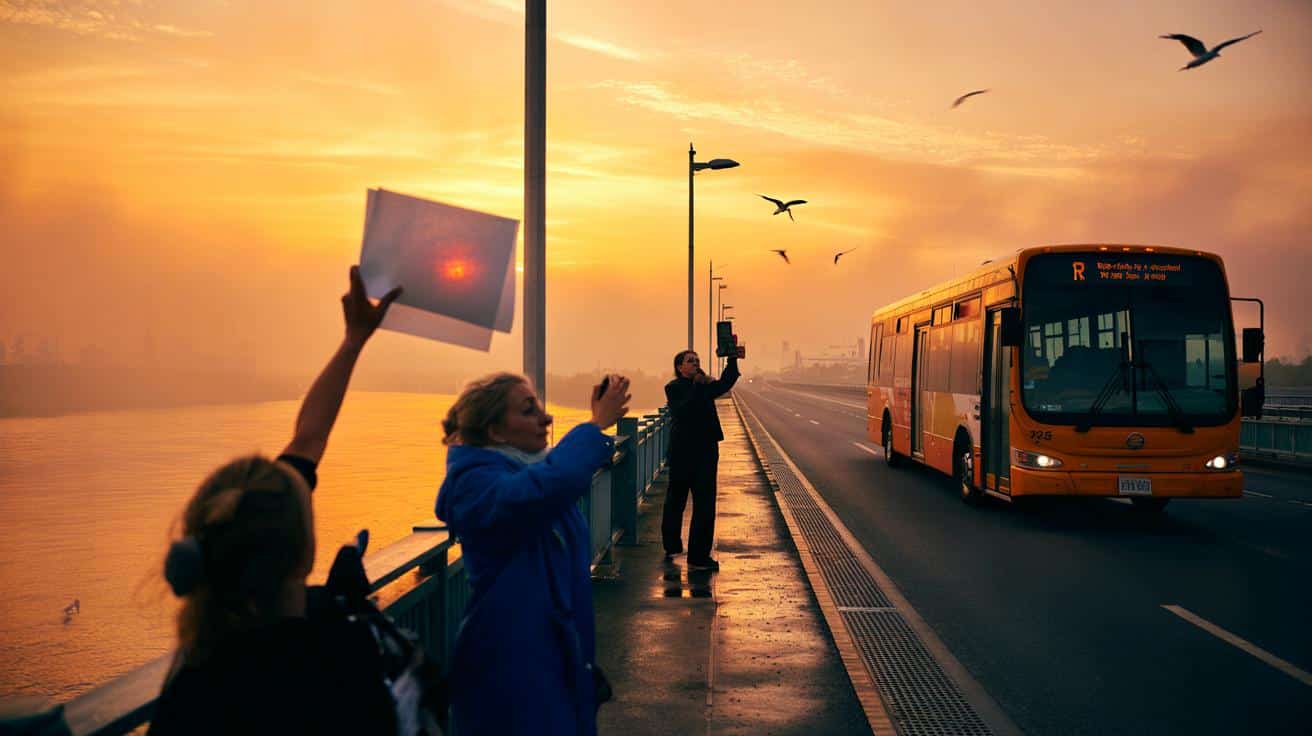
One moment, the pavements held a blue-grey chill; the next, everything blushed. Windows glowed as if a filter had slipped over the city. Commuters paused, phones half-raised, trying to name the colour. Orange, yes — but also copper, apricot, smoke. The question lingered in the warm tint: what on earth makes the sky do that?
I was halfway across the bridge when the glow landed on my hands. Bus roofs gleamed like fruit skins. The river turned marmalade near the banks and pewter in the middle, as if two different mornings had agreed to share. Streetlamps clicked off a shade too late, fooled by daylight that didn’t look like daylight. A woman in a cobalt coat laughed, then looked up with the same frown the gulls wore. The light felt borrowed, like it had travelled a long way to be here. Then the light went orange.
What turns a blue sky orange
Blue skies are a daily physics trick. Sunlight is a rainbow, but tiny air molecules in our atmosphere scatter the short blue wavelengths more, tossing them around like confetti, which is why the dome above us looks blue. At sunrise, the Sun sits low, so its light ploughs through a thicker slice of air. Much of the blue gets scattered out of your direct line of sight. What reaches you is more of the long wavelengths — reds, oranges, ambers — so the sky warms up. Add the right kind of particles and that warmth intensifies.
Real-world example? The UK saw an eerie orange day during Storm Ophelia in October 2017, when a flow dragged Saharan dust and Iberian wildfire smoke across the country. Cars were later dusted with fine grit; midday looked like sepia. New York had its turn in June 2023 as Canadian smoke thickened the air and the skyline vanished into a tangerine blur. On days like these, monitors that track “aerosol optical depth” — a measure of how much light particles block or scatter — spike. You don’t need the graphs to feel it. Your eyes do the maths in seconds.
So why orange, not red? It’s the size and type of particles. Very small gas molecules scatter short wavelengths strongly — that’s Rayleigh scattering, the everyday blue-sky engine. Larger particles like dust, smoke or sea salt interact differently. They scatter and absorb across a broader range, nudging greens out of the beam and letting warm tones dominate. This is often called Mie scattering. With the Sun low, the path is long; add a light veil of mid-level cloud and you get a perfect projector screen. **Clouds don’t create colour — they catch it.** The result is a city painted in peach, then gone in minutes.
How to read the sky from your doorstep
Start with the basics: direction, height, haze. If the Sun is low and the glow feels uniform, walk into an open spot and hold up a white sheet of paper. If that paper looks distinctly orange rather than white, you’re seeing the colour of the incoming light, not just a trick of reflection. Check wind arrows on your weather app; a southerly or south-easterly flow often carries Saharan dust towards Europe, while smoke plumes can ride jet-stream bends. A thin, milky veil overhead hints at particles spread through the column.
Sniff the air, gently. Smoke days carry a campfire edge, while dusty days are odourless yet feel dry in the throat. Look for “dirty shadows” — edges that seem a little softened even in strong sunlight. We’ve all had that moment when the world feels filtered for no good reason. **Let’s be honest: nobody checks satellite maps before breakfast.** If you do feel curious, tools like NASA’s Worldview or your national meteorological service often show daily dust and smoke forecasts in simple colours. One glance can explain a morning.
Think in layers, not just colours. Orange light at ground level often means the spectrum has been shifted by a mix of low Sun angle and airborne particles.
“What you see is the story of distance,” said a veteran sky-watcher I met by a park gate. “The further the light travels, the more it leaves the blues behind.”
Use a mental checklist:
- Low Sun and long path? Expect warmer tones.
- Visible haze or milky sky? Particles are in play.
- Medium cloud acting like a screen? Colours pop and linger.
- Smoky smell or gritty residue later? Clue to the source.
- No smell, southerly winds, dust on cars? Think Sahara.
What this glow says about the days ahead
An orange morning is a message, not a warning siren. It hints at the journey sunlight has taken to find you — across dry deserts, through forest plumes, under the slow lid of a high-pressure day. Sometimes the message is mostly aesthetic: a sunrise that makes people talk to strangers on platforms. Sometimes it’s practical: poorer visibility, reduced solar-panel output, scratchy throats for the sensitive, aircraft diverted to dodge thicker plumes. The glow doesn’t last, yet it changes how we read the day. You look up more. You text a photo to someone who needed a reason to smile. Shapes sharpen when the colour fades, and life goes on under ordinary blue. Still, inside that brief orange, there’s a reminder tucked away: the sky is a traveller, and so are we.
| Key point | Detail | Interest for the reader |
|---|---|---|
| Low Sun, long path | At sunrise, light crosses more atmosphere and loses more blue | Explains why mornings and evenings go warm even on clear days |
| Particles change the palette | Dust and smoke scatter and absorb, pushing the spectrum towards orange | Helps you tell a Saharan day from a smoky day |
| Clouds as a canvas | Mid-level cloud reflects and diffuses warm light | Shows when to expect those dramatic sky-wide glows |
FAQ :
- Is an orange sky dangerous to breathe?Colour alone can’t tell you. Smoke can worsen air quality; dust can irritate. Check your local AQI if you feel symptoms.
- Was it pollution from traffic?Urban pollution adds haze, yet the dramatic orange is more often from regional dust or smoke plus a low Sun.
- Why does it happen in the morning more than midday?The Sun’s low angle at sunrise and sunset lengthens the path, removing blues and enhancing warm tones.
- Can I predict the next orange morning?Look for southerly flows for dust, or news of distant wildfires, plus thin cloud forecasts around dawn.
- Will it affect my photos or solar panels?Photos look richer; panels may see slightly reduced output if haze is thick.







Loved the « clouds don’t create colour — they catch it » line. Beautifuly explained and vivid writing. Thanks!