
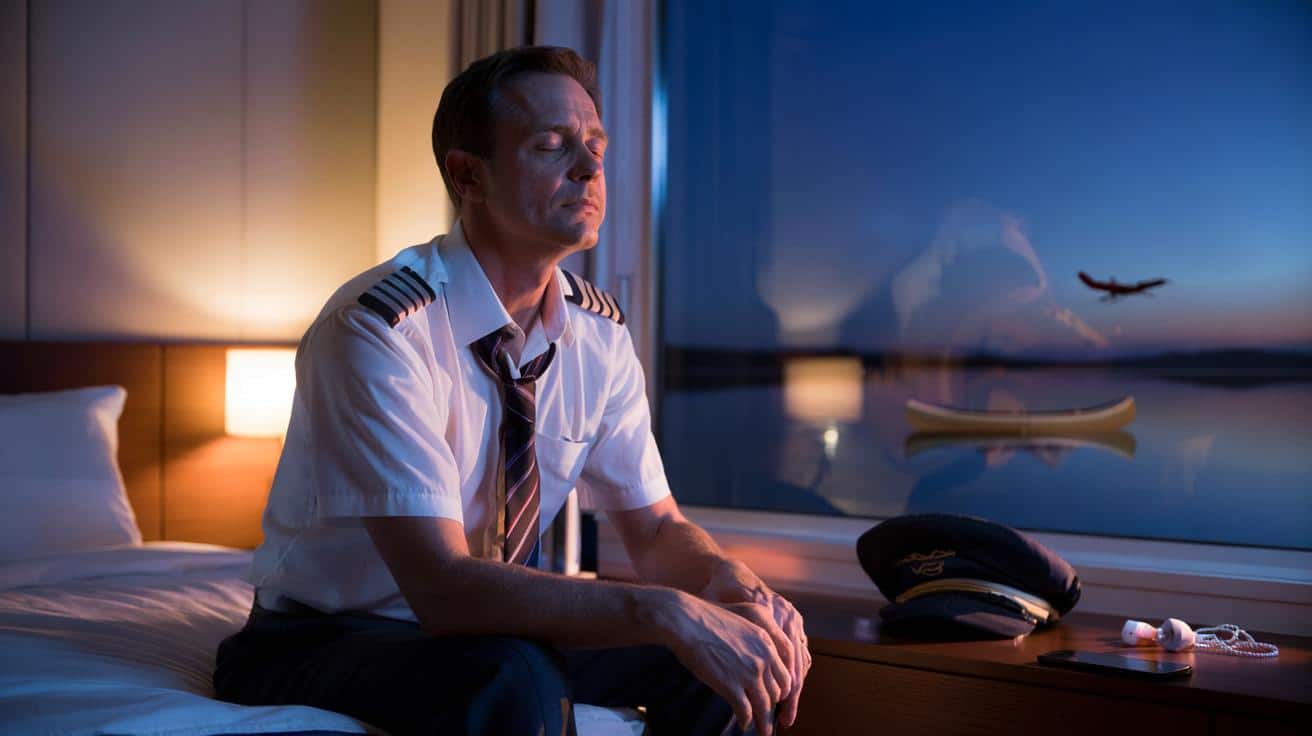
You know that maddening dance with sleep: your mind whirrs, your phone’s glow licks the sheets, and the clock rolls past midnight like a smug commuter train you just missed. Now picture a cockpit at cruising altitude, alarms primed, fuel maths done, and a pilot who knows he’s got minutes to rest before the next handover. He closes his eyes and runs a tight sequence, learned under pressure, honed in noisy barracks and cramped cabins. Shoulders drop. Jaw slackens. Thoughts dim. It’s not magic. It’s training. The rumour is, it takes two minutes. The question is, could it work for you?
A first officer in a crisp white shirt sat on the end of his bed, eyes half–closed, practising a script he could do in turbulence, with the APU humming or a kettle boiling two rooms down. He didn’t argue with his brain, didn’t wrestle with sleep, didn’t chase it. He coached it in like a grateful landing. Two minutes.
Why pilots swear by a two‑minute shutdown
Aircrew live by routines you can set your watch to, and their sleep is no different. In training, they’re taught a rapid wind-down that strips the body of tension from the face down, then parks the mind on a single, boring track. It was popularised in a 1981 coaching manual used by the U.S. Navy and has been passed around cockpits, locker rooms and late‑night forums ever since. The appeal is obvious: no supplements, no apps, no gadgets. Just your nervous system learning a cue. And once you’ve felt it work, you want that switch forever.
Stories from the military paint the picture—men and women nodding off on metal bunks, on aircraft carriers, in tents with generators growling and radios hissing. A widely shared training note claims that after six weeks of daily practice, roughly 96% of trainees could fall asleep in two minutes or less, even with noise and light. The number sounds bold, yet the method keeps travelling because it feels surprisingly mechanical: a set of steps you can repeat in a cramped jump seat or a midnight bedroom. We’ve all had that moment when you’re flat on your back, staring at the ceiling, desperate for anything that works.
What’s going on under the bonnet is simple physiology. When you soften the muscles of the face and let the shoulders melt, you’re signalling to your body that the threat level has dropped and the parasympathetic system can take over. Slow, even breathing lifts carbon dioxide a touch and nudges a lower heart rate. A single, neutral mental image keeps the cortex from leaping between work emails and tomorrow’s school run, so arousal drops rather than spikes. It’s not hypnosis. It’s a clean handover from fight‑or‑flight to rest‑and‑digest, delivered by a sequence your body learns to recognise.
The step‑by‑step ‘pilot sleep hack’ you can try tonight
Lie on your back, let your hands rest by your sides, and start at the top. Soften your forehead, release your jaw, let your tongue fall from the roof of your mouth, and feel your eyes sink heavy in their sockets. Drop your shoulders as if someone untied a knot between your shoulder blades, then relax your upper arms, forearms and hands, one side then the other. Exhale slowly and let your chest deflate like a bellows. Ease your stomach, relax your thighs, calves, then feet. Breathe low and easy. Now clear the deck: picture a calm lake at dusk as you float in a canoe, or a dark room with a heavy velvet hammock. If a thought pops up, say “don’t think” for ten seconds and return to the image.
Most people rush it, or try to squeeze sleep out of their brain like toothpaste. Go slow, 8–10 seconds per body part, and let gravity do some of the work. If your brow keeps tensing, consciously smooth it. If your tongue keeps pressing, let it fall again. Create a low‑stimulation preamble—dim light, cool room, no scrolling. And if the first three nights feel rubbish, that’s normal; you’re teaching a reflex, not winning a race. Let’s be honest: nobody does this every night. A little patience beats a perfect routine you never stick to.
When you feel foolish, remember: pilots and athletes use scripts because scripts work under stress.
“The trick isn’t to force sleep; it’s to practise letting go the same way every time, so your body recognises the route,”
says a veteran trainer who’s taught relaxation to crews on brutal schedules. Some tiny extras help: keep your jaw loose by touching teeth without clenching, try a breath count of four in and six out, and don’t clock‑watch.
- Consistency beats perfection: run the same script for a few weeks before you judge it.
- Noise isn’t fatal: white noise or earplugs can blunt the edges without changing the method.
- Wake at 3am? Restart at the shoulders rather than the face; you’re already drowsy.
- Racing mind? Shorten the visual to a single word like “lake” or “dark”.
- Chronic insomnia or sleep apnoea isn’t DIY—speak to a GP or sleep clinic.
What this hack can’t do — and why it still matters
No routine is a silver bullet when you’re on espresso at midnight, your neighbour’s party is thumping through the plaster, and your head’s full of spreadsheets. The pilot method won’t outmuscle untreated sleep disorders, nor will it erase a late‑night curry, an anxious rumination spiral, or a newborn’s body clock. And yet the value sits in the shift from trying to sleep to rehearsing sleep—one is a struggle, the other is a practice. You’re reclaiming some agency in a part of life that often feels slippery. Share the steps with a partner, teach it to a teenager before exams, build it into a nap on a Saturday. **Two minutes is a direction, not a deadline.** The real win is learning how to arrive at rest on purpose.
| Key point | Detail | Interest for the reader |
|---|---|---|
| Face-to-toes release | Relax face, drop shoulders, arms, chest, legs in sequence | A clear map to switch off tension fast |
| Single neutral image | Visualise a canoe on a calm lake or a dark velvet room | Stops rumination without “trying” to sleep |
| Practise like a drill | Run the same script nightly for several weeks | Builds a reliable, portable sleep cue you can use anywhere |
FAQ :
- Does the two‑minute pilot method really work?It’s a proven relaxation routine with strong anecdotal backing from military and aviation training. Many people see results after steady practice, though not everyone hits two minutes every time.
- Is this the same as 4‑7‑8 breathing?No. You can blend slow breathing with it, but the pilot method focuses on progressive muscle release plus a simple mental image and a “don’t think” cue.
- What if my mind won’t shut up?Keep the image tiny—one word or a black screen—and repeat it gently. If thoughts intrude, notice them and come back to the script without judgement.
- Can I use it for naps or on flights?Yes. It’s built for noisy, bright places. Earplugs or a hoodie help, but even in a seat you can drop your shoulders, relax your jaw, and run the visual.
- How long until I see a change?Some feel a shift in a few nights; the popular training story talks about six weeks for consistent results. Build the habit and track how you feel rather than chasing a stopwatch.







Tried this tonite and got drowsy in about 3 minutes. The loose jaw + slow exhale + « lake » image combo definately helped me stop chasing sleep. It felt more like a drill than a vibe, which I weirdly like. I’m going to run the same script for a few weeks and see if it sticks. Thanks for the clear step-by-step and the reminder that two minutes is a direction, not a deadline.
That 96% success after six weeks sounds bold—do you have any peer-reviewed studies to beleive it, or is this mostly anecdotes from training manuals?