
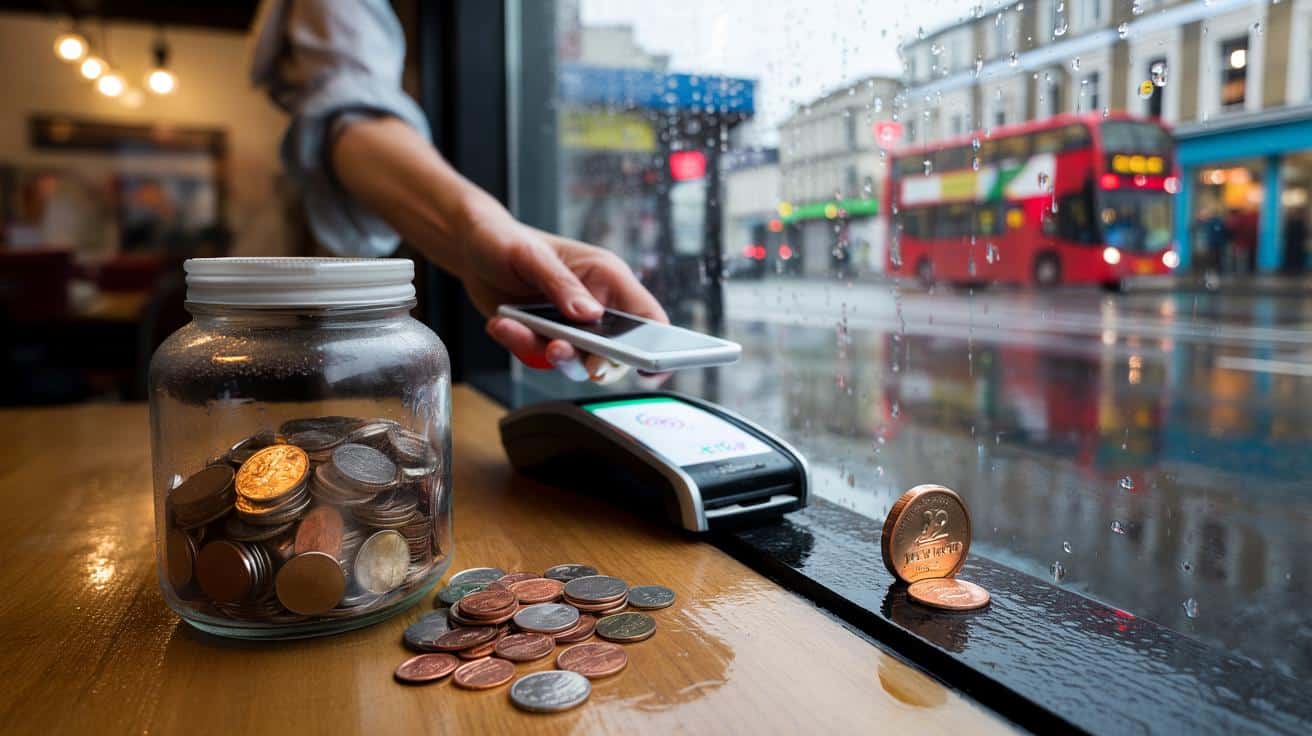
Ministers are weighing what to do with small change as cash slips from daily life and prices round themselves in people’s heads. If a rapid review lands on a Chancellor’s desk, Britain’s 2p could quietly exit by year’s end.
I noticed it on a damp Tuesday in Leeds, the kind of morning where the café windows fog and the card terminals never sleep. A child fed a handful of copper coins into a charity pot with a clatter, while two tables over an older man tried to settle a bill with exact change and was waved towards the tap-to-pay sign. I could feel the coin era thinning at the edges. Outside, the pavement glowed with drizzle and a single 2p lay near the kerb like a prop from a different decade. What if the 2p’s last Christmas is coming?
What’s pushing the 2p to the brink
Cash isn’t dead, but it doesn’t lead anymore. UK Finance says cash use fell to around 14% of all payments in 2022 and it keeps sliding as small buys move to phones and watches. Retail tills see less copper, while household jars hoard more of it than the Mint can shake loose. **The 2p doesn’t move like it used to.**
Take the seaside arcade that once ran on buckets of bronze. The owner told me card readers now handle most of the spend, and the prize counter rarely needs to crack open copper bags. Charities say coin donations are still loved, yet contactless buckets now outperform the old plastic pots, even at village fetes. A decade ago the Royal Mint sometimes struck millions of new 2p pieces a year; recently it has skipped fresh runs because there are already mountains sleeping in drawers.
Policy gives the coin a timeline. The Treasury can trigger a short consultation, gather evidence from retailers and consumer groups, then announce a decision in the Autumn Statement. Ireland dropped its 1c and 2c in 2015 with “rounding to nearest 5c” and life carried on; Canada binned its penny in 2012; Australia ditched 1c and 2c back in 1992. The UK already has new King Charles III designs in circulation, which shows tradition isn’t the blocker here. It comes down to cost, convenience, and how people actually pay on a busy Thursday.
How a phase-out would actually work for you
Think simple: spend, bank, donate. If a phase-out is announced, you’d get a window where 2p coins remain accepted in shops, probably months long, followed by a period where banks and Post Offices keep swapping them indefinitely. At the counter, 50 two-pence pieces make £1 in a standard bag; you can drop those at many branches or deposit machines. If you use supermarket coin counters, check the fee on the screen first and only go that route if time matters more than the charge.
Don’t scrub coins with soda or vinegar in hope of a windfall; collectors dislike cleaned metal. Don’t dump a kilo of copper on a busy till and expect smiles; split it into bank-standard bags and pick a quiet time. We’ve all had that moment where a jar of coins becomes a guilty to-do item on the shelf. Let’s be honest: no one actually does that every day. If you’re short on time, donate the lot to a charity that runs a free coin-count machine at its shop or regional hub.
Retail pricing will adapt almost instantly, because price endings are theatre as much as maths. Most round to .99 for psychology; rounding rules simply settle the final bill at the till.
“If the 2p goes, tills will cope in a week; shoppers will grumble for a day,”
said one high-street manager when I asked how staff would handle it. Here’s a quick action list you can actually use:
- Wait for the official timeline, then start spending your copper on low-stakes buys like newspapers or bus snacks.
- Bag 2p coins in 50s (£1) for smoother deposits at banks or the Post Office.
- Ask your local charity if they have free counting; many do, quietly.
- Keep a small handful for machines that still take coins, then test alternatives.
- Watch rounding rules: bill totals round, not individual items.
The bigger question behind a tiny coin
Some will cheer the end of the 2p as a tidy-up, a clear-out of the nation’s junk drawer. Others will feel a tug of loss, because coins mark moments: a first pocket-money buy, a superstitious toss into a fountain, a copper pressed into a small palm at the corner shop. **Money is never just maths.** A phase-out asks what we value in the texture of daily life, and how we keep it fair for people who lean on cash by choice or by need. The UK can keep cash access alive while letting tiny denominations retire, as neighbours have done. Maybe the point of the 2p was never its 2p of buying power. Maybe it’s what it taught us about exchange, about looking someone in the eye and paying for something that mattered. That part we can carry forward.
| Key point | Detail | Interest for the reader |
|---|---|---|
| Possible timeline | Short consultation in spring or summer; a decision could land at the Autumn Statement; phased withdrawal could begin before year-end. | Know when to act, not panic, and when to empty the coin jar. |
| Rounding rules | Totals at the till would round to the nearest 5p; card and online payments stay exact. | Prices won’t suddenly jump on every item; everyday bills stay predictable. |
| What to do with 2p coins | Spend on small buys, deposit in bank-standard bags, or donate through free counting schemes. | Avoid fees, avoid queues, and give copper a useful last job. |
FAQ :
- Is the 2p definitely being scrapped this year?No decision has been announced. The Treasury could review small coins and take a call later this year, but it needs a consultation and a clear plan before anything changes.
- How would rounding work in shops?It applies to the final bill, not each line item. A £3.42 total would round to £3.40 in cash; £3.43 rounds to £3.45. Card and digital payments stay to the penny.
- Will this make prices rise?Evidence from Ireland, Canada and others shows no lasting inflation effect from rounding; small ups and downs cancel out across baskets.
- Can a shop refuse 2p coins now?Shops can choose which payment methods they accept. Legally, 1p and 2p coins are “legal tender” only up to 20p for settling debts, which isn’t the same as a right to pay with them at any till.
- Are any 2p coins valuable?A tiny number are, like genuine 1983 “New Pence” 2p pieces struck in error. Most are worth face value; if you think you have a rarity, compare details with a reputable guide before selling.




So we ditch 2p and just trust retailers not to round up in practise? You say totals round both ways, but I bet price endings quietlly creep. Seen it before. Also, ‘legal tender’ up to 20p—who enforces that at a busy till?