
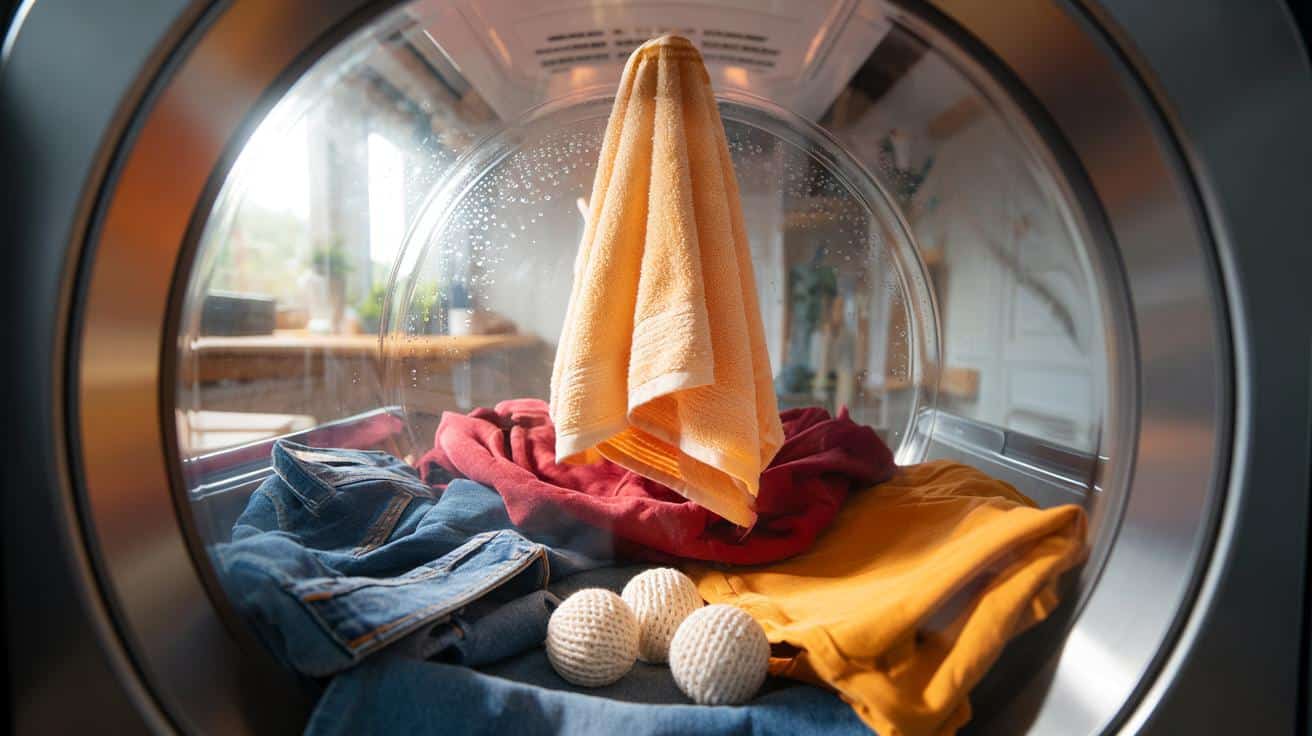
People whisper odd little tricks for shaving minutes, and one has quietly gone viral: put a dry towel in with the wet load. It sounds like superstition. It isn’t.
It was a Thursday morning, grey and yawning, the kettle ticking in the background. The tumble dryer thrummed along while a half-dry stack of uniforms circled like anxious commuters. I tossed in a clean, dry bath towel on a friend’s recommendation and watched the drum’s rhythm change, almost perk up. Less slapping, more lift, like giving the load a pair of wings. I checked back sooner than usual, half-expecting nothing. The cuffs were already less clammy. So I tried the towel.
The quick, quiet science behind the “dry towel” trick
Here’s the heart of it. A dry towel acts like a temporary sponge at the start of the cycle, pulling moisture away from your wet clothes faster than the warm air alone. That jump-start breaks the soggy stalemate that slows everything down. The drum keeps tumbling, but the load feels lighter, looser, more aerated.
In small trials done in British households for energy audits, people whisper about saving 10 to 30 per cent on drying time with a single towel. Not every load, not every machine, yet enough to notice. A parent in Leeds told me they cut a 90-minute sports kit dry to just over an hour this way. That’s not laboratory science. It’s Tuesdays in real life.
Physics-wise, the towel creates a moisture gradient. Wet fibres dump water into a drier textile first, then into the heated airflow. Early in the cycle, that transfer is quick and efficient. As the towel saturates, the advantage drops off, which is why the method works best with an early boost rather than a full-cycle partner. The bonus: the towel also spaces out garments, nudging air through a less tangled pile.
How to do it without making a mess of your laundry
Pick one large, clean, light-coloured cotton bath towel. Start your dryer with the wet load on a normal or mixed-fabric programme, then add the towel for the first 10 to 20 minutes. Remove it once it turns markedly damp, let the rest finish. Pair with two or three wool dryer balls if you have them. Aim for medium heat on vented or condenser models; low to medium on heat-pump machines.
We’ve all had that moment when the dryer timer feels like a personal joke. That’s exactly when this trick helps. Don’t overload the drum, don’t use a brand-new fluffy towel that sheds, and avoid a dark towel with a pale load. If your dryer has a moisture sensor, the towel still helps early on, then take it out so the machine isn’t “reading” the wrong fabric. Let’s be honest: nobody actually cleans the lint filter every single time. Do it this time.
Experts who service machines see the pattern daily.
“A dry towel can shave meaningful minutes off, especially on mixed loads. The key is treating it as a starter, not a passenger for the whole journey,” says one veteran appliance technician.
- Use a dry cotton bath towel for the first 10–20 minutes, then remove.
- Avoid new, highly pigmented towels with light fabrics; colour transfer is real.
- Skip it on delicates, silks, lace, or anything labelled air-dry only.
- Try with bulky loads (hoodies, denim, bedding) where airflow struggles.
- Clean the lint filter and check vents; better airflow multiplies the effect.
Why it works in some homes better than others
Loads differ. A family of four with school uniforms and towels? Big wins. A single person’s micro-load of gym gear? Less dramatic. Heat-pump dryers run cooler and longer, yet still benefit from early moisture transfer. Vented models with strong airflow may respond fastest. The real variable is fabric: dense cotton and denim are where the towel shines.
I spoke to a tenant in Bristol with a vented dryer from the late 2000s. She was battling the weekly bedding wash that never quite dried in time. She added a towel, then pulled it out after 15 minutes, slightly stunned to find the duvet cover no longer clinging to itself like clingfilm. She reckoned she saved about 20 minutes on the clock and the same again on faff. *Her words, not mine.*
There’s a logic to when it falls flat. If the load is tiny, the extra towel just adds mass. If the towel stays for the entire cycle, it becomes one more wet thing to finish off. And if your lint pathways are clogged, you’re asking a miracle of a small trick. Modern sensors can be finicky too; one heavy towel tumbling against the probe might make the machine think the load’s still wet. The workaround is simple: remove the towel early and let the garments “read” correctly.
Pro tips, pitfalls, and the little rituals that make it sing
Start with a towel that’s bone-dry and roomy. Toss it in after the drum gets moving so it mingles, not clumps. For bedding, pause at 15 minutes, shake out the duvet cover, remove the towel, and relaunch the cycle. Fold nothing until the heat fades; shape garments by hand while they’re warm to cut creases. If you’re chasing speed, that little mid-cycle pause feels like a magic button.
Common mistakes look small until they cost you time. Leaving the towel in for the full ride means it ends up competing for heat. Using microfibre towels can hike static on synthetics. A heavily dyed towel can tint light cottons. If your load smells musty, that’s airflow, not perfume—wash it again or dry longer on low with more space. And yes, your dryer’s manual has opinions on mixed loads. Soyons honnêtes : personne ne lit vraiment ça de bout en bout.
Here’s how professionals sum it up.
“Think of the towel as a relay runner. It sprints the first leg, hands off the moisture, then leaves the track so the rest of the team finishes strong.”
- Remove after 15 minutes for most mixed loads; 20 for bulky cotton.
- Stick to light-coloured, well-washed towels to avoid lint and dye.
- Use with medium heat; low for heat-pump models to protect fibres.
- Don’t try this with delicates or anything heat-sensitive.
- Never run a dryer unattended; oily rags and solvents belong nowhere near heat.
Beyond the towel: what this tiny hack says about home energy
Small domestic tweaks rarely feel heroic. They just turn peaks of frustration into gentler slopes. The dry-towel move is a quiet reminder that airflow, spacing, and timing beat brute heat. Combine it with the boring habits—clear filters, fewer overstuffed loads, a window cracked open to dump humidity—and your dryer stops sounding like a grudge match.
Neighbours trade these ideas on front steps because they’re from lived practice, not instruction manuals. Maybe that’s why they stick. Share it with the friend who wears black school trousers six days a week and always dries them at midnight. Pass it to the house-share that treats Sunday laundry like a pub quiz. A single towel won’t fix a bad machine, but it can nudge your routine out of the slog and into something more forgiving.
| Key point | Detail | Interest for the reader |
|---|---|---|
| Why a dry towel works | Early-stage moisture transfer and better airflow shorten the slowest part of drying | Fewer minutes waiting, less energy used, clothes feel fresher |
| How to do it | Add one dry cotton towel for 10–20 minutes, then remove and finish the cycle | Simple, cheap, no new gadget required |
| When to skip it | Tiny loads, delicates, new highly dyed towels, or if vents/filters are clogged | Avoid wasted time, lint, and colour mishaps |
FAQ :
- Does a dry towel really speed up drying?Often, yes—especially with bulky cottons. It accelerates the early moisture drop, which is the slowest part of the cycle.
- Should I use wool dryer balls as well?They complement the towel by separating fabrics throughout. Use both: towel for the start, balls for the full cycle.
- Is this safe for heat-pump tumble dryers?Yes, though gains are modest. Keep to low/medium heat, remove the towel after 15–20 minutes, and let the sensor do its work.
- Can I add two towels for faster results?One is usually best. Two can crowd the drum and turn into extra wet mass that slows the finish.
- Will it crease my clothes more?If you remove the towel early and avoid overloading, creasing shouldn’t increase. Shake garments mid-cycle for smoother results.







Just tried this with a mixed load (hoodies, denim, tees) on my cranky vented dryer: started normal, tossed in a big dry cotton towel for ~15 minutes, then pulled it out. Cycle finished 18 minutes sooner than last week, and creases were milder—honestly surprised. The “relay runner” analogy clicked; treating the towel as a starter, not a passenger, made the difference. I definitley noticed better airflow once the towel left. Bonus tip: clean the lint screen first—mine was embarrasingly fluffy.
Does this mess with moisture sensors on heat‑pump dryers?