
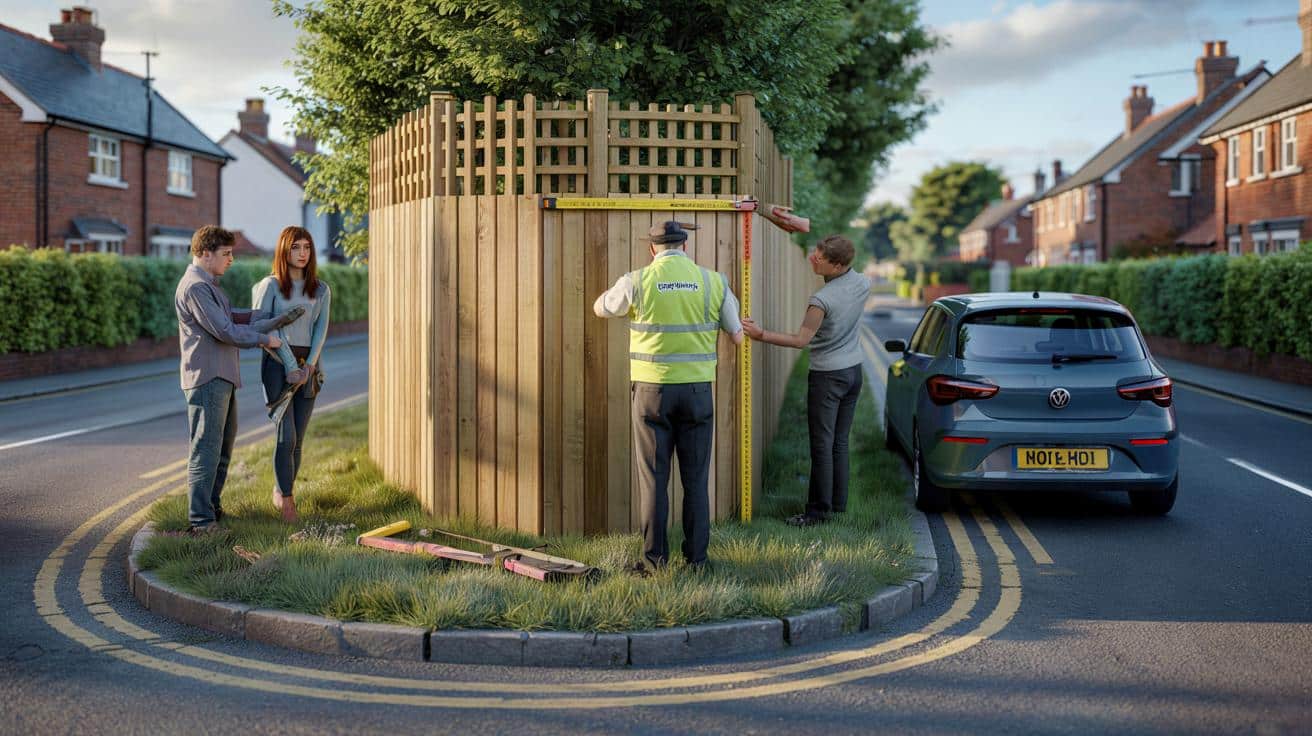
That extra panel for privacy might feel harmless, yet in the UK it can cross a legal line and trigger a council letter, a demand to lower it, and a fine that bites — up to £1,000.
Saturday morning on a quiet cul‑de‑sac in Leeds, a man in paint‑splattered joggers is hoisting fresh panels while his partner passes him the spirit level like a surgical instrument. The neighbour’s dog is curious, the kettle’s on, and the DIY buzz is real. By lunchtime the street looks smarter and the garden feels tucked away. Then a hatchback brakes awkwardly at the corner and the driver leans forward, peering. A week later, a white envelope lands on the doormat: planning enforcement. The fence, handsome as it is, sits next to a road and is taller than the rules allow. It must come down or be cut. The number jumps off the page like a warning flare.
The height rule that catches people out
Across England and Wales, the broad rule is simple: you can put up a fence, wall or gate up to 2 metres high without planning permission. The catch appears when your boundary runs along a highway used by vehicles, including the pavement beside it. Along those edges, the limit drops to **1 metre by a road**, because sight lines and safety trump your privacy plans. The measurement is taken from the natural ground level on your side, not from a raised patio, a planter or a step. A trellis on top still counts toward the total height, even if it looks airy.
Picture a corner‑plot semi with a side garden hugging a bend. The owner replaces a tired 1.2m fence with neat 1.8m panels for security, adds a 30cm trellis for climbers, and finally feels screened from passers‑by. Two weeks later, a planning officer visits after a complaint about visibility at the junction. The tape measure doesn’t lie: 2.1m beside a public road. The owner gets a notice offering options — reduce the height, move the fence back from the highway, or submit a retrospective application that may still fail. Ignore it and the stakes rise fast, including a bill that can hit £1,000.
Why the fuss about a few centimetres? Road safety and neighbourhood amenity. Taller boundaries at corners and driveways can hide oncoming cars, cyclists and children, and robust panels can overshadow light into a neighbour’s garden. Councils are tasked with balancing privacy, safety and the look of a street, which is why extra height often needs explicit consent. The enforcement path is pretty standard: complaint, site visit, advice, and a window to fix or seek permission. Flout an enforcement notice and you risk prosecution with fines that move from a warning shot to a wallop. That’s how a fence turns into a four‑figure problem.
Staying legal without losing your privacy
Start with a tape measure and the ground you actually stand on. Measure from the original soil level along the fence line, not the top of decking or a new bed of gravel. If you’re on a slope, take the height at several points because the low end might tip you over the limit. Consider stepping the fence to follow the fall of the land, or pull it back a little from the pavement so the highway rule no longer applies. In lots of gardens, swapping solid panels for slatted ones and keeping the top at 1m along the road edge delivers privacy without triggering a planning wrangle.
We’ve all had that moment when a friendly chat with a neighbour morphs into a boundary seminar. People mix up who owns which fence, or think a dainty trellis doesn’t count. Another classic is adding planters to boost vegetation height, then measuring from the planter top rather than the soil. Check your title deeds for restrictive covenants and, if you’re in a conservation area or near a listed building, the bar can be even lower. Let’s be honest: nobody reads council guidance for fun, but a five‑minute call to a duty planner beats days of back‑and‑forth later.
Quiet diplomacy is your best tool. Tell neighbours what you’re planning, show them sketches, and avoid springing a taller fence on someone who treasures their morning sun.
“Most disputes start with surprise,” says a veteran fencing contractor. “Share your plan early, keep it at 1 metre by a road, and you’ll rarely hear from enforcement.”
- Max height without permission away from roads: 2m (including any trellis).
- Max height next to a highway or its pavement: 1m.
- Measure from natural ground level on your side, not from decking or planters.
- Corner plots and driveways get extra scrutiny for sight lines and safety.
- Listed buildings, conservation areas and Article 4 zones can remove usual rights.
The fine print, the human bit, and the smarter compromise
Here’s the paradox: the very thing that makes a street feel safe and calm — clear lines of sight — can collide with your craving for seclusion. Most councils aren’t prowling with rulers, yet they do respond when someone complains or when a structure plainly breaks the rules. If you’ve already built too tall, a respectful email and a plan to trim often resets the tone. Some homeowners step the first few bays down to 1m by the road, then rise to 2m deeper into the garden, or swap the top panel for slats that let light through. You might keep the privacy you want without breaching the line the council cares about.
There’s also the hedge route. Evergreen hedges are governed differently, with complaints handled under high‑hedge rules rather than basic planning, and failure to comply with a remedial notice can still cost up to £1,000 plus daily penalties. The signal is the same: solve the problem, don’t dodge it. If your plot sits on a bend, near a school run, or opposite a busy driveway, think like a driver and a walker as well as a homeowner. *It’s a fence, yes, but it’s also part of a shared space.* A little empathy can save you money and a lot of grief.
| Key point | Detail | Interest for the reader |
|---|---|---|
| Highway rule | Limit is 1m beside roads and their pavements | Explains why a “normal” fence can suddenly be “illegal” |
| Standard limit | Up to 2m elsewhere without permission | Gives a clear target for most gardens |
| Enforcement risk | Ignore a notice and fines can hit £1,000 or more | Shows the real‑world cost of getting it wrong |
FAQ :
- What is the legal fence height in the UK?In most cases you can erect a fence, wall or gate up to 2 metres high. If it borders a highway used by vehicles, including the pavement, the limit drops to 1 metre unless you get planning permission.
- Does a trellis count towards fence height?Yes. A trellis fixed on top is part of the overall structure. If the combined height passes the limit, it needs permission.
- What does “adjacent to a highway” mean?It means along a road used by vehicles or the pavement beside it. Corner plots and driveways near junctions are treated with extra care for visibility.
- Are hedges covered by the same rules?Not exactly. Evergreen hedges fall under high‑hedge legislation. Councils can order reductions, and ignoring a remedial notice can lead to a fine up to £1,000 plus daily penalties.
- Do I need my neighbour’s consent to replace a fence?If it’s your fence on your land and within the height limits, no. For shared or unclear boundaries, a quick written agreement avoids disputes — and future headaches.







Didn’t know a trellis on top counts as height. Thanks!
Is this actually enforced outside busy junctions, or is it one of those rules councils dust off only after a neigbour complains?