
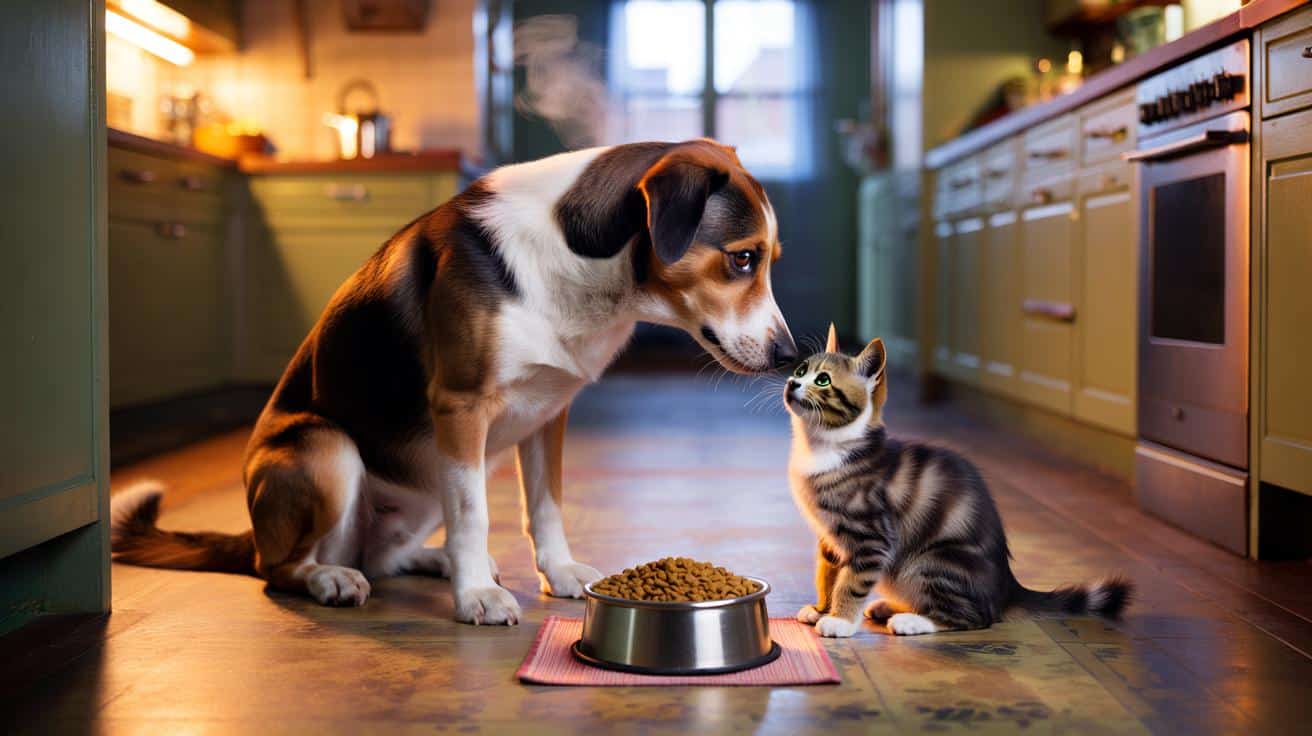
His ears tilt towards the hallway, listening. He won’t touch a crumb until a whiskered shadow appears and a small tabby cat called Pip pads into view.
The kitchen is one of those tidy London rectangles where the kettle is always warm and the lino remembers every step. Milo sits by his food, head lifted, tail low, eyes fixed on the doorway. When Pip arrives, tail flagging like a tiny standard, something unlocks. The dog exhales, touches his nose to the cat’s shoulder, and begins to eat. Pip sits companionably beside him, paws tucked, as if on sentry duty. You can hear the calm in the room. Don’t ask me how, but you can.
Neighbours have started timing their dog walks to catch the scene through the window. Someone filmed it once and shared a clip that collected more hearts than a jewellery advert on Valentine’s Day. The comments weren’t about tricks or training, though. They were about friendship and routine and what we need to feel safe. **He will not eat without her.** That’s the whole story. Or so it seems.
The unlikely dinner ritual
At first glance, it looks like a fussy dog playing hard to get with his kibble. Look closer and you see something else entirely. Milo is a rescue, and rescues carry history in the body. The waiting is not a game. It’s a signal that says, “I eat when my friend is here.” Dogs are social eaters. Plenty of them relax when a trusted companion is nearby. It’s not always a person. Sometimes it’s a cat with a humming purr and a steady presence.
There’s a mirror of this in other homes. A spaniel who won’t drink unless the elderly Labrador shuffles in first. A pair of rabbits who nibble only when their noses touch. A video from a Manchester flat showed a terrier freezing until his housemate, a soot-grey cat called Dot, jumped onto the washing machine. A comment under that clip read, “This is my favourite soap opera.” The Pet Food Manufacturers’ Association says around 57% of UK households live with a pet. Many of those are mixed-species families, even if they don’t make a fuss about it.
Why does Milo wait for Pip? Because rituals are anchors, especially for animals who once lacked them. The sound of Pip’s paw pads on vinyl, the soft thud of her landing by the bowl, the brief touch of fur-to-fur: each is a cue in a chain. Over time, these cues became a green light. The cat’s arrival predicts a quiet, uneventful meal. No surprises. No hands reaching in. No bowls being snatched away. Behaviour folk would call it learned safety. **For him, safety arrives on four silent paws.** Put simply, Pip is the permission slip that lets Milo focus on food instead of worry.
How to nurture calm co‑feeding at home
If you want to build the kind of serene mealtime Milo and Pip share, start with small, boring steps. Feed in the same place, at roughly the same time, with the same bowls. Give each animal a “spot” on a mat and pair that spot with something lovely. Say a quiet word like “dinner” as you place the bowls down. Add a one-second pause. Then release them to eat. Repeat this slow rhythm until it becomes invisible. Routine is the soft power of the home.
Watch the room more than the bowls. If one pet stares, shifts weight forward, or crowds the other, add space. Slide the bowls further apart or use a baby gate so they can see but not steal. Keep the floor calm: no scooping up bowls mid-bite, no looming. Let’s be honest: nobody really does that every day. But a little consistency goes a long way. If someone is nervous, reduce the noise, dim the TV, and make the first bites irresistible with a spoon of warm water over kibble to lift the smell. That scent can be the handrail.
When things wobble, borrow a rule from good training: make it easier, not louder.
“If a pet won’t eat, the meal isn’t a test of willpower. It’s a message about comfort. Bring comfort closer.”
**Start small, repeat often, keep it boring.** Here’s a simple micro‑plan you can screenshot for later:
- Two mats. Two bowls. A quiet word. Same time each day.
- Bowls down. One beat of stillness. Release both with a soft cue.
- If tension shows, add distance or a barrier and reward calm.
- End meals cleanly. Pick up leftovers after ten minutes.
- Celebrate tiny wins: a tail unclenched, a head lowered to eat.
What this bond quietly tells us
There’s a common worry tucked inside stories like Milo’s: is he “too dependent” on the cat? It might look like that from the outside, yet most of the time it’s just a neat piece of associative learning. Pip equals peace. Food sits under that umbrella. The pair have written their own household rules, and the rules make sense in their small world. Sometimes the simplest explanation is right there in the doorway, yawning and whisker-twitching. *This is what trust looks like.*
We’ve all had that moment when a familiar voice or a shared ritual turned the volume down on our day. Animals aren’t so different. A rescue dog doesn’t need a grand theory to eat. He needs the same quiet pattern, served warm, until it feels like home. You might find your version is a radio left low, a hallway light, a pair of bowls kept apart but within sight. That’s not indulgence. It’s design. And it works because it’s ordinary.
If you’re tempted to “fix” a ritual that looks quirky, ask what purpose it serves before you pry it loose. Is everyone healthy? Is the food going down without tension? Is the cat content to supervise like a tiny maître d’? Then let the duet play. If it falters, bring in gentle structure. If it holds, don’t overthink it. The best behaviours in a home are often the ones we barely notice, until a dog pauses at a bowl and waits for the sound of paws on lino, and we realise a small miracle has been happening every night.
| Key point | Detail | Interest for the reader |
|---|---|---|
| Ritual builds safety | Consistent cues tell the brain “this meal is calm” | Easy, low-cost way to help anxious or rescue pets eat |
| Space reduces tension | Line of sight without crowding, barriers if needed | Prevents food stealing and mealtime scuffles |
| Make it easier, not louder | Short pauses, soft release word, tastier first bites | Practical steps you can try tonight without stress |
FAQ :
- Is it OK if my dog waits for my cat before eating?Yes. If both are healthy and relaxed, it’s a harmless ritual that signals comfort, not a problem to fix.
- Could this be separation anxiety or resource guarding?It’s usually learned safety. Guarding looks tense and pushy; this looks calm and expectant. If there’s growling, add space.
- How do I teach a peaceful mealtime routine?Same place, same cue, short pause, release. Use mats and a barrier if needed. Reward calm, not speed.
- What if one pet raids the other’s bowl?Feed with a gate or in separate rooms, then swap bowls only when both are empty. Supervise those last few bites.
- Should I worry if my dog skips meals?One skipped meal can be normal. Repeated refusals, weight loss, or lethargy need a vet check to rule out medical causes.





My heart. The way you describe “learned safety” turns an internet cute clip into something tender and wise. Milo and Pip feel like roommates who rebuilt quiet together.
Isnt this just reinforcing dependance? If a dog won’t eat unless the cat shows up, aren’t we rewarding avoidance? I get the learned-safety angle, but how do you nudge him toward eating calmly even when she’s not there? Curious, not snarky.