
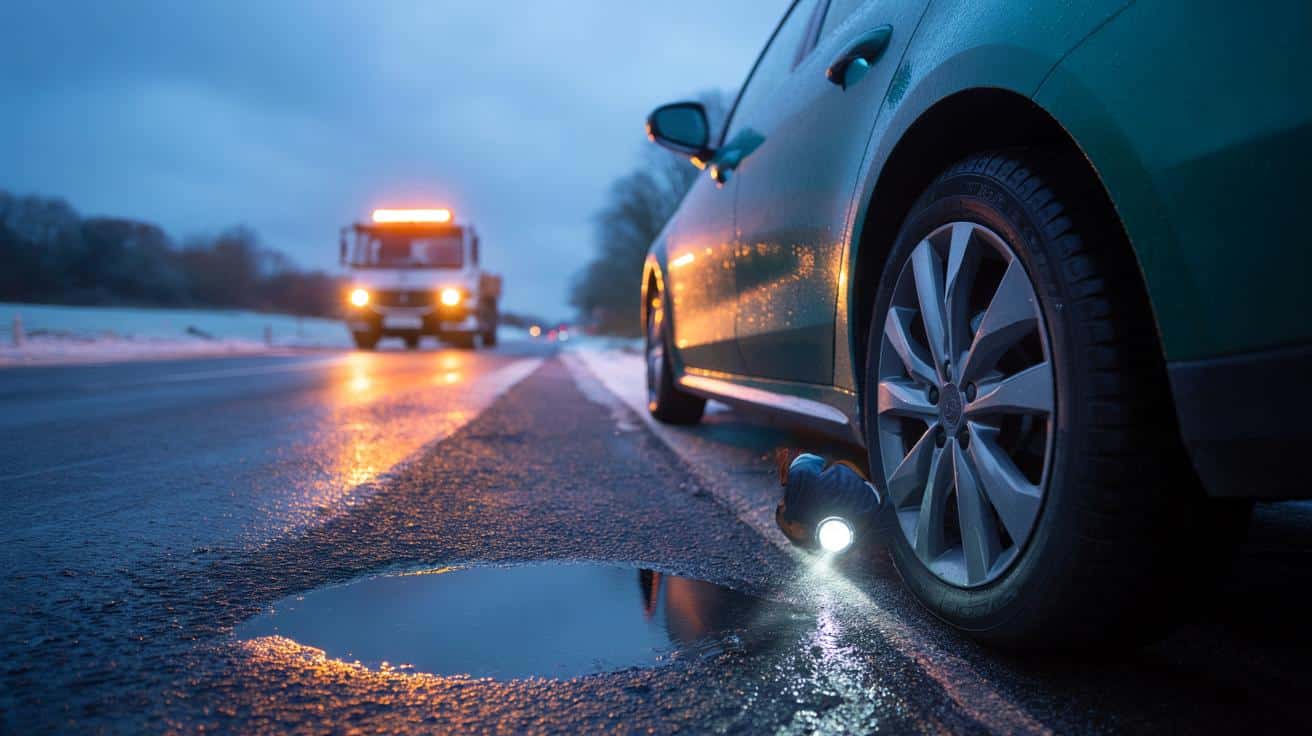
That’s how the season tricks us. Winter potholes don’t just burst tyres; they bruise your car where you can’t see — then send a nasty bill days later. Many drivers shrug off a heavy thud as “just one of those things”. Then the steering starts to drift, a tyre wears jagged on its inner edge, or a bearing begins to sing. The quiet kind of damage. The kind that can snowball into a **£500 bill**.
It started with a hollow thump on a wet A-road, just past the lay-by where the gritter always parks. The puddle looked harmless, almost silky. The car jolted, there was a muttered swear, and then everything felt fine. Music back on. Day back on track.
Two mornings later the steering wheel sat a hair to the right on a straight dual carriageway. By Friday there was a faint humming above 40 mph, like a drone somewhere behind the glovebox. Then a tyre warning pinged — pressure down by a few PSI. Not dramatic. Just… off. That’s how winter potholes get you. The damage was already done.
What makes winter pothole damage ‘invisible’ — and so expensive
The loud blowouts grab attention, yet it’s the stealthy hits that empty wallets. When a wheel slams into a sharp edge submerged under rainwater, the sidewall can suffer a deep bruise. No tear, no drama, still round and black. Inside, the cords weaken, and a **hidden bulge** may form later. The inner lip of an alloy rim can bend, too — you won’t notice until the tyre fails to seal perfectly.
The story repeats in garages across the country. A driver thinks they’ve gotten away with it, only to face a slow puncture on Monday and a rumbling wheel bearing by Thursday. A single pothole can bend a lower arm, nudge the tracking out, nick a shock’s seal, or split a TPMS sensor. One repair leads to another. It’s not hard to stack up £120 for alignment, £160 for a mid-range tyre, £200–£300 for a bearing, and a touch more for labour. There’s your **£500 bill** without a dramatic moment to explain it.
Here’s the physics in plain English. Your tyre is a springy cushion that hates sharp edges. Cold rubber is stiffer, so it transfers more force to the wheel and suspension. Water hides depth and shape, so you hit harder than your brain expects. Salt and grit abrade the tyre’s surface, making small weaknesses bigger. A jolt that would be shrugged off in June can bend something in January. That’s why the worst pothole isn’t always the big crater you can see. It’s the shallow, glassy puddle that smacks the same corner at 28 mph, twice in a week.
What to do right after a winter pothole hit
Pull over somewhere safe within a minute. Take a breath. Then do a two-minute check: look at the outer sidewall for cuts or bulges, and run your hand gently around it. Use your phone torch to peek at the inner sidewall through the wheel gap — that’s where bruises like to hide. Spin the wheel slowly if you can and watch for a wobble on the rim edge. Photograph the puddle or hole, the position on the road, and your wheel. Note the time and location. It feels fussy now, yet it saves arguments later.
Give yourself a short test on a straight, quiet stretch. Light grip on the wheel — does the car drift? Any new vibration at 30–40 mph? Listen with the radio off for a faint whirr that rises with speed. Recheck tyre pressures the next morning when they’re cold; jot the numbers in your notes. Don’t crank the pressure sky-high “for safety”. Overinflation makes impacts harsher and tracking worse. We’ve all had that moment when we just want to pretend the jolt never happened. Winter driving rewards the opposite instinct.
Let’s be honest: nobody checks their tyres every day. Build small habits that stick. Keep a cheap tyre gauge in the door bin. Wash winter grime off the wheels where salt hides problems. Ask a friend to drive behind you for five minutes and watch your rear wheels — wobble or camber looks are more obvious from outside. Then bookmark your council’s reporting page for later claims and repairs.
“Most pothole damage doesn’t shout; it whispers,” a veteran mechanic told me. “By the time the driver hears the chorus — the hum, the drift, the uneven tread — the wheel and tyre have already fallen out with each other.”
- Quick check list: sidewall scan, inner rim glance, pressure note, photo of the pothole, brief straight-line test.
- Book alignment if the wheel sits off-centre or the car pulls gently left or right.
- If you spot a sidewall bulge, park it. That’s a blowout waiting for a roundabout.
- Keep the damaged tyre for photos and a report if you plan to claim.
Repair, claim, or carry on — the real-world choices
There isn’t one right answer. If the car tracks straight and the tyre holds pressure, you might drive on and book a check at the weekend. If you hear a new hum, see a bulge, or feel a shake through the seat, you’re into fix-now territory. Many comprehensive policies cover pothole strikes, yet an excess and a hit to no-claims can sting. Council claims can succeed when a defect was reported and left unrepaired — that’s where your photos and notes earn their keep.
Think of this as triage. Prioritise safety-critical parts: sidewalls, wheels, steering, suspension joints. A slow puncture or bent inner rim won’t wait politely for spring. If cash is tight, ask the garage for a “most urgent first” plan and keep the old parts for proof. The quiet goal is to stop a £120 alignment and a £160 tyre turning into a cascade of wear. Some costs hurt. Silent ones hurt twice.
| Key point | Detail | Interest for the reader |
|---|---|---|
| Invisible tyre and rim damage | Sidewall bruises and bent inner rims don’t show immediately, yet cause slow leaks and blowouts | Spot issues early and avoid being stranded on a cold night |
| Simple post-hit routine | Two-minute check, next-morning pressures, short straight-line test, photos for evidence | Actionable steps that cut stress and support a successful claim |
| Cost control | Fix safety-critical items first; weigh insurance excess vs. council claim; plan repairs in stages | Keep the winter **pothole trap** from snowballing into a £500+ bill |
FAQ :
- How do I spot hidden pothole damage?Watch for a new pull in the steering, a hum that rises with speed, or fresh uneven wear on the inner tread. Check pressures cold the next morning and scan sidewalls for bulges.
- Is pothole damage covered by insurance?Comprehensive policies often cover it, yet you’ll face an excess and possible no-claims impact. Compare that cost with paying for alignment or a tyre yourself.
- Can I claim from the council?Yes, if the pothole was reported and not fixed in time. You’ll need photos, location, date, and repair invoices. Report the defect as soon as you see it.
- How much does wheel alignment cost in the UK?Basic tracking starts around £50–£80; four-wheel alignment can be £100–£150, depending on the car and shop.
- Is it safe to keep driving after a heavy hit?If you see a sidewall bulge, a cracked rim, or feel strong vibration, park it. Otherwise, drive gently and book a check — small defects grow fast in winter.







Last winter I ignored a harmless-looking puddle on the ring road; two days later my steering sat off-centre and the back-right tyre kept losing a few PSI. Garage found a bent inner rim and a bruised sidewall—no obvious damage outside. This article nails the “quiet” failure modes. The two-minute post-hit check and next-morning presure note are gold. I’ve now got a cheap gauge in the door bin and I’m booking alignment sooner, not later. Saved me from a bigger bill, definitley.
Is this a bit of scaremongering? I’ve clattered countless potholes and never seen a £500 bill. Isn’t modern suspension designed to soak this stuff up? Genuinly curious, not having a go.