
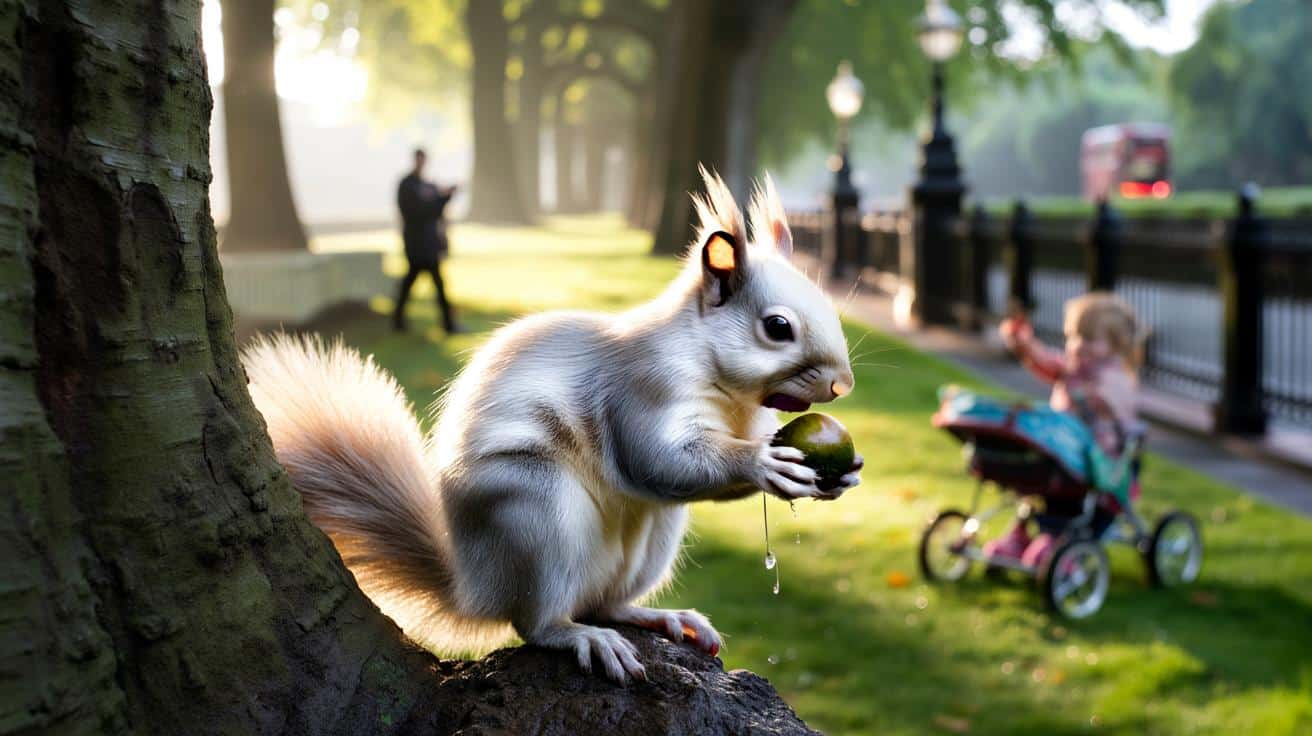
A local walker lifted her phone, a jogger stopped mid-stride, a child whispered “Is it magic?” In a London park known more for takeaway coffees and pigeons, a **super-rare white squirrel** has turned a weekday stroll into a story people can’t stop telling.
It appeared like a snowflake that forgot to melt. Early light spilled across wet grass, black crows heckled from the plane trees, and then—there it was—frost-white fur threading through bramble, tail a soft plume against the dark bark. I watched a circle of strangers slow down, hush, and share a grin that said: did you see that too? The squirrel paused with a conker, blinked with dark, marble eyes, then zipped up the trunk as if to remind us who owned the morning. Phones came out. A pram squeaked. The park felt, for a second, like a tiny theatre with the perfect surprise cameo. Then it was gone.
Why a white squirrel in London makes us stop and stare
London teaches you to skim the surface: bus arrivals, closing doors, keep left at all times. A white squirrel slices through that habit like a spark in drizzle. It’s the city’s wild heart peeking out, a reminder that urban life isn’t only signage and schedules. The colour shocks the eye, so everything else resets. Sounds brighten, the path widens, time loosens a touch. We lean on the railings and watch, silently rooting for a small animal we’ll never meet again.
There’s a reason this goes viral. White squirrels are scarce. Some UK wildlife groups talk about odds ranging from one in 50,000 to one in 100,000 for greys with white coats, depending on local genetics and predation. Albino individuals have pinkish eyes and noses; leucistic ones look white but keep dark eyes. Sightings pop up from Surrey to the Midlands, and yes, across several London parks, yet weeks can pass with nothing. Then someone posts a clip, and the comments fill with “I saw it too!” and “Are we sure it’s real?” Urban myths grow from moments like this.
Part of the appeal is contrast. Against brick, tarmac and winter-bruised hedges, white fur reads almost *glowing*. Predators see it too, which is one reason these squirrels remain uncommon. There’s also the genetics tightrope: a recessive trait has to land twice in one small family tree. City habitats complicate that dance with traffic, foxes, and dogs. Add the human factor—crowds, snacks, sudden noise—and survival becomes a high-wire act in plain sight. Rarity isn’t just numbers; it’s the whole city pressing in.
How to tell what you’re seeing—and how to see it kindly
First, look at the eyes. Pink or red hints at albinism; dark brown or black points to leucism. Check the nose and ears for pigment, and scan the tail for creamy patches. Step slightly to the side to cut glare, and notice how the coat handles shadow. If you’re photographing, tap to expose for highlights so the fur doesn’t blow out. A slow, steady breath helps your hands calm down. That steady makes sharp.
White squirrels often follow the same morning and late afternoon circuits as their grey relatives. Quiet corners near water or old chestnut trees get good traffic. We’ve all had that moment where a rare sight appears just as you’ve put your phone away. Let it happen. Watch first, record second. Let’s be honest: nobody really does that every day. If you do hit record, aim from a respectful distance, linger no more than a minute, and give the animal escape routes. Curiosity is lovely; corralling isn’t.
There’s a line between wonder and stress, and it’s closer than we think. A ranger once put it like this:
“If the animal changes what it’s doing because of you, you’re too close.”
- Stand to the side of a path so joggers and prams can pass without pushing the squirrel toward you.
- Skip any food. It warps behaviour and can make animals bolder than is safe.
- If a small crowd forms, take your turn, take your shot, then drift on. The next person will get their moment.
The science underneath the sparkle
Think of albinism and leucism as two routes to the same visual surprise. Albinism blocks melanin production entirely, which is why eyes appear pink: you’re seeing blood vessels through a pigment-free iris. Leucism alters how pigment cells migrate or survive, leading to white or patchy coats while eyes stay dark. In grey squirrels, both traits are rarities that can cluster in a single neighbourhood when related animals breed locally. Urban greenspaces—long lines of trees, canals, cemeteries—act like corridors that carry those genes around the city in quiet, zig-zag ways.
Predation pressure narrows the odds. A white coat makes a squirrel stand out to hawks and foxes, especially in leaf-off seasons. Yet parks also offer cover: dense shrubs, ivy-choked fences, human footfall that deters some predators. Add warmer winters and reliable food from mast years and bird feeders, and an unusual gene can hang on long enough to be seen. That mix is messy, city-shaped, and always shifting. Which is exactly why this sighting in London struck such a nerve.
White can also be a social wildcard. Among squirrels, dominance plays out in quick, twitchy chases and subtle tail language. A conspicuous coat might change who gets first crack at peanuts or who risks a dash across open grass. It may also change how people respond: extra attention, more photos, the odd attempt at a handout. Small behaviours ripple outward. The appearance feels magical; the living is complicated.
Small rituals that raise your odds without ruining the moment
Try a 20-minute loop at first light or late afternoon on days after rain. Sound carries less, and the ground’s scent-signed in a way squirrels seem to like. Move slow, scan base to canopy, then scan again. If you wear earbuds, keep one out so wingbeats and rustles reach you. Note where greys cross paths rapidly; that’s often where a white one, if present, will dart through as well. Think patient, not prowling.
Common mistakes begin with chasing the perfect shot. Sprinting after a small animal only gives you a blur and the squirrel a bad morning. Another is standing in the middle of the path, which turns you into the problem. Step aside, kneel if you can, and keep your profile narrow. If your phone struggles, lock focus on the tree bark, then slide to the squirrel. Your exposure will be kinder to the whites. If nothing appears, you still got a walk. That counts.
Stories travel faster than wildlife. A single TikTok can pull 50 people to one tree, and that’s when trouble starts. One local birder told me:
“Treat rare city wildlife like a secret café—share it with care, and it’ll still be there next week.”
- Post location fuzzed to the park, not the exact bench or gate.
- Skip reels where the animal is cornered; celebrate the clean, distant shot.
- If you see kids watching, narrate gently: “Look at the eyes—dark, so likely leucistic.” Wonder is a habit we can teach.
What this little ghost says about London right now
The city can feel like one long notification. A white squirrel cuts through all that noise with the simplest of messages: look up. It turns strangers into a chorus of soft gasps and makes us kinder for a minute. The science is neat, the rarity real, yet the feeling is what lingers. You carry it to the bus stop, to the shop line, to the emails waiting for replies.
There’s also a quiet lesson in the trees. Urban nature isn’t a museum piece behind glass; it’s shifting and cheeky and here whether we plan for it or not. A white squirrel is a shard of luck. It’s also a nudge to steward the little habitats tucked between bollards and bins. Hedge by hedge, we set the stage for surprises we can’t script. The next person who glances up might be you. Or the kid beside you, eyes wide as saucers.
| Key point | Detail | Interest for the reader |
|---|---|---|
| Spotting vs. stressing | Watch first, record second; give escape routes | Enjoy the thrill without harming the animal |
| Albino or leucistic? | Check eye and nose colour; albino shows pinkish, leucistic stays dark | Quick field test that makes you feel like a pro |
| Best times and places | First light or late afternoon near mature trees and quiet edges | Practical moments to raise your odds in a **London park** |
FAQ :
- Are white squirrels albino?Some are. Albino squirrels have pinkish eyes and noses; many “white” ones are leucistic with dark eyes.
- How rare is a white squirrel in the UK?Estimates vary, often cited between 1 in 50,000 and 1 in 100,000 grey squirrels, with local clusters.
- Where have white squirrels been seen in London?Reports surface from several large parks and quieter greens, shifting year to year as animals move.
- Is it okay to feed a white squirrel?Better to skip it. Food changes behaviour and can draw risky crowds; watch and let it forage.
- Any quick photo tip to avoid a blown-out white coat?Tap to expose for the bright fur, lock focus, and shoot from the shade side if you can.







Was it albino or leucistic? The eye colour sounded dark, but the photos might mislead in glare.
A snowflake that forgot to melt is exactly how my brain described my hair this winter. Does the squirrel also demand oat lattes or just conkers?